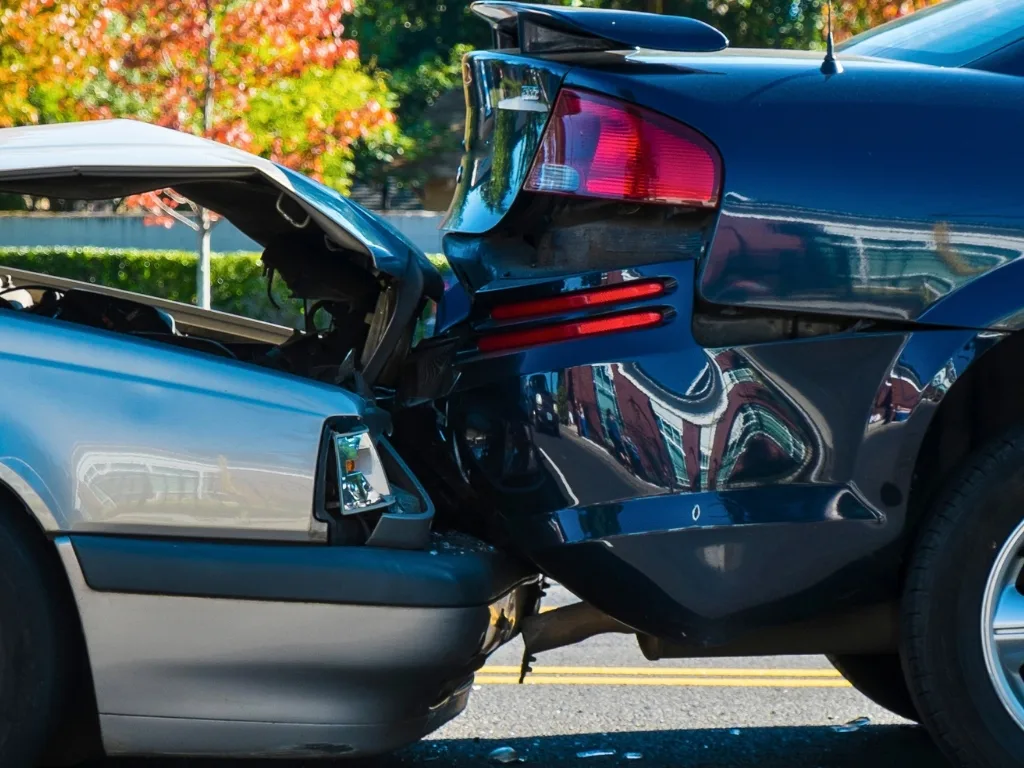
Rear-end collisions are among the most common crashes on Fresno roads, and they are also among the most misunderstood. A crumpled bumper looks minor, but the human body absorbs forces that a repair estimate never captures, and whiplash or spinal injury can develop long after the vehicles have been towed away.
The Law Office of Sam Salhab represents injury victims across Fresno and Orange County, and rear-end collision cases require a specific approach: proving that an injury insurers want to dismiss as minor is actually real, documented, and deserving of full compensation.
California’s Rear-End Presumption of Negligence
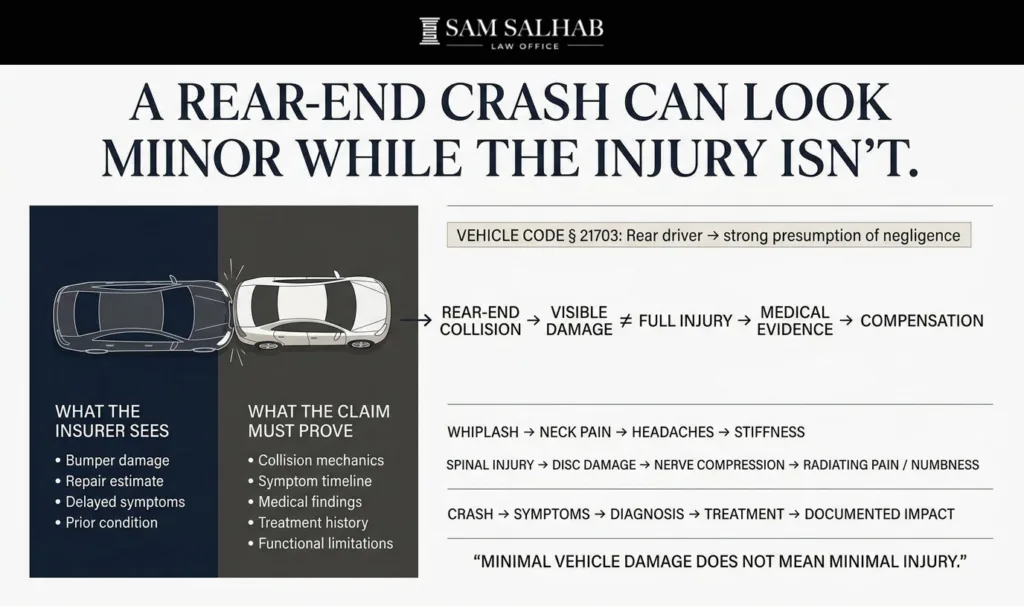
California law gives rear-end collision victims a meaningful legal advantage from the start. Under Vehicle Code § 21703, a driver may not follow another vehicle more closely than is reasonable and prudent given speed, traffic, and road conditions, and a driver who strikes another vehicle from behind is generally presumed to have violated that duty.
Why This Presumption Isn’t Automatic
This presumption is strong but rebuttable. If the lead driver stopped suddenly without cause, had non-functioning brake lights, or made an unsafe lane change immediately before the collision, fault can shift partly or entirely away from the rear driver, which is why insurers still investigate rather than accept liability outright.
Common Causes Behind Fresno Rear-End Crashes
Distracted driving, tailgating in heavy commute traffic, and sudden slowdowns near freeway interchanges are recurring patterns in Fresno rear-end cases. Highway 99 and Highway 41 both see significant congestion during peak commute hours, and a driver checking a phone or following too closely often has no time to react when traffic ahead brakes unexpectedly.
What the Insurer Sees vs. What Actually Proves the Injury
After a rear-end collision, an insurance adjuster may focus on the easiest facts to measure: the repair estimate, photographs of the bumper, the date of the first medical visit, or whether the injured person had prior neck or back problems. Those facts do not necessarily answer whether the collision caused a genuine injury. The California Department of Insurance notes that insurers investigate claims by gathering information from drivers and witnesses and may request documentation of injuries, medical expenses, and lost wages.
Matching the Insurer’s Argument to the Evidence That Answers It
| What the insurer may argue | Evidence that addresses it |
| “There is barely any vehicle damage.” | Vehicle photos, repair records, and evidence showing the collision mechanics |
| “You weren’t hurt immediately.” | The first documented symptom date, medical records, and a consistent symptom history |
| “The MRI shows a pre-existing condition.” | Prior medical records, imaging comparisons, and the treating physician’s assessment |
| “You waited too long for treatment.” | Appointment records and documentation explaining when symptoms developed |
| “You’re exaggerating.” | Consistent clinical findings, treatment progression, and functional limitations |
| “The crash wasn’t serious.” | Police reports, photographs, vehicle positions, witness accounts, and available video |
Why a Pre-Existing Condition Doesn’t End a Claim
A pre-existing condition does not automatically eliminate a claim. California’s Judicial Council Civil Jury Instruction 3927 specifically recognizes that a defendant remains liable for damages when their wrongful conduct makes an existing physical or emotional condition worse, even though a plaintiff cannot recover for the condition as it existed before the crash.
Understanding Whiplash and Spinal Injuries
Whiplash, sometimes called whiplash-associated disorder, occurs when the head and neck are forced through a rapid acceleration-deceleration motion, most commonly in a rear-end collision. It can involve strain or damage to the muscles, ligaments, discs, and nerves of the cervical spine, and symptoms range from mild and short-lived to chronic and disabling.
Beyond Whiplash: Other Spinal Injuries in Rear-End Crashes
Rear-end collisions can also cause disc herniation, facet joint injury, and nerve root compression that produces radiating pain, numbness, or weakness in the arms or legs. These injuries are not always visible on a standard X-ray, which is why an accurate diagnosis often depends on advanced imaging like an MRI along with a treating physician’s clinical evaluation.
Why Symptoms Often Don’t Appear Right Away
Adrenaline and the body’s natural stress response can mask pain in the minutes and hours after a crash, which means neck stiffness, headaches, or numbness in the arms or hands may not surface until the next day or even later. More serious spinal injuries can follow a similar pattern, making a thorough medical evaluation important even when a person initially feels fine.
Why Delayed Symptoms Get Used Against Victims
Insurance companies are familiar with the pattern of delayed whiplash symptoms, and some use it against injured claimants rather than accounting for it. A gap between the crash date and the first medical visit is frequently cited as evidence that the injury either did not happen in the crash or was not serious.
How to Protect a Claim From This Tactic
Seeking a medical evaluation as soon as symptoms appear, and clearly documenting the connection between the collision and the onset of pain, closes the gap insurers look for. A consistent, well-documented treatment history, including any recommended physical therapy or specialist referrals, remains one of the strongest tools against an adjuster’s attempt to minimize a legitimate injury.
What Compensation May Be Available
Rear-end collision injuries span a wide range, from a strain that resolves in a few weeks to a spinal injury requiring surgery and long-term care. While every case depends on its specific facts, general settlement ranges in California personal injury claims often fall into the following categories:
| Injury Severity | Typical Settlement Range |
| Minor | $3,000 – $15,000 |
| Moderate | $15,000 – $75,000 |
| Severe | $75,000 – $500,000+ |
| Catastrophic | $500,000 – millions |
Why Documentation Drives These Numbers
The goal is not simply to document everything, but to build a consistent timeline connecting the collision, symptoms, medical findings, treatment, and resulting limitations. A 2024 systematic review of whiplash-associated disorder research, drawing on more than 100,000 patients across 53 studies, found that WAD symptoms extend well beyond neck pain into broader functional and participation limitations, which is why a thorough medical record should capture more than pain alone.
What Else Factors Into a Claim’s Value
Lost income from missed work, the cost of ongoing physical therapy or injections, and the impact on a person’s ability to care for their household all factor into a claim’s overall value beyond the medical bills themselves. A claim that only documents pain, without addressing how the injury actually disrupted someone’s daily life, often settles for less than its true value.
Acting Before Evidence and Time Run Out
California generally gives injury victims two years from the date of the crash to file a lawsuit under Code of Civil Procedure § 335.1. Even with two years on the clock, waiting to seek treatment or document the crash can allow an insurer to argue that a delayed symptom was caused by something other than the collision.
Why Early Documentation Still Matters
Photographs of the vehicles, a copy of the police report, and prompt medical evaluation all help establish a clear record connecting the crash to the injury. Insurance adjusters often move quickly to obtain a recorded statement in the days after a crash, and having representation early helps ensure that statement does not undermine a legitimate claim later.
Why Choose the Law Office of Sam Salhab
Rear-end collision cases are often treated by insurers as routine, low-value claims, but a whiplash or spinal injury can affect a person’s ability to work, sleep, and care for their family for months or longer. Our personal injury team takes the time to understand the full impact of the injury rather than accepting an insurer’s first offer.
What Clients Can Expect
The firm’s Fresno personal injury office offers free consultations, and every client is treated as a person navigating a genuinely disruptive injury, not a routine file to be closed quickly. That approach shapes how the firm builds every rear-end collision claim from the first conversation.
Moving Forward After a Rear-End Collision
A rear-end collision can leave a person in real pain while an insurance company insists the crash was too minor to justify it. California’s rear-end presumption of negligence, combined with clear medical documentation, gives injured drivers a strong foundation for a fair claim. Anyone experiencing neck, back, or spinal pain after a Fresno rear-end collision is welcome to reach out for a conversation about what happened and what options may be available.
Am I automatically not at fault if I was rear-ended in California?
Not automatically, but California law creates a strong presumption that the rear driver was negligent under Vehicle Code § 21703. That presumption can be challenged with evidence like a sudden unexplained stop or non-functioning brake lights, which is why documentation of the crash still matters.
Can whiplash occur even in a low-speed collision with minimal vehicle damage?
Yes. The neck and spine can move well beyond their normal range of motion even when a bumper absorbs most of the visible impact, meaning a car that looks barely damaged can still cause a real soft tissue or spinal injury.
Will a pre-existing neck or back condition prevent me from recovering compensation?
No. California law allows recovery when a crash aggravates an existing condition, even if that condition existed before the collision. The claim is limited to the additional harm caused by the crash, not the underlying condition itself, which is why comparing pre- and post-crash medical records matters.
Will the insurance company use my delay in seeking treatment against me?
They may try to. Insurers are familiar with the pattern of delayed whiplash symptoms but sometimes use any gap in care as an argument that the injury wasn’t serious or wasn’t caused by the crash, which is why prompt and consistent documentation matters.
How long do I have to file a claim after a rear-end collision in California?
Most personal injury claims must be filed within two years of the crash date under Code of Civil Procedure § 335.1. Waiting to document the injury, even within that window, can still weaken the connection between the crash and the symptoms.
What kind of compensation can a whiplash or spinal injury claim recover?
Compensation can include medical expenses, lost income, and pain and suffering, with the value generally tied to the severity of the injury and the strength of the medical documentation. Settlements for these injuries can range from a few thousand dollars for a short-lived strain to significant sums for a spinal injury requiring surgery or long-term care.
Do I need a lawyer for a rear-end collision claim if fault seems obvious?
Even when fault appears clear, insurance companies routinely dispute the severity of whiplash and spinal injuries to reduce what they pay. Having an attorney review the medical documentation and handle communication with the insurer often makes a meaningful difference in the final outcome.