
A collision with a fully loaded commercial truck is rarely comparable to an ordinary car accident. The size and weight difference alone often means the difference between a fender bender and a catastrophic, life-altering injury. Fresno sits along Highway 99, one of California’s busiest freight corridors, which means Central Valley drivers share the road with commercial trucks every single day.
The Law Office of Sam Salhab represents injury victims across Fresno and Orange County, and commercial truck cases require a different kind of investigation than a typical car crash claim. Federal regulations, corporate liability, and specialized evidence all come into play in ways that a standard auto accident case simply does not involve.
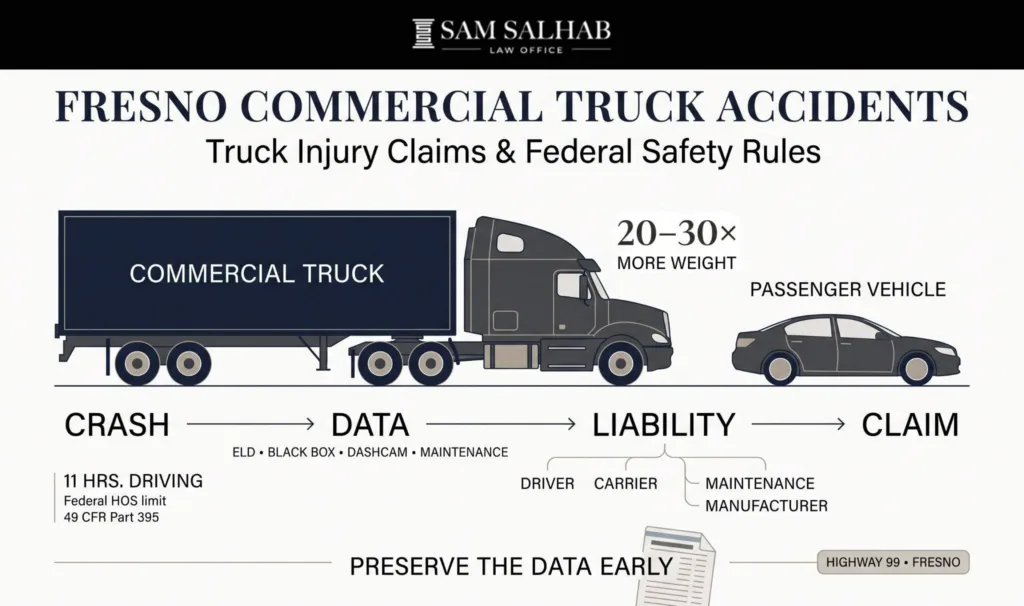
The Federal Rules That Govern Truck Safety
Commercial truck drivers and the companies that employ them operate under federal safety regulations that do not apply to ordinary drivers. Chief among these are the Hours of Service rules under 49 CFR Part 395, which generally limit property-carrying drivers to 11 hours of driving within a 14-hour on-duty window, following at least 10 consecutive hours off duty.
Why These Rules Exist and How They Get Broken
Drivers must also take a 30-minute break after 8 hours of driving and generally cannot exceed 60 hours on duty in 7 days or 70 hours in 8 days without a 34-hour restart. These limits exist because fatigue remains a documented danger behind the wheel of an 80,000-pound vehicle, and violations often happen when a driver is pressured by a dispatcher or employer to meet an unrealistic delivery schedule.
Why Truck Crashes Cause Such Severe Injuries
The Federal Motor Carrier Safety Administration’s Large Truck Crash Causation Study, conducted with the National Highway Traffic Safety Administration, found that driver fatigue was a factor in roughly 13 percent of large truck crashes, while brake problems were identified in nearly 30 percent of trucks involved in the crashes studied. That combination of driver fatigue and mechanical neglect regularly turns survivable collisions into catastrophic ones.
The Physics Behind the Damage
A fully loaded commercial truck can weigh twenty to thirty times more than the passenger vehicle it strikes, and that weight disparity means occupants of the smaller vehicle absorb a disproportionate share of the crash forces. This is why injuries in truck collisions so often include traumatic brain injury, spinal cord damage, and injuries requiring long-term or permanent care.
Who Can Actually Be Liable for a Fresno Truck Accident?
A truck accident does not automatically make the driver or trucking company the only responsible party. Liability depends on what caused the crash and which party had control over the risk that caused it, which makes the investigation more important than simply identifying the truck’s owner.
Matching the Crash Fact to the Responsible Party
| Crash fact | Potentially responsible party | Evidence to investigate |
| Driver was speeding or fatigued | Driver + motor carrier | ELD data, GPS, dispatch records |
| Driver was inadequately qualified | Motor carrier | Driver qualification file, MVR, employment records |
| Driver was an independent contractor | Carrier + potentially other parties | Operating agreement, lease, control over driver |
| Brake or tire failure | Carrier + maintenance provider | Inspection, repair and maintenance records |
| Cargo shifted or was improperly secured | Carrier/driver; potentially other parties depending on the facts | Bills of lading, weight tickets, loading records |
| Defective truck component contributed | Manufacturer or other responsible entity | Recall history, component records, expert inspection |
| Dangerous roadway condition contributed | Government entity, if legal requirements are met | Road design, maintenance records, notice of condition |
What Federal Rules Say About Who Is Responsible for What
Federal rules require motor carriers to maintain a driver qualification file for every driver, containing records such as the employment application, motor vehicle record, and required annual reviews, making those records potentially critical when negligent hiring or qualification is at issue. Cargo liability also requires careful analysis: under 49 CFR § 392.9, FMCSA guidance confirms that the motor carrier and driver, not the shipper, generally bear responsibility for ensuring cargo is properly loaded and secured, so a shipper should not automatically be treated as liable simply because it loaded the truck.
Checking for a Documented Mechanical Defect
If a mechanical defect is suspected, NHTSA’s recall database can help determine whether the vehicle or a specific component already has a documented safety issue. The key question is therefore not simply who owned the truck, but who controlled, created, or failed to correct the condition that actually caused the collision.
The Evidence Unique to Truck Accident Cases
Commercial trucks generate a volume of data that ordinary passenger vehicles do not. Electronic logging devices record hours of service in real time, and many trucks carry an event data recorder, sometimes called a black box, that can capture speed, braking, and engine performance in the moments before a crash.
Why Time Is Critical for Preserving This Evidence
Trucking companies are not required to preserve this data indefinitely, and some records are routinely overwritten or destroyed on a standard schedule unless a formal preservation request is sent promptly. A delayed investigation can mean losing access to ELD logs, dashcam footage, or maintenance records that might otherwise prove exactly what happened before the collision.
What Compensation May Be Available
Truck accident injuries tend to be more severe than the average car accident claim, and settlement values generally reflect that difference. While every case depends on its specific facts, general ranges for California personal injury claims often fall into the following categories:
| Injury Severity | Typical Settlement Range |
| Minor | $3,000 – $15,000 |
| Moderate | $15,000 – $75,000 |
| Severe | $75,000 – $500,000+ |
| Catastrophic | $500,000 – millions |
Why Truck Cases Often Land at the Higher End
Because commercial carriers typically carry substantially higher liability coverage than individual drivers, and because truck crash injuries are frequently catastrophic, these cases often involve the upper end of these ranges. The specific outcome still depends on the clarity of fault, the strength of the available evidence, and the extent of the injuries involved.
Acting Before Time and Evidence Run Out
California generally requires injury victims to file a lawsuit within two years of the crash date under Code of Civil Procedure § 335.1, though claims involving a government-owned roadway or vehicle may carry a much shorter administrative filing deadline. Trucking companies and their insurers often begin their own investigation within hours of a serious crash, sending representatives to the scene before the injured party has even left the hospital.
Why Early Representation Levels the Playing Field
Sending a formal evidence preservation letter as soon as possible helps ensure ELD data, maintenance logs, and dashcam footage are not lost before a claim can be built around them. Waiting even a few weeks can mean the difference between having that evidence available and having to build a case without it.
Why Choose the Law Office of Sam Salhab
Truck accident cases demand an investigation that goes beyond a police report, examining the driver’s history, the carrier’s safety record, and the mechanical condition of the vehicle itself. Our personal injury team approaches these cases with that full scope in mind, rather than accepting the first explanation an insurance adjuster offers.
What Clients Can Expect
The firm’s Fresno personal injury office offers free consultations, and clients are treated as people navigating a serious, often life-changing event, not case files to be processed quickly. That approach shapes how the firm investigates every truck accident claim from the earliest possible stage.
Moving Forward After a Truck Accident
A commercial truck crash often leaves victims facing medical bills, lost income, and an insurance company already working to minimize what it owes. Understanding the federal regulations that govern the trucking industry, and having someone who can move quickly to preserve the evidence that proves what happened, can make a meaningful difference in the outcome. Anyone injured in a truck accident near Fresno is welcome to reach out for a conversation about what happened and what options may be available.
Who is liable when a commercial truck causes a crash?
Liability depends on what caused the crash and which party controlled that risk, and can extend to the driver, the trucking company, a maintenance provider, or in some cases a manufacturer or government entity. Identifying every liable party often requires reviewing the driver’s qualification file and the carrier’s safety history.
Why are truck accident injuries often more severe than car accident injuries?
A fully loaded commercial truck can weigh twenty to thirty times more than a passenger vehicle, and that weight disparity means occupants of the smaller vehicle absorb a disproportionate share of the crash forces. This often results in traumatic brain injuries, spinal cord damage, and injuries requiring long-term care.
What are the federal hours-of-service rules for truck drivers?
Under 49 CFR Part 395, property-carrying drivers are generally limited to 11 hours of driving within a 14-hour on-duty window following at least 10 consecutive hours off duty, with a mandatory 30-minute break after 8 hours of driving. Weekly limits cap at 60 hours over 7 days or 70 hours over 8 days without a 34-hour restart.
Is a shipper responsible if a truck’s cargo shifts and causes a crash?
Generally, no. FMCSA guidance under 49 CFR § 392.9 places responsibility for properly loading and securing cargo on the motor carrier and driver, not the shipper, so liability in a shifting-cargo case typically points back to the carrier rather than the company that loaded the freight.
How is fault determined in a truck accident case?
Fault is established through evidence including police reports, ELD and black box data, driver qualification files, and maintenance records, all evaluated against the standards set by federal trucking regulations. California’s comparative negligence rule also allows fault to be divided between multiple parties based on the specific facts.
How long do I have to file a claim after a truck accident in California?
Most personal injury claims must be filed within two years of the crash date under Code of Civil Procedure § 335.1. Claims involving a government entity or government-maintained roadway generally require a much shorter administrative claim to be filed first.
Why does a trucking company’s safety record matter in my case?
A pattern of hiring drivers with poor safety histories, inadequate training, or ignored maintenance issues can support a claim of negligent hiring or entrustment directly against the trucking company. That evidence often significantly increases both the strength of a claim and the compensation ultimately available.