Intersections bring traffic together from every direction at once, and one driver’s mistake about who has the right of way can change another person’s life in seconds. Fresno’s busiest crossroads see this play out with alarming regularity, and the moments after a crash are rarely the time to sort out who was actually at fault under California law.
The Law Office of Sam Salhab represents injury victims across Fresno and Orange County, and intersection collisions are among the most common serious injury cases the firm handles. Right-of-way disputes are rarely as simple as they first appear, and untangling them correctly often determines whether a victim recovers the full compensation their injuries warrant.
Which Driver Had the Right of Way?
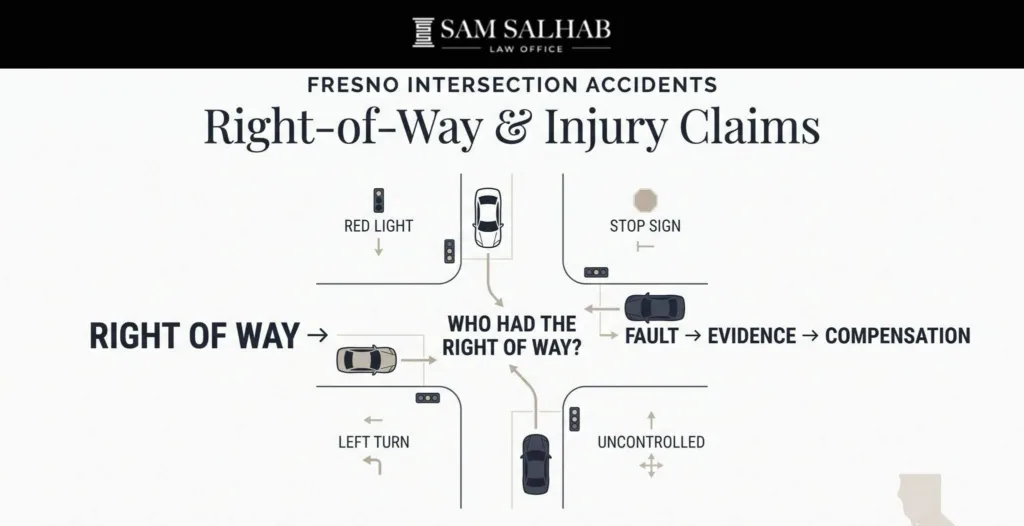
Right-of-way disputes are rarely resolved by asking only whether one driver “had the right of way.” The controlling rule depends on how the intersection was regulated, how the vehicles approached it, and what each driver did immediately before impact.
Breaking the Crash Into Its Specific Scenario
| Crash scenario | Primary California rule | Key question |
| Uncontrolled intersection | Vehicle Code § 21800 | Had another vehicle already entered the intersection? |
| Vehicles arrive together | Vehicle Code § 21800 | Which vehicle was on the other driver’s immediate right? |
| Left turn | Vehicle Code § 21801 | Was approaching traffic close enough to create a hazard? |
| Stop sign | Vehicle Code § 22450 | Did the driver stop at the required location? |
| Red light | Vehicle Code § 21453 | Did a driver enter or turn against the applicable signal? |
| Yellow light | Vehicle Code § 21452 | Was the driver responding appropriately as the green movement ended? |
| Pedestrian crossing | Vehicle Code § 21456 | What did the pedestrian control signal require? |
Why the Statute Is Only the Starting Point
Evidence such as signal timing, vehicle positions, surveillance footage, witness statements, skid marks, and vehicle damage may determine whether the statutory right-of-way was actually violated. For an injured person, having the right of way does not automatically resolve every issue of legal fault, and the complete circumstances of the collision still have to be reconstructed.
Why Fresno’s Intersections Are Especially Dangerous
Fresno’s traffic safety concerns are not just anecdotal. A 2025-2026 Fresno County Civil Grand Jury investigation into the intersection of Friant Road and Shepherd Avenue found that more than 80 percent of collisions there were caused by drivers running red lights, and the report noted two separate crashes occurring within three days of each other during its review period.
The City’s Response and What It Signals
The city of Fresno has committed $2.5 million toward safety improvements at that intersection alone, including signal and lane changes, and Fresno Mayor Jerry Dyer has stated publicly that the location has already moved out of the city’s top ten most dangerous intersections following those changes. That kind of documented, government-acknowledged danger can matter in an injury claim, since it may support arguments about foreseeable risk at a specific location.
How Fault Is Determined After an Intersection Crash
California follows a pure comparative negligence rule, meaning an injured driver can still recover compensation even if they were partially at fault, with their recovery reduced by their own percentage of responsibility. This makes intersection cases fact-intensive, since insurance companies frequently try to shift blame onto the injured party to reduce what they owe.
The Evidence That Actually Decides These Cases
Police reports, traffic signal timing data, witness statements, and increasingly, dashcam or nearby surveillance footage, all play a role in reconstructing exactly who had the right of way. In cases involving malfunctioning signals or intersections with known visibility problems, additional evidence about the intersection’s design and history can strengthen a claim significantly.
What Compensation May Be Available
Intersection crash injuries range from minor whiplash to catastrophic, life-altering trauma, and the value of a claim generally reflects that range. While every case depends on its specific facts, general settlement ranges in California personal injury claims often fall into the following categories:
| Injury Severity | Typical Settlement Range |
| Minor | $3,000 – $15,000 |
| Moderate | $15,000 – $75,000 |
| Severe | $75,000 – $500,000+ |
| Catastrophic | $500,000 – millions |
Why These Ranges Vary So Widely
Factors like ongoing medical treatment, lost earning capacity, the clarity of fault, and available insurance coverage all push a case toward the higher or lower end of its category. A T-bone collision at a red-light-running intersection with clear fault and serious injuries, for example, often settles differently than a low-speed fender bender with disputed liability.
Acting Before Evidence and Time Run Out
California generally gives injury victims two years from the date of the crash to file a lawsuit under Code of Civil Procedure § 335.1, though claims against a government entity, such as one involving a poorly maintained traffic signal, require a much shorter administrative claim deadline.
Why Early Action Still Matters Even With Two Years to File
Waiting to pursue a claim risks losing access to traffic camera footage, fading witness memory, and physical evidence at the intersection itself. Insurance adjusters also tend to move quickly to gather statements in the days after a crash, and having representation early helps ensure those statements do not undermine a valid claim later.
Why Choose the Law Office of Sam Salhab
Our personal injury team understands that a serious intersection crash disrupts far more than a person’s schedule. It affects their ability to work, care for family, and recover both physically and financially, and clients often benefit from having an advocate who takes that full picture into account rather than settling for a quick payout.
What Sets Our Approach Apart
The firm’s Fresno personal injury office is available for consultations at no cost, and the same client-first philosophy that shapes the firm’s criminal defense work carries over here: a client is a person navigating a genuinely difficult moment, not a claim number to be processed and closed.
Moving Forward After an Intersection Crash
An intersection collision can leave a person questioning what actually happened and who is responsible, especially when insurance adjusters are quick to suggest shared blame. Understanding California’s right-of-way laws, and having someone who can gather the evidence that actually supports a claim, often makes the difference between a fair settlement and a frustrating fight. Anyone injured at a Fresno intersection is welcome to reach out for a conversation about what happened and what options may be available.
Who is at fault in a California intersection accident?
Fault depends on which driver had the right of way under the applicable statute, whether that involves a stop sign, a signal, or an uncontrolled crossing, along with evidence like police reports, witness statements, and traffic signal data. California’s comparative negligence rule means fault can also be split between both drivers based on the specific facts.
Can I still recover compensation if I was partly at fault for the crash?
Yes. California follows a pure comparative negligence rule, which allows an injured driver to recover compensation even if they share some responsibility for the crash, with the final award reduced by their percentage of fault.
What makes Fresno intersections particularly dangerous?
A Fresno County Civil Grand Jury investigation found that more than 80 percent of collisions at one of the city’s most reviewed intersections were caused by drivers running red lights, reflecting a broader pattern of signal violations at high-traffic Fresno crossroads. Intersection design, signal timing, and traffic volume all contribute to which locations see the most serious crashes.
How long do I have to file a claim after an intersection accident in California?
Most personal injury claims must be filed within two years of the crash date under Code of Civil Procedure § 335.1. Claims involving a government entity, such as a malfunctioning traffic signal, generally require a much shorter administrative claim to be filed first.
What should I do immediately after an intersection collision?
Seek medical attention, document the scene with photos if safely possible, and avoid making statements to an insurance adjuster about fault before speaking with an attorney. Early documentation of signal timing, skid marks, and witness contact information can become critical evidence later.
How is the value of an intersection accident claim calculated?
Claim value generally reflects the severity of the injury, the clarity of fault, ongoing medical costs, and lost income, ranging from a few thousand dollars for minor injuries to well into the millions for catastrophic, life-altering harm. Insurance coverage limits and the strength of the liability evidence also play a significant role in what a case ultimately settles for.
Does a police report determine who was at fault in my case?
A police report is an important piece of evidence, but it does not automatically determine legal fault or control the outcome of an insurance claim. Additional evidence, including surveillance footage, signal timing records, and independent witness accounts, often plays just as large a role in establishing what actually happened.