
A sex crime accusation moves faster than almost any other criminal charge, and it comes with consequences that reach far beyond a courtroom. Registration requirements, employment restrictions, and public record exposure can follow a person for years, sometimes for life, even before a case goes to trial. Anyone facing this kind of charge in Fresno needs a defense built around the reality that an accusation is not proof.
The Law Office of Sam Salhab has represented clients across serious felony and violent crime charges throughout Fresno and Orange County for more than a decade. The firm’s founding principle, that a client is a person and not a case number, matters most in cases like these, where public judgment often arrives long before any court does.
Why an Accusation Is Not a Conviction
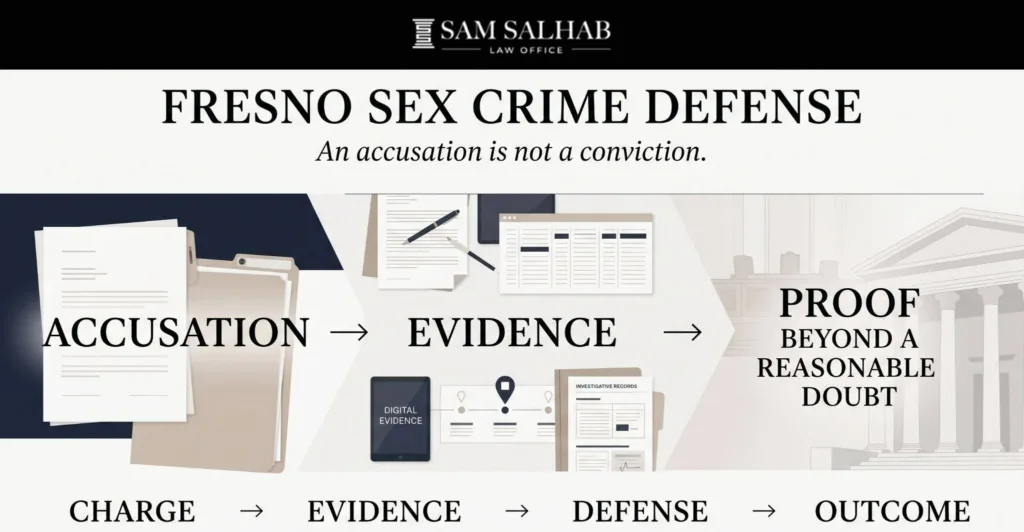
California’s criminal justice system places the full burden of proof on the prosecution. A person accused of a sex crime is presumed innocent unless and until a jury finds otherwise, and the prosecutor must prove every element of the charge beyond a reasonable doubt.
Why This Principle Gets Lost in Sex Crime Cases
Sex crime allegations carry a level of social stigma that other charges do not, and that stigma can pressure a defendant into rushed decisions before an attorney has reviewed the evidence. False accusations occur more often than commonly believed, particularly in cases involving custody disputes, personal conflict, or mistaken identity, and a defense built early can prevent a rushed prosecution from becoming a conviction.
Sex Crime Charges We Defend in Fresno
Sex crime allegations in California span a wide range of statutes, each with different elements, penalties, and registration consequences. Our firm defends clients against charges including:
- Rape and forcible sexual assault under Penal Code § 261
- Lewd or lascivious acts with a minor under Penal Code § 288
- Sexual battery under Penal Code § 243.4
- Statutory rape under Penal Code § 261.5
- Sexual penetration by force under Penal Code § 289
- Indecent exposure and solicitation-related offenses
Why the Specific Charge Matters From Day One
Two charges that sound similar on the surface can carry dramatically different consequences depending on the alleged victim’s age, the presence of force, and prior criminal history. Identifying exactly which statute applies, and which elements the prosecution actually has to prove, shapes every decision that follows in the case.
Understanding Sex Offender Registration Under Penal Code § 290
A conviction for many sex offenses in California triggers a registration requirement under Penal Code § 290, California’s Sex Offender Registration Act. Since Senate Bill 384 took effect, registration is no longer automatically for life, but the tiered structure it created still carries serious long-term consequences.
Your Exact Charge Can Change the Registration Consequences
A sex crime conviction does not automatically mean the same registration period for every defendant. California’s tiered system looks at the specific registrable offense, conviction history, risk-assessment information, and other statutory factors when determining registration requirements. The California DOJ explains that the department generally assigns tiers for registrants, while courts determine the tier in certain cases involving court-ordered registration under Penal Code § 290.006.
| Charge or situation | Why the exact offense matters | Potential registration outcome |
| Sexual battery | The specific subsection and circumstances matter | Tier depends on the offense |
| Statutory rape | The specific Penal Code § 261.5 subsection matters | Registration consequences vary |
| Lewd acts with a minor | The victim’s age and specific offense are critical | Potentially significant registration |
| Rape | The specific Penal Code § 261 offense and circumstances matter | Potentially Tier 3 |
| Court-ordered registration | Penal Code § 290.006 governs when registration is ordered for an otherwise non-registrable offense | Court determines the tier |
How the Three-Tier System Works
Tier one generally carries a ten-year minimum and applies to lower-level misdemeanor offenses, including misdemeanor sexual battery. Tier two generally carries a twenty-year minimum, and California Courts explains that tier three generally carries twenty years when based solely on risk level, but can require lifetime registration when the statutory basis for tier three applies.
Why the Real Question Isn’t Just “Do I Have to Register?”
The more useful question after a sex crime charge is not simply whether registration applies, but what exact offense and circumstances determine the registration requirement and tier. That answer can affect how long registration lasts, whether relief may eventually be available, and what information may be publicly disclosed, which is why identifying the precise charge matters as much as the underlying facts of the case.
Why Registration Relief Isn’t Automatic
Tier one and tier two registrants may petition the court to terminate their registration requirement once the minimum period has passed, but that relief requires a formal petition and is not guaranteed. This is one more reason why the outcome negotiated or won at the original case, whether it is a dismissal, an acquittal, or a reduced charge, has consequences that extend for years afterward.
Why Timing Matters: The Statute of Limitations
Unlike most California crimes, many serious sex offenses no longer carry any statute of limitations at all. Under Penal Code § 799, as amended by the Justice for Victims Act, prosecutors may file charges for offenses including forcible rape, sodomy by force, and lewd acts with a child at any time, with no filing deadline, for qualifying conduct occurring on or after January 1, 2017.
What This Means for a Defendant
Because there may be no deadline for prosecution, evidence, memories, and witness availability can change dramatically between an alleged incident and an eventual charge. A defense built years after the fact often depends heavily on reconstructing timelines, locating old records, and challenging the reliability of testimony that has had years to shift, which makes early legal involvement even more valuable once an investigation becomes known.
Common Defense Strategies in Sex Crime Cases
Every sex crime case turns on its own specific facts, but certain defense strategies recur across many of these cases. A prepared defense typically examines:
- Whether the alleged conduct actually meets every legal element of the charged offense
- Inconsistencies in the accuser’s statements across interviews, reports, and testimony
- Evidence of a motive to fabricate, including custody disputes or personal conflict
- Digital evidence, including messages and location data, that supports or contradicts the timeline
- Whether law enforcement followed proper procedure during questioning and evidence collection
Why Independent Investigation Matters
Prosecutors build their case around the evidence law enforcement gathers, but a defense that only responds to that evidence is starting from a disadvantage. An independent investigation, including interviewing witnesses the prosecution did not call and reviewing evidence the state did not emphasize, often reveals facts that reshape the entire case.
Why Choose the Law Office of Sam Salhab
Sex crime cases require a defense attorney who understands both the criminal exposure and the collateral consequences, including registration, immigration status, and professional licensing. Sam Salhab has managed serious felony cases and strikes-eligible charges throughout his career, giving the firm direct experience with the kind of high-stakes litigation these cases demand.
What Clients Can Expect
The firm offers free, confidential consultations, including jail interviews, with 24/7 emergency availability for clients who need to speak with an attorney immediately after an arrest. Every client is treated as a person building a defense, not a file waiting to be processed, and that approach shapes how the firm prepares each case from the earliest possible stage.
Building a Defense Before It’s Too Late
An accusation is the beginning of a legal process, not the end of one, and the decisions made in the first days after an arrest often shape everything that follows. Whether the goal is to challenge the evidence before charges are filed, negotiate a reduced charge, or take a case to trial, that strategy has to be built with a clear understanding of the specific statute, the registration consequences, and the timeline involved. Anyone facing a sex crime investigation or arrest in Fresno is often better served by speaking with an attorney as early as possible, before statements are made that cannot be taken back.
What should I do if I’m being investigated for a sex crime in Fresno?
Avoid speaking with investigators without an attorney present, since anything said during an investigation can be used later even if no charges are ultimately filed. Contacting a criminal defense attorney immediately gives you time to understand your rights before law enforcement completes its case.
Does every sex crime conviction require registration under Penal Code § 290?
Many, but not all, sex offense convictions trigger registration, and the length of that requirement depends on the specific registrable offense, conviction history, and risk-assessment factors that determine which of the three tiers applies. Tier one requires at least ten years, tier two requires at least twenty years, and tier three can require lifetime registration.
Is there a deadline for prosecutors to file sex crime charges in California?
For many serious offenses, including forcible rape and lewd acts with a child, Penal Code § 799 removed the statute of limitations entirely for conduct occurring on or after January 1, 2017. Less serious offenses may still carry filing deadlines, which is why the specific charge and timeline matter in every case.
Can sex offender registration ever be terminated?
Yes, but only for tier one and tier two registrants, and only through a formal petition filed after the minimum registration period has been completed. The court is not required to grant the petition, and prosecutors can present evidence opposing removal at a hearing.
What’s the difference between rape and sexual battery under California law?
Rape under Penal Code § 261 generally involves nonconsensual sexual intercourse accomplished by force, threat, or incapacity, while sexual battery under Penal Code § 243.4 generally involves nonconsensual touching of an intimate part for sexual gratification. The two charges carry significantly different penalties and registration consequences, which is why accurately identifying the charge matters early.
How common are false accusations in sex crime cases?
While most reports are genuine, false or exaggerated allegations do occur, particularly in cases involving custody disputes, personal conflict, or mistaken identity. An experienced defense attorney looks for inconsistencies, motive to fabricate, and corroborating or contradicting evidence before assuming the state’s version of events is complete.
Why does hiring an attorney early make a difference in these cases?
Early involvement allows an attorney to preserve evidence, interview witnesses while memories are fresh, and potentially intervene before charges are even filed. Waiting until after an arrest to seek help often means losing access to evidence and testimony that could have shaped the outcome of the case.