Anyone searching for a California DUI diversion program is usually hoping for the same outcome: complete a program, avoid a conviction, and keep the arrest off their record. That outcome exists in California, but not in the way most people assume. State law specifically blocks diversion for the vast majority of DUI charges, and understanding that distinction early can save a defendant from wasted time chasing an option that was never available to them.
The Law Office of Sam Salhab has litigated thousands of DUI cases across Fresno and Orange County, including serving as lead attorney for the Fresno County DUI Court Pilot Program. That hands-on experience with the county’s own alternative-sentencing structure matters here, because the real path forward in most DUI cases is not diversion at all. It is a set of narrower, better-documented alternatives that a prepared defense can actually secure.
What “DUI Diversion” Actually Means
Diversion is a legal process where criminal proceedings are paused while a defendant completes a treatment or education program. If the program is completed successfully, the charge is dismissed and, in many cases, never appears as a conviction on the defendant’s record.
Why the Term Gets Misused Online
Many websites use “DUI diversion” loosely to describe anything that avoids jail time, including plea deals and probation. That is not accurate. The better question is not whether diversion exists in the abstract, but which specific diversion statute applies to a DUI charge, and whether another law specifically blocks it.
Why This Distinction Matters Before You Search Further
A defendant who spends weeks researching general diversion eligibility, only to learn at arraignment that the charge was never eligible, has lost valuable preparation time. Knowing which statutes actually apply to a DUI charge from the outset lets a defense team focus on the options that can realistically move the case forward.
Which California DUI Diversion Programs Actually Apply?
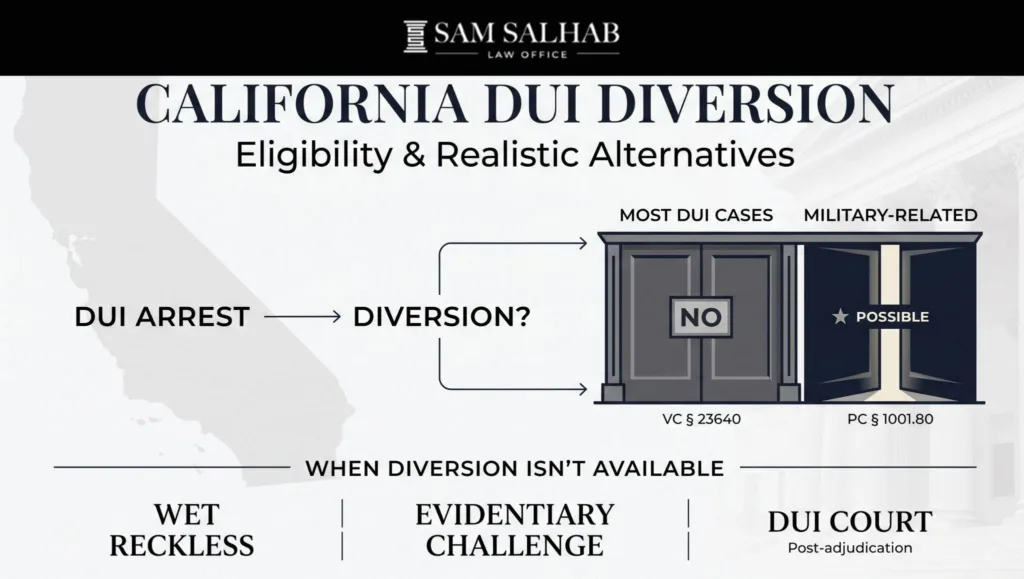
For most DUI defendants, California Vehicle Code § 23640 remains the critical barrier. It prohibits pretrial diversion for charges under Vehicle Code §§ 23152 and 23153, the state’s core DUI statutes. The California Courts of Appeal have confirmed that general misdemeanor diversion under Penal Code § 1001.95 does not override that prohibition.
| Program | DUI eligible? | Key requirement | Pretrial? | Result |
| PC § 1001.95 | No | General misdemeanor diversion | Yes | Blocked by VC § 23640 |
| PC § 1001.36 | Generally no | Qualifying mental-health condition | Yes | VC § 23640 controls |
| PC § 1001.80 | Yes, narrowly | Qualifying military-related condition | Yes | Express DUI exception |
| Fresno DUI Court | Potentially | Local eligibility | No | Post-adjudication treatment court |
Why the Courts Have Drawn This Line
In Tan v. Superior Court and Ortiz v. Superior Court, California courts held that Penal Code §§ 1001.95 and 1001.36 do not silently repeal the older, DUI-specific prohibition in Vehicle Code § 23640. By contrast, the Legislature expressly amended Penal Code § 1001.80 to state that military diversion applies notwithstanding Vehicle Code § 23640, creating a narrow statutory exception that the general diversion statutes do not share.
Why Mental Health Diversion Falls Short for Most DUI Defendants
Courts examining Penal Code § 1001.36 have reached the same conclusion for defendants with a qualifying mental health disorder who are not military-connected. Even where a diagnosis clearly played a role in the arrest, judges have found that the Legislature never carved out a DUI exception for general mental health diversion the way it did for military diversion, leaving Vehicle Code § 23640 controlling.
The Narrow Military Exception in Practice
Penal Code § 1001.80 authorizes pretrial diversion for misdemeanor DUI when the defendant may be suffering from sexual trauma, traumatic brain injury, post-traumatic stress disorder, substance abuse, or another mental health condition connected to their military service. The court can request a formal assessment to confirm eligibility, and the defendant does not have to plead guilty or no contest to participate.
How the Assessment and Treatment Process Works
If the court finds a defendant eligible, it will typically request a needs assessment from a treatment provider before setting the terms of the program. The judge then suspends the underlying criminal case while the defendant completes a treatment plan addressing the qualifying condition, which may include counseling, substance abuse treatment, or other service-connected care.
What Happens After Completion
Successful completion of a Section 1001.80 program typically results in dismissal of the charge, and the arrest may be eligible for sealing from public view afterward. A defendant who does not complete the program successfully returns to standard criminal proceedings on the original DUI charge, so the decision to pursue this path should be made with a clear understanding of the commitment involved.
Fresno DUI Court Is Something Different
The Fresno Superior Court describes its DUI Court as a post-adjudication treatment program, not pretrial diversion. It is built primarily for repeat offenders facing a second or third DUI, combining close supervision with substance abuse treatment after the case has already been adjudicated, rather than as a way to avoid a conviction before one occurs.
How the Program Is Structured
The program holds weekly court sessions and pairs judicial oversight with individualized treatment plans, regular testing, and coordination between the court, probation, and the county’s behavioral health department. Eligibility is typically assessed for defendants identified as high risk and high need, generally those with multiple prior DUI convictions, rather than first-time offenders.
Why This Distinction Matters for Sentencing Strategy
Because DUI Court operates after a plea or conviction, it functions as an alternative to a harsher sentence rather than a way to avoid a criminal record entirely. For an eligible repeat offender, though, it can still meaningfully change the outcome, replacing extended incarceration with structured, supervised treatment.
What Actually Happens at Arraignment
A DUI case moves quickly. The defendant is typically arraigned within days of arrest, and by that hearing, the prosecution has already made an initial charging decision that shapes every option available afterward.
Why Early Preparation Still Pays Off
Even though pretrial diversion is off the table for most defendants, the facts a defense attorney gathers early, including employment history, prior record, and the specifics of the stop and testing procedures, directly shape whether a wet reckless, DUI Court referral, or dismissal becomes realistic. Clients who bring documentation and a clear account of the arrest to their first consultation are often in a stronger position than those who wait.
What a Standard DUI Conviction Can Carry
Understanding why these alternatives matter starts with understanding what is at stake. A DUI conviction in California can bring fines, mandatory license actions, required alcohol education programs, and in some cases jail time, with penalties increasing sharply for repeat offenses or for cases involving injury.
Why the Consequences Extend Beyond the Courtroom
Beyond the immediate sentence, a DUI conviction can affect insurance rates, professional licensing, and employment background checks for years afterward. That long tail of consequences is part of why negotiating toward a reduced charge, or securing eligibility for a program like military diversion or DUI Court, is worth pursuing even when full pretrial diversion is not an option.
Alternatives When Diversion Isn’t Available
For the large majority of DUI defendants who do not qualify for military diversion, the meaningful leverage points shift toward negotiation and evidentiary challenges rather than a diversion program. These typically include:
- A negotiated “wet reckless” plea under Vehicle Code § 23103.5, which carries fewer consequences than a standard DUI conviction
- Challenges to the traffic stop, field sobriety testing, or breath and blood test accuracy that can lead to a reduction or dismissal before trial
- Negotiated probation terms that limit license impact and satisfy court requirements
- For qualifying repeat offenders, referral into Fresno’s post-adjudication DUI Court in place of a harsher sentence
What a Wet Reckless Actually Changes
A wet reckless plea reduces the charge from a full DUI to reckless driving involving alcohol, which generally carries a shorter license suspension and less severe insurance consequences. It can still count as a prior offense if the defendant is arrested for DUI again within the state’s lookback period, so it is best understood as damage control rather than a clean outcome.
Why Fresno’s DUI Court Still Matters
Firm founder Sam Salhab served as lead attorney for the Fresno County DUI Court Pilot Program, giving the firm direct familiarity with how that structure evaluates candidates and what documentation moves a case toward a favorable placement, even though it applies after adjudication rather than as a substitute for it.
Building the Right Strategy From the Start
An arrest is not a conviction, and a DUI charge does not have to end in the harshest possible outcome. Whether the path forward involves a Section 1001.80 military diversion request, a negotiated wet reckless, or a Fresno DUI Court referral after a plea, the strategy depends on facts specific to the arrest and the defendant’s history. Families and individuals facing a DUI charge in Fresno or Orange County often benefit from a consultation before the arraignment date, while there is still time to shape how the case is presented.
What is DUI diversion in California?
DUI diversion is a legal process where criminal proceedings are paused while a defendant completes treatment, with dismissal possible upon successful completion. In California, this option is blocked by statute for nearly all DUI charges under Vehicle Code § 23640, with one narrow exception for military-connected defendants.
Can a first-time DUI offender get pretrial diversion in California?
Generally, no. Vehicle Code § 23640 bars pretrial diversion for charges under Vehicle Code § 23152, and courts in cases like Tan v. Superior Court have confirmed that this bar applies even under the state’s newer general misdemeanor and mental health diversion statutes.
Does mental health diversion under PC § 1001.36 apply to DUI charges?
Generally, no. Courts have held that Vehicle Code § 23640 controls over Penal Code § 1001.36, making DUI defendants categorically ineligible for pretrial mental health diversion even when they have a qualifying condition that contributed to the offense.
Who qualifies for military DUI diversion under Penal Code § 1001.80?
Current or former U.S. military members charged with a misdemeanor DUI may qualify if they may be suffering from PTSD, traumatic brain injury, sexual trauma, substance abuse, or another mental health condition connected to their service. This is the one diversion statute the Legislature expressly exempted from the Vehicle Code § 23640 bar.
Is Fresno DUI Court the same as diversion?
No. Fresno Superior Court describes DUI Court as a post-adjudication treatment program, meaning it applies after a case has been resolved, primarily for defendants facing a second or third DUI, rather than as a pretrial alternative to conviction.
If diversion isn’t available, what are the realistic alternatives?
Most DUI defendants pursue a negotiated wet reckless plea, a challenge to the stop or testing procedure, or negotiated probation terms. Repeat offenders may also become eligible for placement in a post-adjudication program like Fresno DUI Court once the case has been resolved.
How quickly do I need to act after a DUI arrest?
Arraignment typically happens within days of arrest, and the facts gathered before that hearing often shape whether a reduced charge, DUI Court eligibility, or dismissal becomes realistic. Reaching out for guidance as early as possible gives an attorney time to review the stop, the testing procedure, and any grounds for a Section 1001.80 diversion request before the court sets the case’s direction.