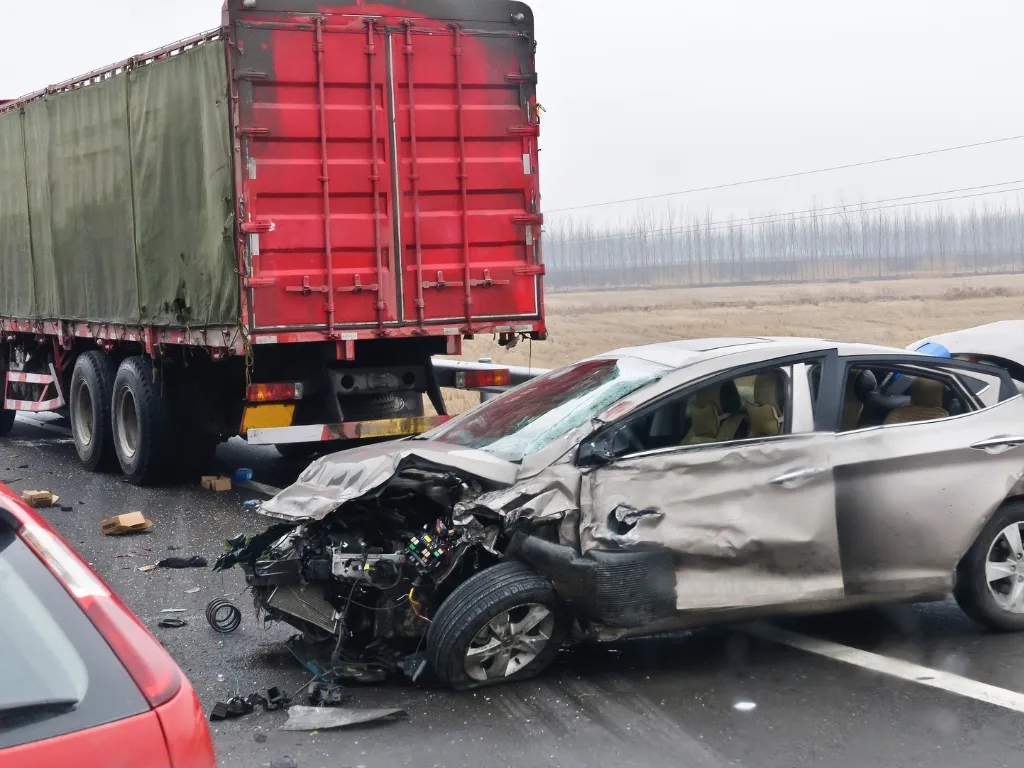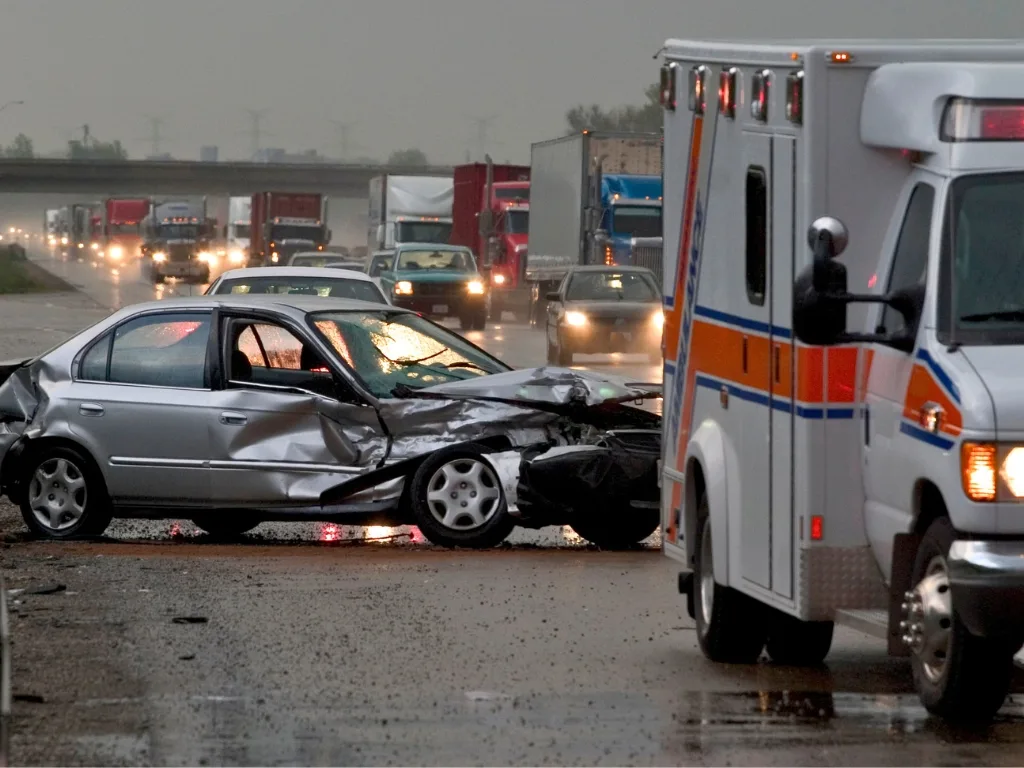
A DUI arrest following a crash is not the same charge as a standard DUI. When a collision is involved, California law introduces additional elements the prosecution must prove, enhancements that can multiply the consequences, and a parallel DMV process that begins at the moment of arrest.
The Law Office of Sam Salhab has defended DUI cases in Fresno for over fifteen years, including as lead attorney in Fresno County’s DUI Court Pilot Program. If you are facing charges involving a crash, a free, confidential consultation is available.
The Statute: What VC § 23153 Requires
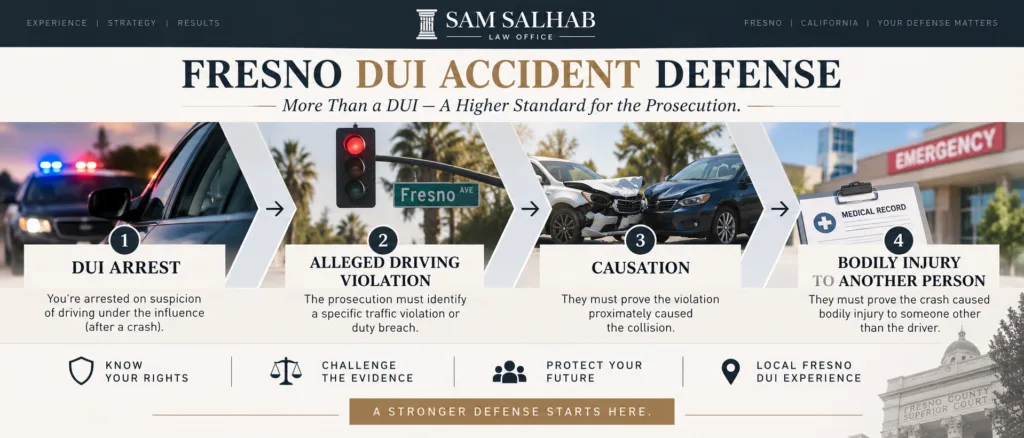
A standard DUI under Vehicle Code § 23152 requires the prosecution to prove impairment or a BAC at or above 0.08%. Vehicle Code § 23153 requires four distinct elements, each proven beyond a reasonable doubt:
- The defendant drove a vehicle
- While under the influence of alcohol or drugs, or with a BAC at or above 0.08%
- While simultaneously committing an unlawful act or neglecting a driving duty
- And that act or neglect proximately caused bodily injury to another person
Does a Crash Automatically Mean a VC § 23153 Charge?
No. The crash alone is not the statutory test. The prosecution must identify a specific traffic violation or duty breach, such as a speeding violation, an unsafe lane change, or running a red light, and prove that the breach, not merely the fact of intoxication, proximately caused someone’s injury.
If another driver’s conduct caused the collision, or if road conditions were the primary cause, the causation element may be contested even where the defendant’s BAC was above the legal limit.
Misdemeanor vs. Felony: How the Charge Is Filed
Vehicle Code § 23153 is a “wobbler,” meaning prosecutors can charge it as either a misdemeanor or a felony. The filing decision involves multiple considerations, including injury severity, prior DUI history, BAC level, number of victims, and the circumstances of the crash. Prosecutorial discretion governs this decision based on the totality of the facts.
| Factor | General Tendency |
| Injury severity | More serious injury increases likelihood of felony filing |
| Prior DUI history | One or more priors within 10 years increases felony exposure |
| BAC level | Significantly elevated BAC is an aggravating consideration |
| Number of victims | Multiple victims add complexity and potential enhancements |
| Aggravating conduct | Excessive speed, reckless driving, or fleeing weighs toward felony |
A felony conviction under VC § 23153 qualifies as a strike under California’s Three Strikes Law when great bodily injury is found. Sentencing ranges vary depending on the subsection and the defendant’s prior record. Under Vehicle Code § 23554, a first-offense felony DUI causing injury is punishable by 16 months, 2, or 3 years in state prison. Defendants with two or more prior DUI-related convictions within 10 years face a term of 2, 3, or 4 years under VC § 23566.
Bodily Injury vs. Great Bodily Injury
The Standard Injury Threshold
Under VC § 23153, “bodily injury” includes any physical harm to another person. This can be relatively minor, though the prosecution must still establish that the defendant’s unlawful act proximately caused it.
Great Bodily Injury and the GBI Enhancement
California Penal Code § 12022.7 defines great bodily injury as a “significant or substantial physical injury.” When GBI is proven in a felony DUI causing injury case, Penal Code § 12022.7(a) provides an additional consecutive prison term of three years. The statute contains multiple subsections with different enhancement terms depending on the circumstances; the applicable provision is fact-specific and determined at sentencing.
Whether an injury qualifies as GBI is a case-specific question. Minor bruising or soft-tissue complaints that appear days after the crash may not meet the threshold. Pre-existing conditions can complicate the causation analysis. These are issues that benefit from careful medical and legal review early in the case.
What If Multiple People Were Injured?
Vehicle Code § 23558 provides a one-year state prison enhancement for each additional person who suffers bodily injury or death in a qualifying DUI-causing-injury case, up to a maximum of three such enhancements. These enhancements are consecutive, not concurrent, and apply to passengers, occupants of other vehicles, pedestrians, and cyclists.
The enhancements require the same causation showing as the underlying charge. A victim who was injured but whose injury was caused by an independent factor may not support an enhancement. The number of enhancement allegations significantly affects plea negotiations and sentencing exposure.
What If Someone Dies in a Fresno DUI Crash?
When a DUI crash results in a fatality, Penal Code § 191.5 governs. California distinguishes two levels:
- Gross vehicular manslaughter while intoxicated (§ 191.5(a)): requires gross negligence, carries 4, 6, or 10 years in state prison
- Vehicular manslaughter while intoxicated (§ 191.5(b)): requires ordinary negligence, carries 16 months, 2, or 4 years
The Watson Murder Risk
In cases involving a prior DUI conviction, prosecutors may pursue a second-degree murder charge under Penal Code § 187, known as a “Watson murder,” based on the California Supreme Court’s holding in People v. Watson (1981). The theory is that a driver who received a prior DUI conviction was warned of the dangers of driving impaired, establishing implied malice. This is the most serious charging outcome after a fatal DUI crash and requires aggressive, immediate defense intervention.
Two Cases Running Simultaneously: Criminal Court and the DMV
A DUI crash arrest in Fresno creates two separate proceedings, and both begin immediately.
The Criminal Case
The criminal case proceeds through arraignment, pretrial hearings, and potentially trial in Fresno County Superior Court. Under Fresno Superior Court’s 2026 bail schedule, VC § 23153 carries differentiated bail amounts depending on prior DUI history, making early attorney involvement particularly important for release decisions.
The DMV Administrative Per Se Process
Simultaneously, the California DMV initiates an Administrative Per Se (APS) action against the driver’s license. A pink DS-367 temporary license is issued at the time of arrest, valid for 30 days. The driver has 10 calendar days from the arrest date to request a DMV hearing to contest the administrative suspension. Missing this window waives the right to a hearing, and the suspension becomes automatic on day 31. This deadline runs whether or not the criminal case has been resolved.
What Defense Looks Like in a DUI Crash Case
Because VC § 23153 adds causation and the unlawful-act element to the standard DUI charge, the defense has more statutory terrain to contest than in a simple § 23152 case.
Causation Challenges
If another driver’s negligence, a mechanical failure, or road conditions were the primary cause of the collision, the proximate causation element of § 23153 is contested. Accident reconstruction evidence, skid mark analysis, vehicle event data recorder information, and witness statements can all support a causation defense that is simply unavailable in a standard DUI case.
Injury Severity Disputes
If the prosecution has alleged GBI for purposes of the enhancement, independent medical review of the injury documentation may show the harm does not meet the “significant or substantial” threshold. Delayed-onset complaints and soft tissue injuries may not support the enhancement even where some injury is proven.
Standard DUI Defenses Still Apply
All defenses available in a § 23152 case remain available in a § 23153 case: challenging the legality of the traffic stop, contesting BAC accuracy through California Title 17 compliance issues, raising the rising blood alcohol defense based on absorption timing, and challenging field sobriety test administration under NHTSA protocols.
You Have More Time Than You Think — and Less Than You Realize
The 10-day DMV deadline creates a false sense of urgency that causes some people to panic, and a false sense of security about the criminal case that causes others to delay. Both are equally problematic. The DMV clock is real and unforgiving. The criminal case moves more slowly, but the earliest stages, before charges are formally filed, are often the most influential in whether and how a case proceeds.
Sam Salhab has conducted over 25 jury trials in Fresno County and brings the specific trial experience that DUI crash cases require. The Law Office of Sam Salhab offers free, confidential consultations with 24/7 availability. Contact the firm today so the DMV hearing can be requested and the defense evaluation can begin before any window closes.
Frequently Asked Questions
Does being in an accident automatically make my DUI a felony?
No. Vehicle Code § 23153 is a wobbler that can be filed as either a misdemeanor or a felony. Charging depends on prosecutorial discretion based on the totality of the circumstances, including injury severity, prior DUI history, BAC level, and any aggravating factors. The existence of a crash and injury alone does not determine how the case is filed.
Does the prosecution have to prove the DUI caused the crash?
Yes. VC § 23153 requires proof that an unlawful act or neglect of a driving duty — separate from intoxication itself — proximately caused the bodily injury. If another driver caused the collision, or if road conditions were the primary cause, the causation element is contested even where impairment is established.
What if only I was injured in the crash?
VC § 23153 requires injury to a person other than the driver. If no person other than the driver suffered bodily injury, the injury element required for VC § 23153 would not be satisfied, though other DUI or related charges may still apply depending on the circumstances.
What counts as great bodily injury?
California law defines GBI as a significant or substantial physical injury under Penal Code § 12022.7. The threshold is fact-specific and is not satisfied by every injury that occurs in a crash. Minor bruising, subjective pain complaints, or injuries that predate the crash may not meet the standard. Whether an injury qualifies as GBI is one of the most frequently litigated issues in DUI causing injury cases.
Do I still have 10 days to request a DMV hearing after a DUI crash?
Yes. The 10-day window to request an Administrative Per Se hearing applies regardless of whether a crash was involved. The window begins on the date of arrest and does not extend for any reason related to the criminal case. Requesting the hearing through an attorney also gives your counsel an early opportunity to review the DMV’s evidence and use the hearing process to gather discovery.
What if someone died in the crash?
A fatality triggers separate homicide statutes rather than VC § 23153. Penal Code § 191.5 covers vehicular manslaughter while intoxicated at two levels based on the degree of negligence involved. In cases with a prior DUI conviction, prosecutors may charge second-degree murder under the Watson murder theory. The specific charge depends on the facts, prior record, and prosecutorial discretion, and these cases require immediate, experienced defense intervention.
Can hit-and-run charges be added to a DUI crash case?
Yes. A driver who leaves the scene of an accident involving injury or death faces additional exposure under Vehicle Code § 20001, which is a wobbler offense that can be charged as either a misdemeanor or a felony depending on the circumstances and prosecutorial discretion. Hit-and-run charges can be pursued alongside DUI causing injury charges arising from the same incident, and the combination substantially increases overall sentencing exposure.