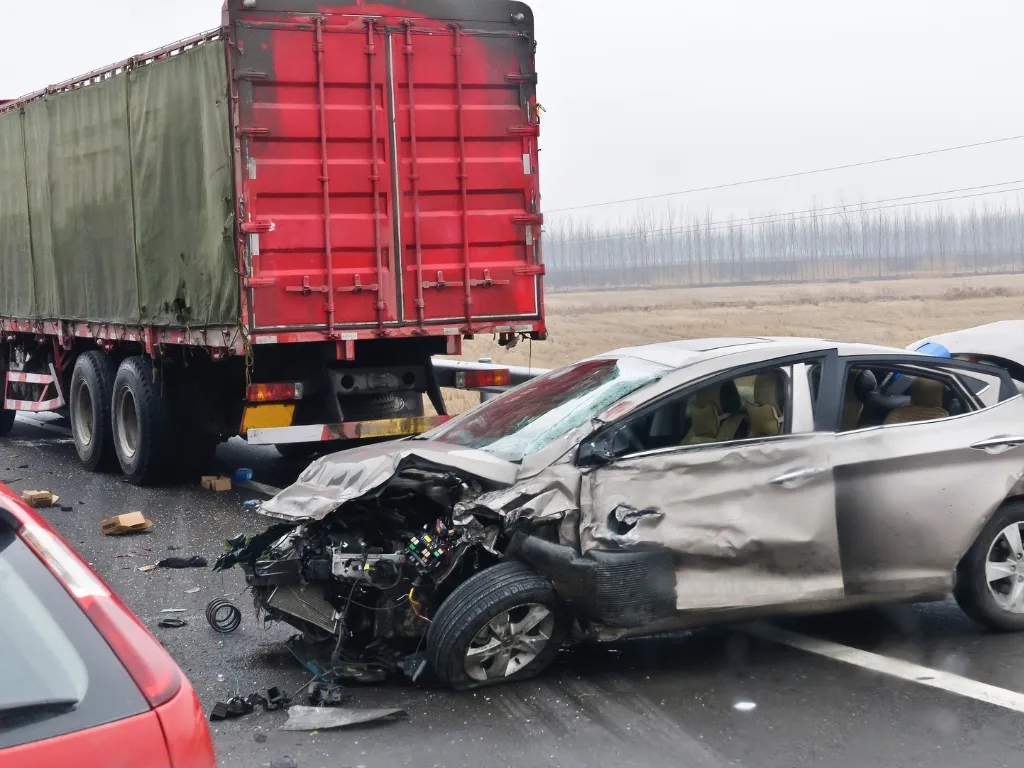
An 18-wheeler crash is not just a bigger version of a car accident. Semi-trucks fail in specific, well-documented ways, underride collisions, blind-spot sideswipes, jackknife loss-of-control, and each mechanism carries its own safety standards, its own evidence trail, and often its own set of responsible parties beyond the driver behind the wheel.
The Law Office of Sam Salhab represents injury victims across Fresno and Orange County, and 18-wheeler cases demand an investigation built around how these specific crashes actually happen, not a generic car-accident approach applied to an 80,000-pound vehicle.
Why 18-Wheelers Crash Differently Than Other Vehicles
A fully loaded semi-truck can weigh twenty to thirty times more than the passenger vehicle it collides with, and that disparity produces a handful of recurring, well-studied crash patterns. Understanding which pattern caused a specific crash often determines which safety standard was violated and who is legally responsible.
The Crash Types Unique to Semi-Trucks
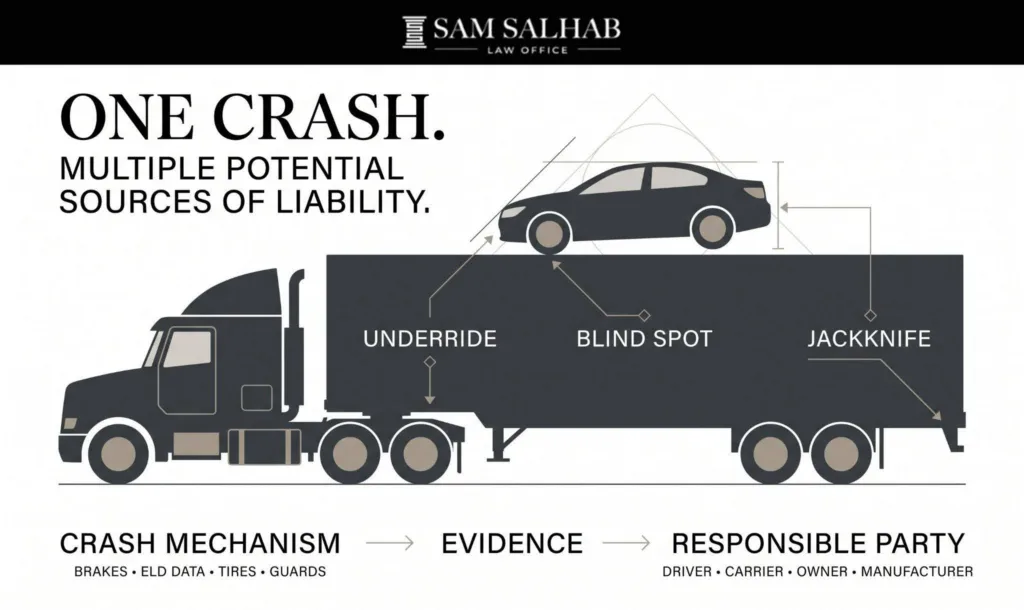
Rear and side underride collisions, where a smaller vehicle slides beneath the trailer, blind-spot or “no-zone” crashes caused by the truck’s massive coverage gaps, and jackknife crashes, where the trailer swings out of control relative to the cab, together account for a large share of the most catastrophic 18-wheeler crashes on the road.
Crash Mechanism → Evidence → Responsible Party
An 18-wheeler claim becomes much clearer when investigators start with how the truck crashed, then identify the evidence capable of proving that mechanism, and finally determine who controlled the part of the operation that failed. Different crash types leave different evidence trails, and the potentially responsible party can change accordingly.
| Crash mechanism | Evidence to examine | Potential responsibility |
| Underride | Guard condition, trailer inspection, collision damage | Carrier, trailer owner, manufacturer |
| Jackknife | Brake components, inspection and repair records, ELD data | Driver, carrier, maintenance provider |
| Blind-spot collision | Mirrors, signals, camera footage, vehicle positions | Driver, carrier |
| Tire blowout | Tire carcass, inspection records, maintenance and purchase records | Carrier, tire manufacturer, maintenance provider |
| Fatigue-related crash | ELD/RODS, dispatch records, trip documents, communications | Driver, carrier |
| Overloaded or unstable trailer | Bills of lading, weight records, cargo and loading documentation | Carrier, shipper, loading party |
Why Federal Records Make This Framework Work
Federal rules make several of these records particularly valuable. FMCSA identifies bills of lading, dispatch records, electronic mobile communications, and payroll records as supporting documents carriers must retain to verify a driver’s record of duty status, which means a fatigue-related crash claim can often be reconstructed from records the carrier is already legally required to keep.
Underride Crashes and the Federal Safety Standard Built to Prevent Them
Underride crashes occur when a passenger vehicle’s front end slides beneath the rear or side of a trailer, often with catastrophic or fatal results because the trailer bed strikes the vehicle at windshield or roofline height rather than the bumper. An underride investigation should examine more than whether a guard was simply present.
The 2022 Federal Rule Upgrade
NHTSA’s updated standards, FMVSS Nos. 223 and 224, require rear impact guards on trailers and semi-trailers to provide sufficient strength and energy absorption to protect occupants of compact and subcompact passenger cars striking the rear of a trailer at 35 miles per hour, an upgrade from the previous 30 mph threshold. The Federal Motor Carrier Safety Administration also added rear impact guards to the list of items examined during a commercial motor vehicle’s required annual inspection, meaning a damaged or missing guard can itself be evidence of a maintenance violation.
No-Zone Blind Spot Crashes
Large trucks carry blind spots, sometimes called “no-zones,” far larger than an ordinary car’s, extending roughly 20 feet in front of the cab, 30 feet behind the trailer, and across one or more lanes along both sides. FMCSA’s public safety campaign was built specifically around educating drivers on these coverage gaps because of how often crashes occur when a passenger vehicle lingers in one.
Why Fault Isn’t Always the Smaller Vehicle’s
A no-zone crash is not automatically the passenger vehicle driver’s fault simply because they were in a blind spot. Truck drivers still carry a duty to check mirrors, signal properly, and use additional caution before a lane change, and evidence like turn signal timing, dashcam footage, and the truck’s own mirror positioning can establish that the driver failed that duty.
Jackknife Crashes and Mechanical Failure
A jackknife occurs when a trailer swings out relative to the cab, typically during sudden braking, often folding the rig into a V-shape that can span multiple lanes of traffic. These crashes frequently trace back to worn or improperly maintained brakes, since federal brake performance standards exist specifically to keep a trailer’s braking force synchronized with the tractor’s.
Why Maintenance Records Matter in a Jackknife Case
A jackknife caused by brake imbalance or worn components points directly toward a maintenance failure rather than driver error alone, which is why a thorough investigation reviews the carrier’s brake inspection and repair history rather than accepting a driver’s account of “black ice” or “sudden traffic” at face value.
California’s Additional Layer of Oversight: The BIT Program
Beyond federal regulation, California imposes its own inspection requirement on motor carriers operating in the state. Under California’s Basic Inspection of Terminals program, administered by the California Highway Patrol, motor carriers operating commercial vehicles over 10,001 pounds must enroll in a state inspection system, and carrier terminals are subject to CHP review of vehicle safety records, maintenance history, and driver qualification files.
Why BIT Records Can Strengthen a Case
A carrier’s BIT compliance history, including any past violations or deficient inspection findings, can become relevant evidence in a Fresno 18-wheeler case, particularly when a mechanical failure like a brake defect or missing underride guard is at issue. These records exist independently of the federal supporting documents a carrier is required to keep, giving California claimants an additional avenue for uncovering a carrier’s safety history.
The Corporate Chain of Responsibility Behind an 18-Wheeler
Unlike a typical car accident, an 18-wheeler crash often involves a chain of separate legal entities, each with their own potential liability. The driver may be an employee or an independent owner-operator, the trailer may be owned by a different company than the tractor, and a freight broker may have arranged the load without directly employing anyone involved in the crash.
Why Each Link in the Chain Matters
Whether the driver was an employee or an independent contractor affects whether the motor carrier can be held vicariously liable for the crash, and a broker’s own safety vetting practices when selecting a carrier can become relevant if that carrier had a documented history of safety violations. Untangling this structure early is often necessary to identify every applicable insurance policy before a claim’s value is limited to whatever the driver alone can pay.
What Compensation May Be Available
18-wheeler crash injuries tend toward the severe end of the spectrum given the size and weight forces involved. While every case depends on its specific facts, general settlement ranges for California personal injury claims often fall into the following categories:
| Injury Severity | Typical Settlement Range |
| Minor | $3,000 – $15,000 |
| Moderate | $15,000 – $75,000 |
| Severe | $75,000 – $500,000+ |
| Catastrophic | $500,000 – millions |
Why These Cases Often Reach the Higher End
Underride, jackknife, and rollover-related 18-wheeler crashes frequently produce catastrophic injuries, and the involvement of a commercial carrier typically means substantially higher policy limits than an individual driver would carry. The strength of the maintenance and inspection evidence, both federal and California-specific, often shapes how much of that available coverage a claim can actually reach.
Acting Before Evidence and Time Run Out
California generally requires injury victims to file a lawsuit within two years of the crash date under Code of Civil Procedure § 335.1. Evidence unique to these cases, including underride guard condition, brake maintenance logs, and electronic logging device data, can be lost or overwritten quickly if not preserved early, so sending a formal preservation request promptly is often the single most important early step.
Why Choose the Law Office of Sam Salhab
18-wheeler cases require an attorney who understands the specific mechanics of underride, no-zone, and jackknife crashes, not just general negligence principles. Our personal injury team investigates these cases with that specialized lens, tracing responsibility through the driver, the carrier, and every other entity in the corporate chain behind the truck. The firm’s Fresno personal injury office offers free consultations, and clients are treated as people facing a serious injury, not a case number to be closed quickly.
Moving Forward After an 18-Wheeler Crash
An 18-wheeler crash often leaves victims facing catastrophic injuries and a confusing web of corporate entities behind the truck itself. The key question is not simply who caused the accident, but what mechanism caused the crash, what evidence proves it, and who was responsible for the component or conduct involved, a framework that can uncover liability a routine accident investigation might miss. Anyone injured in a Fresno 18-wheeler crash is welcome to reach out for a conversation about what happened and what options may be available.
What is an underride crash, and why is it so dangerous?
An underride crash occurs when a passenger vehicle slides beneath the rear or side of a trailer, often striking the vehicle at windshield height rather than the bumper. Federal standards now require rear impact guards to withstand a 35 mph impact, and a damaged or missing guard can be evidence of a maintenance violation.
Am I automatically at fault if I was hit while in a truck’s blind spot?
No. Truck drivers still have a duty to check mirrors and signal properly before changing lanes, and evidence like turn signal timing and dashcam footage can show the driver failed that duty even though the passenger vehicle was in a “no-zone.”
What causes a semi-truck to jackknife?
Jackknifing typically results from sudden braking combined with worn or improperly maintained brakes that cause the trailer’s braking force to fall out of sync with the tractor’s. A carrier’s brake inspection and repair history is often central evidence in these cases.
What kind of records can prove a fatigue-related truck crash?
Federal rules require carriers to retain supporting documents including bills of lading, dispatch records, electronic communications, and payroll records that can be used to verify a driver’s actual hours against their logged record of duty status. These records often reveal discrepancies that point to a fatigue-related cause even when a driver’s logs appear compliant on their face.
What is California’s BIT program, and why does it matter for my case?
The Basic Inspection of Terminals program, administered by the California Highway Patrol, requires motor carriers operating in California to undergo state inspections of their vehicles, maintenance records, and driver files. A carrier’s BIT compliance history can provide additional evidence of a pattern of safety violations beyond federal records alone.
Can a freight broker be held responsible for a truck accident?
Potentially, depending on the broker’s role in selecting the carrier and whether it had knowledge of the carrier’s safety history. Untangling the corporate chain between the driver, motor carrier, trailer owner, and broker is often necessary to identify every available source of insurance coverage.
How long do I have to file a claim after an 18-wheeler accident in California?
Most personal injury claims must be filed within two years of the crash date under Code of Civil Procedure § 335.1. Because evidence like brake maintenance logs and ELD data can be lost quickly, early legal action is often necessary to preserve the record a strong claim depends on.