
A criminal protective order does not follow a single timeline. Depending on when it was issued and why, the same case can move through an order that lasts a matter of days, one that lasts three years, and one that follows a person for a decade or longer after sentencing. For anyone facing an active case, or trying to understand what happens after one, that variability is often the most confusing part.
The Law Office of Sam Salhab has handled protective order matters across Fresno and Orange County criminal courts for over a decade, and the firm’s approach starts from a simple premise: an arrest is not a conviction, and a protective order should never be treated as more restrictive or more permanent than the law actually requires. Understanding the different stages, and what triggers each one, is the first step toward knowing what to expect.
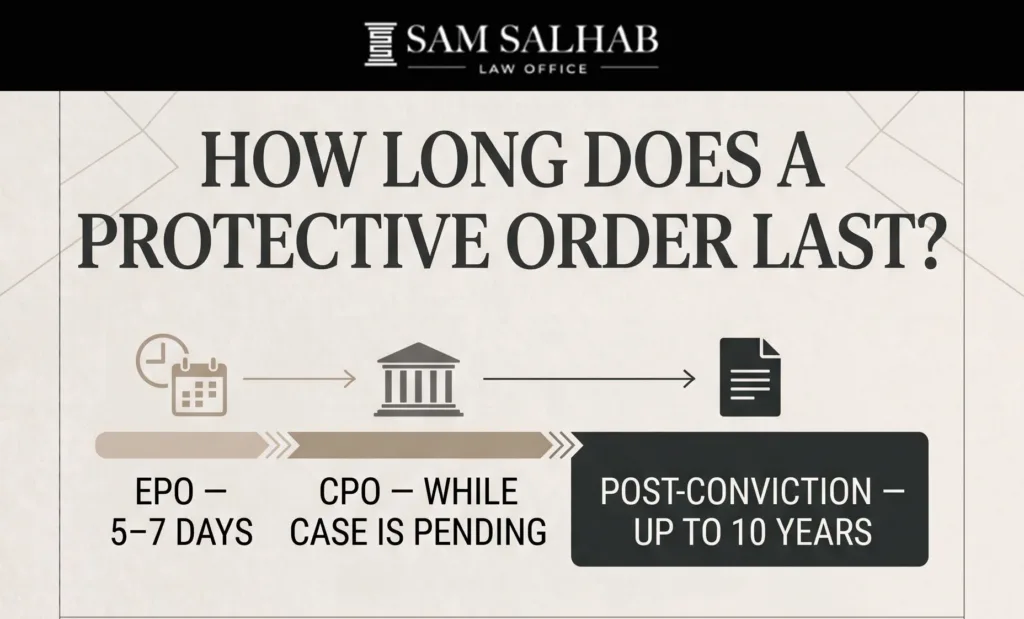
Emergency Protective Orders: The First 5 to 7 Days
An Emergency Protective Order (EPO) is typically the first order issued in a case, often at the scene of an arrest or shortly after. A judicial officer can issue one when a peace officer asserts reasonable grounds to believe a person is in immediate danger, and California law sets a short, fixed lifespan for it. An emergency protective order expires at the close of judicial business on the fifth court day following its issuance, or the seventh calendar day following issuance, whichever comes first.
This short window exists by design. An EPO is meant to bridge the gap between an emergency and a court’s opportunity to review the situation, not to function as a long-term order. As the California Courts self-help guide explains, an EPO only lasts a short time, usually five to seven days, and a person who needs longer protection has to apply for a formal restraining order instead. If the case proceeds, a longer criminal protective order under a different statute typically follows.
Criminal Protective Orders During an Open Case (Penal Code 136.2)
Once formal charges are filed, courts frequently issue a protective order under Penal Code Section 136.2. This is the order most people mean when they refer to a “stay-away order” or “no-contact order,” and its purpose is different from an EPO: it is meant to protect a victim or witness for as long as the criminal case itself remains open. According to the California Courts’ domestic violence reference materials, orders issued under Penal Code section 136.2 remain valid as long as the court retains jurisdiction over the case, and they are not valid after a defendant is committed to state prison.
That structure matters for defendants and protected parties alike. A 136.2 order is tied to the pending case rather than a fixed calendar date, which is why the same order can be modified, narrowed, or lifted entirely before it would otherwise be expected to end. If the case resolves through dismissal, acquittal, or a plea to a non-qualifying charge, the order tied to the pending proceeding typically terminates along with it.
Post-Conviction Protective Orders: Years, Not Days
The timeline changes substantially once a conviction is entered. At sentencing, a court can issue a protective order that extends well beyond the life of the case, and current California law gives judges wide discretion in setting that duration. Under the 2023 amendment to Penal Code 136.2, a post-conviction protective order tied to domestic violence, human trafficking, gang-related crimes, or a registerable sex offense may remain valid for up to ten years, as determined by the sentencing court.
Certain offenses carry their own, separate durational rules. A protective order issued to protect a victim or witness from harm or intimidation connected to the case itself, rather than a conviction, generally runs for three years under standard CLETS-CPO practice. Stalking-related orders under Penal Code 646.9 follow a different track entirely, with courts authorized to issue protection for up to ten years in appropriate cases. The specific facts of the conviction, not a single statewide default, determine which duration applies.
How Do I Know How Long My Criminal Protective Order Lasts?
The most reliable way to determine a CPO’s actual duration is to read the order itself rather than apply a general rule. Start with the Judicial Council form the court issued: CR-160 is used in domestic violence cases, while CR-161 applies in criminal cases outside the domestic violence context. Both forms state the statutory basis for the order and list its expiration terms directly on the document.
The Penal Code section cited on the form matters as much as the form type. Current CR-160 instructions distinguish orders that stay in effect only while a case is pending from post-conviction orders carrying a fixed statutory maximum, which is why two CPOs from different cases can expire on entirely different schedules. It is also worth noting that the Judicial Council revised these forms after determining a blanket three-year expiration did not accurately describe every order, according to its own rule-revision materials. When the expiration date or statutory basis isn’t clear, the signed court order, not a general timeline, should settle the question.
When and How a Protective Order Can End Early
A protective order’s stated expiration date is not always the date it actually ends. Cases resolve early, charges get reduced, and courts retain ongoing authority to revisit an order’s terms while a case is pending. Several circumstances commonly bring an order to an earlier close:
- Dismissal or acquittal on the underlying charge, which typically ends a 136.2 order tied to that case
- A negotiated plea to a charge that does not carry protective order eligibility
- A defendant’s commitment to state prison, which by law ends the validity of certain 136.2 orders
- A court-approved modification request, which can adjust an order from “no contact” to a more limited “peaceful contact” standard without ending it outright
Because these orders sit at the intersection of criminal law and personal liberty, requesting a modification or early termination is a legal process with its own evidentiary standard, not an automatic result of asking. Courts weigh the protected party’s safety alongside the defendant’s circumstances, and the burden of showing why a change is appropriate falls on the person requesting it.
Why Working With Defense Counsel Early Matters
The duration and terms of a protective order are often decided at critical early hearings, sometimes before a defendant has had the chance to fully understand what is being requested. A protective order that goes unchallenged at arraignment can carry consequences well beyond the courtroom, including restrictions on firearm ownership, housing arrangements, and contact with family members who live in the same household.
Clients working with Sam Salhab’s office benefit from representation that treats these hearings with the same seriousness as the underlying criminal charge, not as a procedural afterthought. For readers evaluating their options in a pending matter, it’s worth exploring how a Fresno criminal defense attorney can address a protective order’s terms and duration at the same time the broader case is being handled.
Getting the Full Picture for Your Case
A protective order’s length depends on which statute authorized it, what stage the case has reached, and whether the underlying charge results in a conviction. An EPO issued at arrest is not the same instrument as a post-conviction order issued at sentencing, and confusing the two can lead to unnecessary anxiety or, in some cases, an unchallenged order that lasts far longer than the facts support. Reviewing the specific order attached to a case, rather than relying on generalized timelines, is the only reliable way to know what applies.
Clients and families navigating an active protective order in Fresno or Orange County often benefit from a direct conversation about the order’s specific terms and duration. The firm’s contact page is available for anyone who wants to walk through the details of a pending case with the office directly.
Frequently Asked Questions
How long does a temporary criminal protective order last in California?
A temporary or emergency protective order issued at the outset of a case expires quickly. It ends at the close of judicial business on the fifth court day after issuance, or the seventh calendar day, whichever happens first. A longer order typically follows if the case continues.
Does a criminal protective order end automatically when a case is dismissed?
Generally, yes, for orders issued under Penal Code 136.2 while a case is pending. These orders are valid only as long as the court has jurisdiction over the case, so a dismissal or acquittal usually terminates the order along with the case. Confirming this with the court file is still recommended.
Can a protective order last longer than 10 years in California?
In most domestic violence, trafficking, gang-related, and sex offense convictions, ten years is the statutory maximum under current law. Certain aggravated domestic violence convictions have been extended further under recent legislative changes, so the applicable statute and conviction type both need to be checked directly.
How do I find out exactly when my protective order expires?
Check the expiration date printed on the signed CR-160 or CR-161 form itself, along with the Penal Code section it cites. These forms state whether the order runs with the pending case or carries a separate post-conviction maximum, which is more reliable than any general estimate.
What happens if someone violates a criminal protective order before it expires?
A violation is treated as a separate criminal offense from the underlying case and can result in new charges, additional jail exposure, and a bail or probation revocation. Courts generally treat these violations seriously regardless of whether the original charge is still pending.
Can a protective order be modified before its expiration date?
Yes. Courts retain authority to modify an order’s terms, including shifting from a strict no-contact order to a peaceful-contact arrangement, while it remains active. A modification request requires a formal filing and a showing of why the change is appropriate for the court’s safety concerns.
Is a criminal protective order the same as a domestic violence restraining order?
No. A criminal protective order under Penal Code 136.2 is issued within a criminal case and tied to that proceeding, while a domestic violence restraining order is a civil order requested through family court using a separate petition process (Form DV-100). The two can coexist, and each follows its own rules for issuance and duration.