
A backyard pool or apartment complex spa is supposed to be a place for relaxation, not tragedy. When a missing pool gate latch, an unsupervised moment, or a poorly maintained pool leads to a near-drowning or fatal accident, families are often left with devastating grief and unanswered questions about who was responsible. The Law Office of Sam Salhab represents Fresno families pursuing accountability after a swimming pool accident, treating each case with the seriousness a child’s life or a family’s loss deserves.
Pool accident cases sit at the intersection of premises liability and specific California safety regulations designed to prevent exactly this kind of tragedy. Fresno families benefit from an attorney who understands both the general negligence standard property owners must meet and the pool-specific statutes that can strengthen a claim considerably.
How Common Are Drowning Accidents?
National and California Data
Drowning remains one of the leading causes of unintentional death for young children nationwide.
Approximately 4,000 people die from unintentional drowning in the United States each year, and drowning is the leading cause of death among children aged 1 to 4 years, with the second highest drowning death rate among adults 65 and older. Drowning deaths rose to over 4,500 people per year from 2020 through 2022, about 500 more deaths per year compared to 2019, with the sharpest increases among children ages 1 to 4, older adults, and Black Americans of all ages.
Why Pools Present a Particular Risk for Young Children
California’s own drowning data underscores why pool-specific safety laws matter so much for young children in this state.
Pools account for the majority of fatal drowning incidents among California children under age 5, and unlike open water drownings, pool drownings often happen within a family’s own backyard or a residential complex, in moments when a caregiver briefly looks away. That combination of proximity and brief inattention is exactly what California’s pool safety statute was designed to guard against.
Common Causes of Swimming Pool Accidents
Fresno pool accident cases tend to trace back to a handful of recurring failures, whether at a private residence, an apartment complex, or a public facility.
Barrier and Supervision Failures
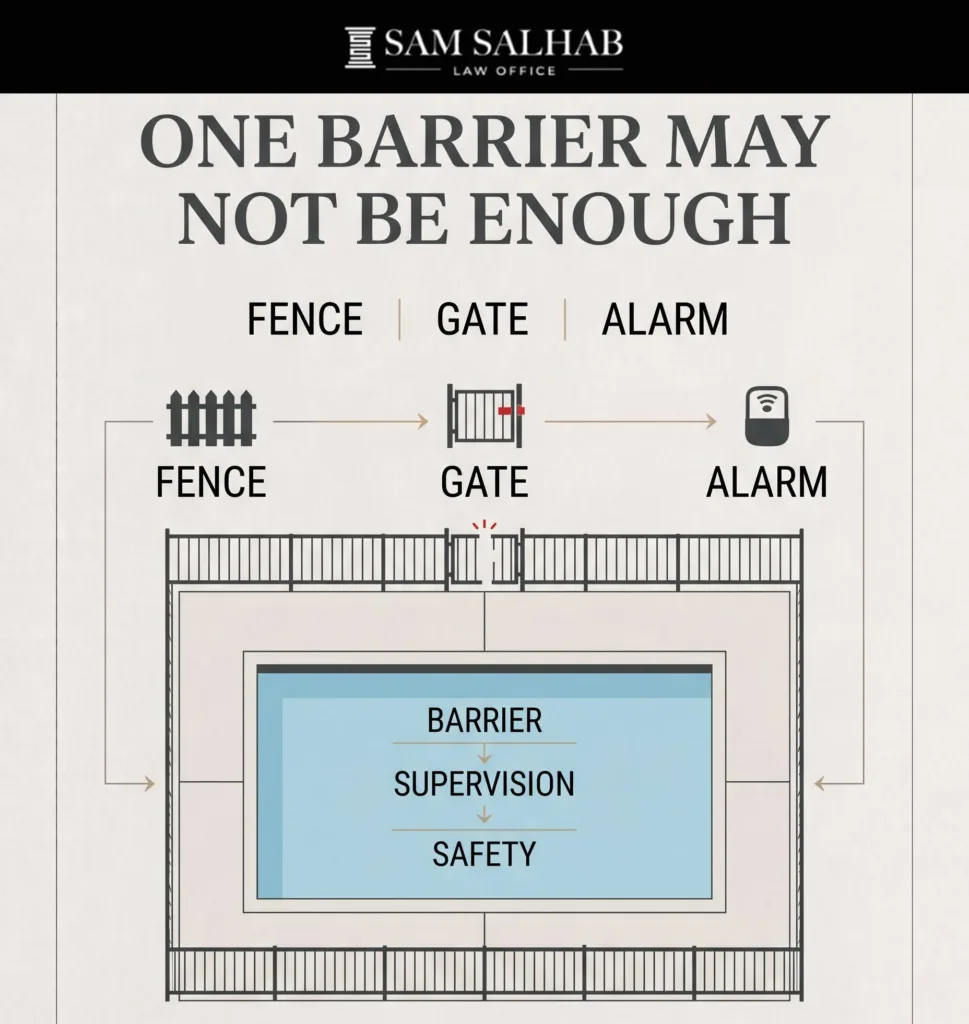
- Missing or non-compliant pool fencing and gates
- Broken or disabled self-latching gate mechanisms
- Inadequate lifeguard supervision at public or apartment pools
- Unlocked doors providing direct access from a home to the pool area
Maintenance and Equipment Failures
- Malfunctioning or missing pool drain covers, creating suction hazards
- Slippery pool decks without adequate traction or maintenance
- Broken or missing pool alarms
- Inadequate lighting around pools used after dark
California’s Swimming Pool Safety Act
California enacted specific legal requirements for residential pools through the Swimming Pool Safety Act, codified at Health and Safety Code Section 115922.
When a building permit is issued for the construction of a new swimming pool or spa, or the remodeling of an existing pool or spa at a private single-family home, the pool must be equipped with at least two of seven specified drowning prevention safety features, including an isolating enclosure, self-latching mesh fencing, an approved safety cover, or a certified pool alarm. The two-feature requirement reflects a redundant-protection principle: if one barrier fails or is temporarily disabled, a second layer remains in place.
A pool that lacks the required layers of protection, or has a gate propped open, a broken latch, or a missing alarm, is not automatically proof of negligence on its own, but it can be powerful evidence that a property owner failed to meet a safety standard the state specifically created to prevent child drownings. Combined with evidence about supervision at the time of the accident, a documented Swimming Pool Safety Act violation often becomes central to establishing liability.
Who Can Be Held Responsible for a Swimming Pool Accident?
Determining who is legally responsible depends on who controlled the pool, what safety duties applied, and what failure contributed to the injury. A drowning or near-drowning does not automatically establish liability, and a violation of a pool-safety regulation is not necessarily the end of the analysis. Homeowners may be responsible when they fail to reasonably maintain barriers, gates, alarms, or other safety features around a private residential pool.
Landlords and property owners may have responsibility for dangerous conditions they control at rental properties, while an apartment, HOA, or other pool operator may have separate obligations involving common-area maintenance, access, inspections, and applicable public-pool health regulations enforced through the state.
Third Parties Beyond the Property Owner
Responsibility can also extend beyond the property owner. A pool maintenance company may become relevant if negligent maintenance or inspection contributed to a dangerous condition, and a lifeguard or staffing contractor may be involved when inadequate supervision is alleged.
If a defective drain cover, alarm, gate component, or other product contributed to the accident, the manufacturer, distributor, or seller may potentially face a products-liability claim, since California’s Judicial Council civil jury instructions on products liability recognize claims involving manufacturing defects, defective designs, and inadequate warnings.
The key question is therefore not simply who owned the pool, but who had responsibility for the condition or conduct that caused the accident. Establishing that connection requires examining ownership, control, maintenance records, safety inspections, prior complaints, and the specific circumstances surrounding the injury.
What a Fresno Swimming Pool Accident Claim Can Recover
Compensation in drowning and near-drowning cases depends heavily on the severity of the injury, since nonfatal submersion incidents can cause permanent brain damage requiring lifelong care. The ranges below reflect general California outcomes and are not a prediction for any specific case.
| Case Severity | Typical Settlement Range |
| Minor (near-drowning, full recovery) | $10,000 – $50,000 |
| Moderate (temporary hospitalization, no lasting impairment) | $50,000 – $250,000 |
| Severe (permanent brain injury requiring ongoing care) | $250,000 – $1,000,000+ |
| Catastrophic or wrongful death | $1,000,000 – multiple millions |
Cases involving young children who survive a near-drowning with permanent brain damage often settle at the higher end of this range, since the cost of lifelong medical and custodial care must be calculated across an entire lifespan.
Why Fresno Families Choose the Law Office of Sam Salhab
Sam Salhab’s practice treats grieving and traumatized families as people who deserve compassion, not files moving through an insurance process, a principle reflected across the firm’s broader work. That approach shapes how the firm investigates pool accident cases, starting with a rapid review of the property’s compliance with pool safety requirements and the specific circumstances of the accident.
The firm coordinates with safety inspectors and, when needed, medical experts to document both the property’s failures and the full scope of injury a child or adult sustained. Flexible payment structures and a contingency fee model mean families aren’t asked to pay out of pocket while managing a devastating medical or emotional aftermath.
Getting Started With a Pool Accident Claim
Evidence at a pool accident scene can change quickly, since a broken gate latch might get repaired or a missing pool alarm replaced within days of the incident. Photographing the pool area, its fencing, gates, and any safety equipment as soon as possible helps preserve what the conditions actually looked like at the time of the accident. It’s also worth identifying who owned or managed the property, since apartment complexes and rental properties often involve a different set of responsible parties than a private residence.
Fresno-area families can request a free, confidential consultation to have a pool accident reviewed. There is no fee unless the case results in a recovery, keeping the financial risk off the family during an incredibly difficult time.
FAQs
Can I still bring a claim if the pool has already been repaired since the accident?
Yes, a claim can still move forward based on photographs, witness statements, prior maintenance records, and any documentation showing the pool’s condition at the time of the accident. This is why documenting the scene as soon as possible matters, even amid the chaos of an emergency.
Is a property owner automatically liable if a child drowns in their pool?
No, liability generally requires showing the owner was negligent, such as failing to maintain required safety barriers or failing to supervise appropriately, and that this negligence caused the accident. A drowning alone does not establish fault without evidence connecting a specific failure to the incident.
Does the Swimming Pool Safety Act apply to apartment complexes and rental properties?
Yes, rental properties with pools are generally subject to the same safety requirements as private single-family homes, and landlords who fail to maintain compliant barriers or supervision can face liability. Multi-unit properties often carry additional obligations depending on local building and public-pool health codes.
What if my child got into a neighbor’s pool without permission?
California law recognizes a doctrine sometimes called attractive nuisance, which can hold a property owner responsible for foreseeable harm to children drawn onto their property by an appealing but dangerous feature like a pool. Whether this applies depends on the specific barriers and precautions the property owner had in place.
Could a pool maintenance company or product manufacturer be responsible instead of the property owner?
Yes, if negligent maintenance or a defective drain cover, alarm, or gate component contributed to the accident, the maintenance company or product manufacturer could face separate liability. Identifying every party whose conduct or product contributed to the accident is a key part of building a full claim.
How long do I have to file a swimming pool accident claim in California?
California’s personal injury statute of limitations generally gives an injured person or family two years from the date of the accident to file a lawsuit. Cases involving a minor can sometimes extend this timeline, so early legal review helps confirm the applicable deadline.
How much does it cost to hire a pool accident attorney?
Consultations are free, and the firm works on a contingency basis, meaning there is no attorney fee unless the case results in a settlement or verdict. This structure allows families to pursue accountability without upfront legal costs during an already devastating time.
If a swimming pool accident has affected your family, reaching out to discuss what happened costs nothing and can help preserve evidence before conditions change.