
An unlawful stop, an excessive use of force, or a fabricated police report doesn’t just create physical or financial harm. It represents a breach of the constitutional protections every person in Fresno is entitled to, regardless of the charges eventually filed or dropped. The Law Office of Sam Salhab brings the same civil libertarian principles that shape its criminal defense practice to civil rights cases, holding law enforcement accountable when officers exceed the authority the law actually grants them.
Police misconduct cases require proving more than a bad outcome. Establishing a viable claim means identifying which specific right was violated, which legal theory applies, and whether a qualified immunity or public entity defense stands in the way. Fresno residents pursuing these claims benefit from an attorney who can navigate both state and federal civil rights law and who understands how local law enforcement agencies typically respond to litigation.
How Common Is Police Misconduct in California?
Statewide Stop Data
California collects more law enforcement stop data than almost any other state, and the pattern it reveals has remained consistent across multiple reporting years. A 2026 state report analyzed 5.1 million vehicle and pedestrian stops conducted in 2024 by 533 law enforcement agencies, along with 13,000 civilian complaints filed under the Racial and Identity Profiling Act.
That report found individuals perceived to be Black were stopped 128% more often than expected relative to their share of the population, while individuals perceived to be Pacific Islander were stopped 58% more often than expected.
What This Means for Individual Cases
Aggregate stop data doesn’t prove misconduct in any single case, but it provides important context for the pattern-and-practice evidence that often strengthens an individual civil rights claim. Fresno’s own reported stop data becomes part of the record an attorney can draw on when building a case involving a specific officer or department, particularly when a pattern of similar complaints already exists against the same agency.
Common Types of Police Misconduct Claims
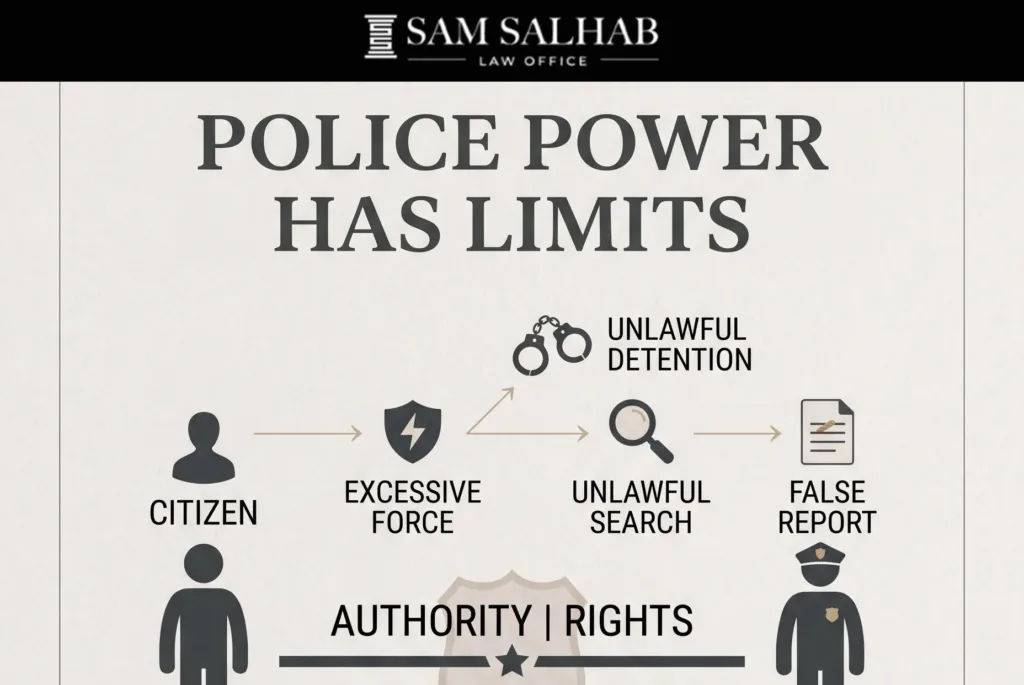
Civil rights violations by law enforcement take several recognized forms, each with its own legal elements and evidentiary requirements.
Force and Detention-Related Misconduct
- Excessive or unreasonable use of force
- Wrongful or false arrest without probable cause
- Unlawful search and seizure
- Failure to intervene when another officer used excessive force
Process and Reporting Misconduct
- Fabrication of evidence or false police reports
- Malicious prosecution
- Retaliation for exercising First Amendment rights
- Denial of medical care while in custody
When Does Police Misconduct Become a Civil Rights Case?
Not every unpleasant, mistaken, or even questionable interaction with police amounts to a constitutional violation. The key question is whether the officer’s conduct violated a specific constitutional right and caused a legally recognizable injury or deprivation.
A practical way to evaluate a potential claim is to work through five questions: what did the officer do, what constitutional protection applies, was the conduct unreasonable or unlawful under the circumstances, what harm resulted, and what legal claim provides a remedy.
A rude or disrespectful officer is not necessarily violating the Constitution. A traffic stop generally requires the officer to have an appropriate legal basis, such as reasonable suspicion of wrongdoing, and courts evaluate the surrounding circumstances rather than applying a single mechanical test. Similarly, an arrest supported by probable cause presents a different situation from an arrest without probable cause, which can potentially implicate the Fourth Amendment, and a warrantless search is not automatically unconstitutional since recognized exceptions to the warrant requirement exist.
How Courts Evaluate Excessive Force
Excessive-force claims require their own fact-specific analysis. The Supreme Court has held that force used during a seizure is evaluated under the Fourth Amendment’s objective-reasonableness standard, weighing the circumstances confronting the officer rather than judging the encounter solely with hindsight. Allegations such as fabricated evidence can also raise constitutional claims when the fabrication contributes to a deprivation of protected rights.
The important distinction is that feeling treated unfairly is not itself the legal test. The strength of a civil rights case depends on identifying the protected right, the specific conduct that violated it, and evidence connecting that violation to the resulting harm.
Legal Avenues for Holding Officers Accountable
Civil rights victims in California generally have two overlapping legal avenues: the federal civil rights statute, 42 U.S.C. Section 1983, and California’s own Tom Bane Civil Rights Act, codified at Civil Code Section 52.1. Section 1983 allows a person to sue a government official for violating federally protected rights, but that claim can be defeated by qualified immunity, a doctrine that shields officers from liability unless the violated right was clearly established by prior case law with substantially similar facts.
The Bane Act offers a state-law alternative that doesn’t carry that same immunity defense, and it applies when someone interferes with a person’s constitutional or statutory rights through threats, intimidation, or coercion, an element that California’s civil jury instructions specifically define. Since 2022, amendments to the Bane Act also allow claims for malicious prosecution and injuries to people in custody, removing immunities that previously blocked those specific claims from moving forward.
What a Fresno Police Misconduct Claim Can Recover
Civil rights cases can result in compensatory damages, and both federal and state law allow for additional remedies not typically available in an ordinary negligence case. The ranges below reflect general outcomes and are not a prediction for any specific case.
| Case Severity | Typical Settlement Range |
| Minor (brief unlawful detention, no lasting harm) | $5,000 – $50,000 |
| Moderate (excessive force with injury requiring treatment) | $50,000 – $250,000 |
| Severe (serious injury, wrongful conviction, prolonged detention) | $250,000 – $1,000,000+ |
| Catastrophic (permanent injury or death in custody) | $1,000,000 – multiple millions |
Bane Act claims can also result in treble damages and enhanced attorney’s fee awards in certain circumstances, which is part of why California plaintiffs increasingly pair a Bane Act claim alongside a federal Section 1983 claim rather than relying on federal law alone.
Why Fresno Residents Choose the Law Office of Sam Salhab
Sam Salhab’s practice is grounded in the belief that every person, regardless of the accusations against them, deserves to be treated with dignity and have their rights protected, a philosophy reflected across the firm’s criminal defense and civil rights work. That perspective shapes how the firm approaches police misconduct cases, starting with a thorough review of body camera footage, police reports, and any prior complaint history against the officers involved.
The firm evaluates each case for both federal and state law claims, since the strongest civil rights cases often combine a Section 1983 claim with a Bane Act claim to reduce the risk that qualified immunity defeats the case entirely. Flexible payment structures and a contingency fee model mean clients aren’t asked to pay upfront while pursuing accountability against a government agency with far greater resources.
Getting Started With a Police Misconduct Claim
Evidence in these cases can be difficult to obtain once an agency realizes litigation is likely, and body camera footage in particular is sometimes subject to retention schedules that allow for deletion after a set period. Requesting preservation of all footage, reports, and radio communications as early as possible, ideally through a formal records request or an attorney’s preservation letter, helps ensure this evidence isn’t lost. Identifying every witness present, including bystanders who may have recorded video on their own devices, also strengthens a case considerably.
Fresno-area residents can request a free, confidential consultation to have a potential police misconduct claim reviewed. There is no fee unless the case results in a recovery, keeping the financial risk off the client while pursuing accountability against a government entity.
FAQs
What is qualified immunity and how does it affect my case?
Qualified immunity is a legal doctrine that can shield individual officers from liability under federal civil rights law unless the right they violated was clearly established by prior case law with substantially similar facts. This is one major reason attorneys often pursue a parallel claim under California’s Bane Act, which does not recognize this defense.
How long do I have to file a police misconduct claim in California?
Claims against a government entity generally require a formal administrative claim within six months of the incident, followed by a lawsuit within the applicable statute of limitations, which is typically two years for most civil rights claims. Missing the six-month government claim deadline can bar the case entirely, so early legal review is critical.
Can I still file a claim if criminal charges against me were dropped or dismissed?
Yes, a civil rights claim is a separate legal matter from any criminal case, and the outcome of criminal charges does not determine whether a civil claim exists. In some situations, a dismissal of charges can actually support a malicious prosecution claim under the amended Bane Act.
What if there’s no video footage of the incident?
Video footage strengthens a case but isn’t strictly required, since witness testimony, medical records, radio communications, and inconsistencies in an officer’s written report can also establish what occurred. An attorney can help identify what evidence still exists and how to obtain it before it becomes unavailable.
Can I sue the police department itself, not just the individual officer?
In some circumstances, yes, particularly when a pattern or department policy contributed to the violation, a legal theory sometimes called a Monell claim under federal law. Public entities can also be held vicariously liable for certain Bane Act violations committed by their employees.
Does filing a complaint with internal affairs affect my ability to file a civil lawsuit?
Filing an internal affairs complaint does not replace or interfere with your right to file a separate civil lawsuit, and the two processes generally proceed independently. However, statements made during an internal affairs investigation can sometimes become relevant evidence in later civil litigation, so it’s worth discussing this with an attorney beforehand.
How much does it cost to hire a police misconduct attorney?
Consultations are free, and the firm works on a contingency basis, meaning there is no attorney fee unless the case results in a settlement or verdict. This structure allows individuals to pursue accountability against a government agency without upfront legal costs.
If your rights were violated during an encounter with law enforcement, discussing what happened costs nothing and can help preserve evidence before it becomes unavailable.