
A missed diagnosis, a surgical error, or a medication mistake can undo months of trust in a single appointment. When that happens, patients are often left managing a new injury while still trying to understand what their original doctor did wrong. The Law Office of Sam Salhab approaches these cases with the same client-first philosophy that shapes its criminal defense work, treating each person as someone who deserves answers, not a file number.
Medical negligence claims are harder to prove than most personal injury cases because they require showing that a provider deviated from an accepted standard of care, not simply that a bad outcome occurred. Fresno patients navigating this process benefit from an attorney who can work with medical experts, interpret hospital records, and build a claim that holds up against well-funded defense counsel from insurers and health systems.
How Common Is Medical Error, and Where Does It Happen?
National Scope of the Problem
Diagnostic errors are the most frequent and consequential category of medical mistakes, contributing to about 10% of patient deaths and standing as the leading reason behind medical liability claims nationwide. A federal systematic review estimated that among roughly 130 million annual emergency department visits, about 7.4 million patients receive an incorrect diagnosis, with hundreds of thousands suffering serious harm as a result.
Where Fresno Cases Typically Originate
Local malpractice claims tend to cluster around a few recurring scenarios: delayed cancer or cardiac diagnoses, surgical errors, birth injuries, medication mix-ups, and nursing home neglect. Each category carries its own documentation trail, from imaging reports to medication administration records, and identifying which records matter early can shorten the time it takes to evaluate whether a claim is viable.
Common Types of Medical Malpractice Claims
Not every bad outcome is malpractice, but certain patterns show up often enough in Fresno cases to warrant a closer look from an attorney and a medical expert.
Diagnostic and Treatment Errors
- Misdiagnosis or delayed diagnosis of cancer, stroke, or heart attack
- Failure to order appropriate tests or refer to a specialist
- Misreading lab results or imaging studies
- Prescribing the wrong medication or dosage
Surgical and Hospital-Based Errors
- Wrong-site or wrong-patient surgery
- Anesthesia errors
- Surgical instruments or materials left inside the patient
- Hospital-acquired infections tied to inadequate sanitation protocols
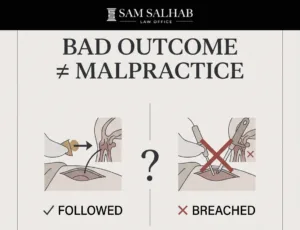
Was It Medical Malpractice or a Bad Medical Outcome?
A poor medical outcome does not automatically mean that malpractice occurred. Under California law, a medical negligence claim generally requires evidence of a doctor-patient relationship or other applicable duty, a professional standard of care, a departure from that standard, and a causal connection between the provider’s conduct and the patient’s injury and resulting losses. The California Judicial Council Civil Jury Instructions identify these as the essential elements of a medical negligence claim, while state law defines professional negligence as a negligent act or omission by a healthcare provider that proximately causes injury or death.
That distinction matters because medicine involves recognized risks and complications. A treatment can produce a known complication even when the provider followed the appropriate standard of care, and that alone does not establish negligence. By contrast, failing to recognize symptoms that a reasonably careful provider should have caught, operating on the wrong surgical site, or administering the wrong medication may raise very different questions about whether the standard of care was breached.
When a Bad Result Isn’t Negligence, and When It Is
The same principle applies to medications. A known side effect following an appropriately prescribed and administered drug is not necessarily negligence, while dispensing the wrong medication entirely may support a separate professional-negligence claim depending on the circumstances. Ultimately, the question is not simply whether something went wrong, but whether the provider’s care fell below the applicable standard and whether that departure caused compensable harm.
California courts generally require expert evidence addressing the standard of care, the provider’s conduct, and whether that conduct caused the injury before a malpractice claim can proceed. The statute governing how long a patient has to bring this kind of claim is California Code of Civil Procedure Section 340.5, which sets the filing deadlines discussed later in this article.
What California’s MICRA Cap Means for Your Case
California limits noneconomic damages, the compensation for pain and suffering, in medical malpractice cases under the Medical Injury Compensation Reform Act, codified at Civil Code Section 3333.2. The law entitles an injured plaintiff to recover noneconomic losses for pain, suffering, inconvenience, physical impairment, disfigurement, and other nonpecuniary damage, subject to statutory limitations. For decades that cap sat at a flat $250,000, but 2022 reforms replaced it with a tiered structure that rises annually through 2033.
This matters because the cap applies only to noneconomic damages, not to the full claim. Economic damages, including past and future medical bills and lost income, are not capped and often make up the larger share of a serious malpractice recovery. An attorney familiar with how the current tiers apply to healthcare providers versus healthcare institutions can help identify every category of defendant a claim may reach.
What a Fresno Medical Malpractice Claim Can Recover
Settlement values depend heavily on the severity of the harm, the strength of the causation evidence, and whether the injury caused permanent disability. The ranges below reflect general outcomes for malpractice claims and are not a prediction for any specific case.
| Injury Severity | Typical Settlement Range |
| Minor (temporary complication, full recovery) | $10,000 – $50,000 |
| Moderate (extended treatment, partial lasting impact) | $50,000 – $250,000 |
| Severe (permanent impairment, major economic loss) | $250,000 – $1,000,000+ |
| Catastrophic or wrongful death | $1,000,000 – multiple millions |
Because economic damages such as future care costs and lost earning capacity aren’t subject to MICRA’s cap, cases involving long-term disability or death often settle far above the noneconomic damages ceiling once medical experts document the full scope of future needs.
Why Fresno Patients Choose the Law Office of Sam Salhab
Sam Salhab’s approach centers on treating clients as people navigating a difficult moment, not case numbers to process quickly, an ethos reflected across the firm’s practice areas. That philosophy shapes how the firm handles malpractice intake, starting with a free, confidential review of medical records before any commitment is required from the client.
The firm coordinates directly with medical experts to establish the standard of care and where a provider departed from it, a step that is often the deciding factor in whether an insurer takes a claim seriously. Flexible payment structures and a contingency fee model mean clients aren’t asked to pay out of pocket while they’re already managing new medical expenses from the original injury.
Getting Started With a Malpractice Claim
Medical records can be difficult to obtain quickly, and providers sometimes delay releasing them once litigation becomes a possibility. It’s worth requesting your complete chart, including nursing notes and imaging, as early as possible, since these documents form the backbone of any expert review. Teams handling malpractice cases often benefit from involving an attorney before signing any settlement offer from a hospital’s risk management department.
Fresno-area clients can request a free consultation to have their case reviewed, including situations where the original provider dismissed ongoing symptoms or a hospital discharged a patient prematurely. There is no fee unless the case results in a recovery, keeping the financial risk off the client during an already stressful period.\
FAQs
How long do I have to file a medical malpractice claim in California?
California generally requires a medical malpractice lawsuit to be filed within three years of the injury or one year from when the injury was discovered, whichever comes first, under Code of Civil Procedure Section 340.5. Claims involving a minor or fraud can extend this timeline, so early legal review helps confirm the applicable deadline.
What is the MICRA cap and does it limit my entire recovery?
The MICRA cap only limits noneconomic damages like pain and suffering, currently set on a rising scale that reached $470,000 for injury cases and $650,000 for wrongful death cases in 2026. Economic damages such as medical bills and lost income are not subject to this cap and are often the larger portion of a serious claim.
Do I need an expert witness to prove medical malpractice?
Yes, California law generally requires expert testimony to establish the accepted standard of care and show how a provider deviated from it. An attorney typically works with a qualified physician in the relevant specialty to build this part of the case before filing.
Can I sue a hospital if an individual doctor made the mistake?
In some cases, yes, particularly if the doctor was a hospital employee or the hospital’s own policies contributed to the error, such as inadequate staffing or a failure to verify credentials. A separate noneconomic damages cap can apply to the hospital as a healthcare institution, distinct from the cap that applies to the treating physician.
What if I already signed a consent form before the procedure?
A signed consent form does not protect a provider from liability if the malpractice involved something outside the risks that were disclosed, such as a surgical error or negligent technique. Consent covers known risks of a properly performed procedure, not negligence during that procedure.
How much does it cost to hire a malpractice attorney in Fresno?
Consultations are free, and the firm works on a contingency fee basis, meaning there is no attorney fee unless the case results in a settlement or verdict. This structure allows clients to pursue a claim without upfront legal costs while they’re already facing new medical expenses.
What evidence should I gather before contacting an attorney?
Complete medical records, billing statements, a written timeline of symptoms and appointments, and the names of every provider involved are the most useful starting points. Photos of any visible injury and a list of witnesses, such as family members present during hospital visits, can also strengthen the case.
If a medical provider’s mistake has changed the course of your recovery, a conversation about your options costs nothing and can help preserve records before they become harder to obtain.