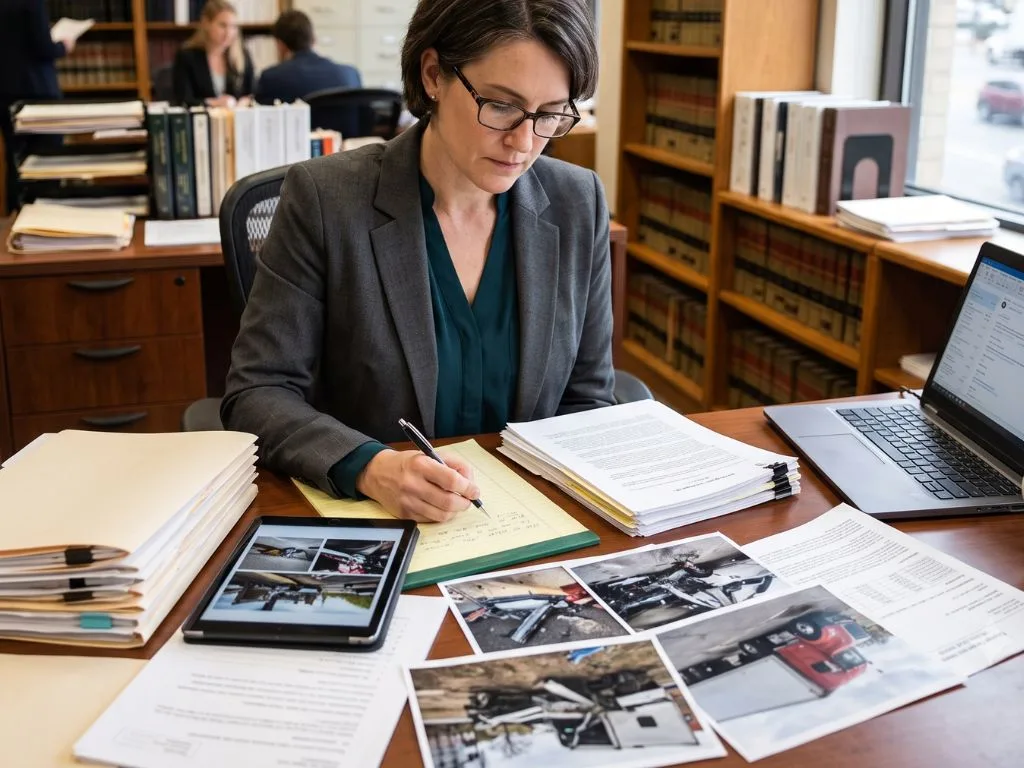
A collision with a commercial truck is not like any other car accident. The vehicles are heavier, the injuries are more severe, and the legal claims involve a web of federal regulations, multiple insurers, and corporate defendants with experienced legal teams already working against you.
The Law Office of Sam Salhab represents truck accident victims throughout Fresno and the Central Valley, handling the full complexity of commercial claims from investigation through resolution. Attorney Sam Salhab brings over 25 jury trials of experience, Super Lawyers Rising Star recognition (2014–2016), and Top 40 Under 40 honors from The National Trial Lawyers — credentials that matter when you’re up against a carrier’s legal team.
The Scale of the Truck Accident Problem in California
Commercial truck crashes cause disproportionate harm relative to their numbers on the road. According to FMCSA’s Large Truck and Bus Crash Facts report, fatal crashes involving large trucks increased 26.4% between 2016 and 2022 — a trend federal regulators have flagged as a national safety crisis. In 2022 alone, 5,969 people were killed in crashes involving large trucks nationwide.
The National Safety Council reports that California recorded nearly 392 deaths from large-truck crashes in a recent year — consistently placing the state among the highest in the nation for commercial vehicle fatalities. Fresno sits directly on Highway 99 and Interstate 5, two of California’s busiest freight corridors, making the Central Valley one of the state’s highest-exposure regions for truck crash risk.
Why Truck Crashes Cause Such Severe Injuries
NHTSA’s large truck crash data shows that 80% of large trucks involved in fatal crashes are in multi-vehicle collisions — and in those crashes, it is overwhelmingly the occupants of smaller passenger vehicles who sustain the most severe injuries.
A fully loaded semi-truck can weigh up to 80,000 pounds. At highway speeds, the force transferred to a passenger car in a collision is catastrophic. Common injuries include traumatic brain injury, spinal cord damage, internal organ trauma, crush injuries, and multiple fractures — injuries that require extensive hospitalization, surgery, and long-term rehabilitation.
Central Valley Freight Corridors and Local Risk
UC Irvine transportation research has found that large trucks represent approximately 2.5% of California vehicles but account for roughly 9% of fatal crashes statewide. Fresno’s position as an agricultural and logistics hub means heavy commercial traffic flows through the region year-round. High-speed arterials, highway on-ramps, and rural routes throughout the Central Valley are among the most common sites for serious truck collisions.
Who Can Be Liable in a Truck Accident?
This is where commercial truck claims fundamentally differ from standard car accident cases. Multiple parties may share legal responsibility for a single crash, each with their own insurance policy and legal representation.
Potentially liable parties include the truck driver, the trucking company that employed or contracted them, the cargo loading company if improper loading caused a shift or spill, the truck manufacturer if a mechanical defect contributed to the crash, and maintenance contractors if a known mechanical issue went unaddressed. Freight brokers and leasing companies may also carry exposure depending on the contractual structure of the operation.
Trucking Company Liability
Under federal law, trucking companies bear significant responsibility for the conduct of their drivers. When a driver is a direct employee, the company is liable under standard respondeat superior principles. When a driver is classified as an independent contractor, liability depends on the degree of control the carrier exercised — a question courts examine closely in trucking cases.
Trucking companies also have independent duties: to conduct proper driver background checks, enforce hours-of-service rules, maintain vehicles to federal safety standards, and ensure cargo is loaded correctly. Failures in any of these areas can establish direct negligence against the carrier — separate from and in addition to driver fault.
Federal Regulations That Govern Commercial Trucking
Unlike standard auto accident claims, truck accident litigation requires working knowledge of FMCSA safety regulations that govern the entire commercial trucking industry. These rules exist because the consequences of non-compliance are deadly.
Hours-of-service (HOS) regulations cap how many consecutive hours a truck driver can operate before mandatory rest. Electronic Logging Devices (ELDs) are federally required to record driving time — and ELD data is among the first evidence an attorney should secure after a crash. Drug and alcohol testing requirements apply to all commercial drivers. Maintenance and inspection logs must be kept current and are discoverable in litigation.
Evidence That Disappears Quickly
Trucking companies are not required to preserve black box (ECM) data, dashcam footage, or maintenance records indefinitely. Without a legal hold notice, critical evidence can be overwritten or destroyed within days. This is one of the most important reasons to contact an attorney immediately after a truck accident — before the carrier’s legal team controls the evidence.
Caltrans collision data and California OTS crash records can further establish crash history on specific roadway segments, strengthening claims that involve dangerous routes or locations with prior incidents.
What Compensation Can Truck Accident Victims Recover?
Commercial trucking cases often involve higher compensation potential than standard auto claims, both because injuries are more severe and because commercial insurance policies carry higher limits than personal auto policies.
Economic damages include all past and future medical expenses, lost wages and reduced earning capacity, rehabilitation costs, in-home care needs, and property damage. Non-economic damages cover pain and suffering, emotional distress, loss of enjoyment of life, and loss of consortium for affected family members. In cases involving egregious violations — such as a carrier knowingly allowing a fatigued driver to operate — punitive damages may also be available.
What to Do After a Truck Accident in Fresno
Call 911 and request emergency services. Seek immediate medical treatment — even injuries that feel minor at first can reflect internal trauma that worsens without intervention. If you are physically able, photograph the truck, its markings, license plates, cargo, and the crash scene. Do not speak with the trucking company’s insurance adjuster without legal counsel.
The statute of limitations for truck accident personal injury claims in California is two years from the date of the crash. If a government entity bears any responsibility — such as a poorly maintained state highway — a government tort claim must be filed within six months. Retaining an attorney early protects both deadlines and preserves critical evidence before it is lost.
How Salhab Law Handles Commercial Truck Claims
Truck accident cases require a different investigative approach than standard personal injury claims. At the Law Office of Sam Salhab, commercial truck cases are handled with the depth they demand: issuing immediate evidence preservation letters to carriers, obtaining ELD and black box data, securing driver qualification files, reviewing maintenance records, and working with accident reconstruction experts when the facts require it.
Sam Salhab has spent his career representing Central Valley clients against well-resourced defendants — and his trial record reflects what happens when cases are prepared for court rather than for settlement convenience. The firm handles truck accident cases on contingency, meaning there is no fee unless compensation is recovered. Reach out today for a free consultation.
Frequently Asked Questions
Why do I need a truck accident attorney instead of handling the claim myself?
Trucking companies typically deploy their own investigators and legal teams within hours of a serious crash. Without an attorney issuing evidence preservation notices immediately, critical records — ELD logs, dashcam footage, black box data — can be lost. An experienced attorney levels the playing field from day one and ensures the full value of your claim is pursued, not just the amount the carrier’s insurer initially offers.
Can a truck driver be personally liable even if they work for a large carrier?
Yes. Truck drivers can be named as individual defendants alongside their employer. This matters especially in cases where the driver was operating under the influence, falsified logbooks, or acted with reckless disregard for safety. Pursuing both the driver and the company maximizes available insurance coverage and potential recovery.
What federal rules govern how long truck drivers can drive without rest?
Under FMCSA hours-of-service regulations, most commercial truck drivers are limited to 11 hours of driving within a 14-hour on-duty window, followed by a mandatory 10-hour off-duty period. Drivers are also subject to a 60- or 70-hour weekly limit. Violations of these rules are among the most common factors in serious truck crashes and are directly relevant to negligence claims.
What if the trucking company claims the driver was an independent contractor to avoid liability?
This is a common defense tactic. California courts look beyond the contractor label to assess the actual degree of control the carrier exercised over the driver’s work. If the carrier set routes, required specific equipment, enforced schedules, or had authority over the driver’s conduct, courts may still find the carrier liable regardless of how the employment relationship was classified.
How long do I have to file a truck accident claim in California?
The standard statute of limitations for personal injury claims in California is two years from the date of the accident. If a government agency bears any responsibility — for example, due to a dangerous highway condition — a government tort claim must be filed within six months. Because evidence in truck cases deteriorates quickly, contacting an attorney as soon as possible after the crash is strongly advised.
What is the difference between a jackknife accident and an underride crash?
A jackknife occurs when the trailer swings out at an angle from the cab — often due to sudden braking or slick roads — and can sweep multiple lanes of traffic. An underride crash happens when a smaller vehicle slides beneath the rear or side of a trailer, often resulting in catastrophic injuries or death. Both crash types frequently involve equipment failures or driver error and are subject to specific federal safety standards that, when violated, establish negligence.
Can family members file a claim if a loved one was killed in a truck accident?
Yes. Under California Code of Civil Procedure § 377.60, eligible family members — including spouses, domestic partners, children, and in some cases parents — may bring a wrongful death claim to recover damages including loss of financial support, loss of companionship, funeral and burial costs, and the deceased’s pre-death pain and suffering. These claims have the same two-year statute of limitations as personal injury claims.