
Fresno sits directly on Highway 99, one of the primary corridors for drug supply chains moving through California’s Central Valley, and that geography shapes almost every drug trafficking case filed in this district. A traffic stop that turns up more than a personal-use quantity of narcotics can escalate from a state misdemeanor to a federal conspiracy charge carrying a mandatory decade in prison. The Law Office of Sam Salhab defends clients across the Fresno area against drug trafficking charges at both the state and federal level, built on the understanding that the quantity found in a vehicle rarely tells the full story of who was actually involved and why.
Drug trafficking cases often turn on constructive possession, chain of custody, and whether the government can actually prove intent to distribute rather than personal use. Anyone facing these charges benefits from securing representation immediately, since evidence handling and search procedures are frequently where a defense is won or lost.
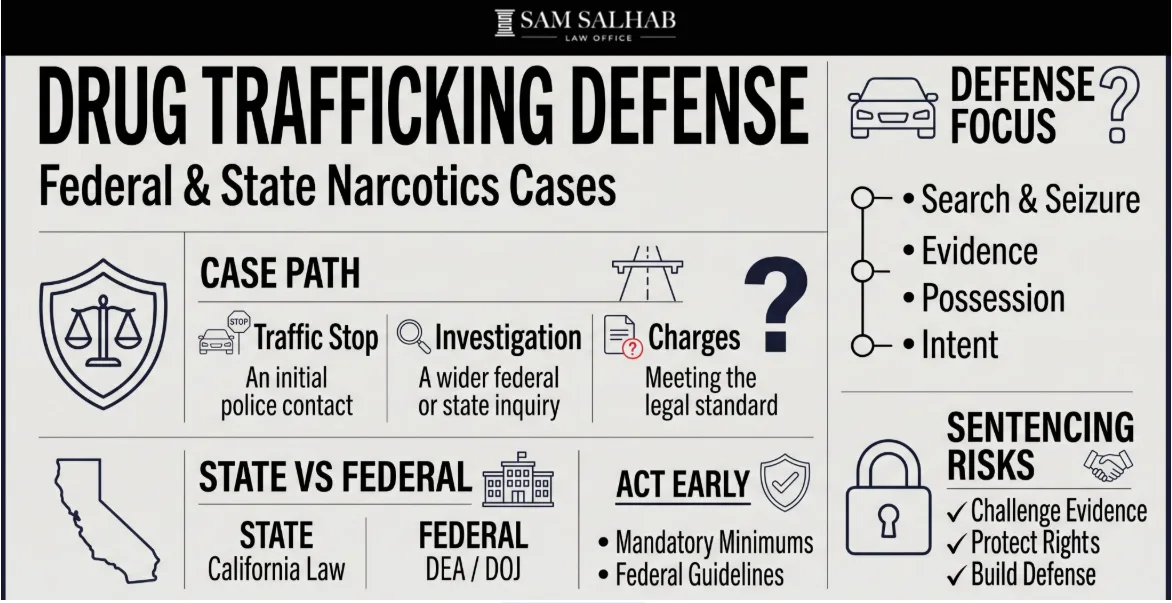
State vs. Federal Drug Trafficking Charges
California prosecutes drug trafficking primarily under the Health and Safety Code. Health and Safety Code 11351 criminalizes possession of most controlled substances for sale, while Health and Safety Code 11352 covers the actual transportation or sale of those substances. Methamphetamine is addressed separately under Health and Safety Code 11378 for possession for sale and Health and Safety Code 11379 for transportation.
Federal charges apply once trafficking crosses state lines, involves quantities the government treats as evidence of a distribution network, or connects to an organized supply chain. 21 U.S.C. § 841 criminalizes the manufacture, distribution, or possession with intent to distribute a controlled substance, while 21 U.S.C. § 846 allows prosecutors to charge conspiracy even when a defendant never personally possessed the drugs, based solely on an agreement to participate in the trafficking scheme.
What Happens After a Drug Trafficking Arrest?
A drug trafficking arrest marks the beginning of a legal process that can unfold over months or even years, particularly when federal agencies become involved, and understanding the typical sequence of events helps explain where critical defense opportunities arise.
- Investigation or Traffic Stop — many trafficking cases begin with a traffic stop, search warrant, or ongoing investigation; law enforcement may seize suspected narcotics, cash, cell phones, or other evidence, and whether officers had lawful grounds for the stop or search can become central to the defense. The Drug Enforcement Administration coordinates many of these investigations jointly with federal, state, and local agencies
- Arrest and Booking — evidence is logged, reports are prepared, and prosecutors begin evaluating potential charges; statements made during booking or questioning may later be introduced in court, making constitutional protections particularly important
- Charging Decision — prosecutors determine whether the case proceeds in California state court or is adopted for federal prosecution, based on factors such as drug type, quantity, alleged conspiracy, and interstate activity
- Discovery and Pretrial Motions — both sides exchange evidence, including laboratory reports, body-camera footage, search warrants, and witness statements, and the defense may challenge unlawful searches, chain of custody, or probable cause
- Plea Negotiations or Trial — many trafficking cases resolve through negotiated plea agreements, while others proceed to trial where prosecutors must prove knowledge, possession, and intent to distribute beyond a reasonable doubt
- Sentencing — if a conviction occurs, the court imposes sentence under California law or, in federal court, the U.S. Sentencing Commission’s sentencing guidelines and any applicable statutory mandatory minimums; reviewing the presentence report and advocating for available guideline reductions can significantly affect the final sentence
Because the charging decision determines which of these tracks a case follows, and because federal mandatory minimums generally cannot be revisited once charges are filed, the investigation and charging stages are typically where a defense has the most room to change the eventual outcome.
Why Fresno Is a Federal Enforcement Priority
Fresno County’s position on Highway 99 places it at the center of an active federal drug enforcement corridor. The Eastern District’s U.S. Attorney’s Office has prosecuted a steady stream of cases stemming from traffic stops along this route, including a 2025 indictment where a Bakersfield man was pulled over on State Road 99 in Fresno County and found with approximately 22 pounds of methamphetamine individually packaged in one-pound bags. A separate case involved two men who led DEA agents on a high-speed pursuit along State Routes 99 and 180 after officers recovered approximately 5 kilograms of fentanyl thrown from their vehicle during the chase.
These cases illustrate the sentencing exposure that comes with federal fentanyl charges specifically. Prosecutors in that pursuit case announced that the defendants, if convicted of conspiracy to distribute fentanyl, face a minimum statutory penalty of 10 years in prison, a maximum of life in prison, and a $10 million fine. That mandatory minimum applies regardless of a defendant’s role in the broader conspiracy, which is part of why the specific quantity and substance charged matters as much as the underlying conduct.
Mandatory Minimums and Sentencing Enhancements
Federal drug trafficking sentences are frequently governed by mandatory minimums tied to the type and weight of the substance involved, which removes much of a judge’s usual discretion. A charge involving certain fentanyl or methamphetamine quantities under 21 U.S.C. § 841 can trigger a 10-year mandatory minimum before any sentencing guideline calculation even begins, and that floor generally cannot be reduced without a specific statutory exception such as the safety valve or substantial cooperation.
Additional enhancements can increase exposure further. 21 U.S.C. § 860 doubles penalties for distribution within 1,000 feet of a school, and prior drug convictions can trigger enhanced mandatory minimums under federal recidivist statutes. State law includes similar enhancements, with Health and Safety Code 11370.4 adding consecutive prison time based on the weight of certain substances involved.
The National Fentanyl Crisis and Local Impact
Fentanyl remains the central driver of federal drug enforcement priorities nationally. The DEA’s most recent National Drug Threat Assessment identifies the Sinaloa Cartel and Jalisco New Generation Cartel as the primary organizations behind the synthetic drug supply reaching U.S. communities, and federal data compiled for Congress shows that synthetic opioids, primarily fentanyl-related substances, resulted in 48,422 overdose deaths in 2024, down from more than 76,282 in 2023.
That decline has not reduced enforcement pressure locally. The Eastern District has run a dedicated Fentanyl Overdose Resolution Team investigating distribution networks in the Fresno area, and cases originating from this team have resulted in sentences exceeding a decade for defendants convicted of conspiring to distribute fentanyl and methamphetamine together. That enforcement posture means even mid-level distribution allegations in Fresno frequently draw the same investigative resources typically associated with larger metropolitan drug task forces.
Building a Defense Strategy
An effective trafficking defense starts with a detailed review of the stop, search, or investigation that led to the charge, since procedural errors at this stage frequently provide the strongest grounds for a motion to suppress. Whether a traffic stop had a valid legal basis, whether a search warrant was properly supported, and whether informants were reliable are all questions that can unravel a prosecution’s case before trial.
A defense built around the Fresno criminal defense practice at the Law Office of Sam Salhab evaluates both the state and federal exposure a client faces, since the same conduct can sometimes be charged in either venue, and the choice of venue significantly affects sentencing outcomes.
Why Early Representation Matters in Drug Trafficking Cases
The earliest stage of a drug trafficking investigation, often before formal charges are filed, is frequently the best opportunity to influence whether a case proceeds at the state or federal level. Once federal prosecutors take a case, mandatory minimums generally lock in sentencing exposure that a judge cannot reduce regardless of mitigating circumstances.
Clients considering their options in this position often benefit from a consultation before making any statement to investigators. The Law Office of Sam Salhab offers free consultations, including jail interviews and 24/7 emergency availability, because the earliest response to a drug trafficking investigation frequently determines the entire trajectory of the case.
Moving Forward with a Fresno Drug Trafficking Defense Team
A drug trafficking charge carries some of the most severe sentencing exposure in the criminal justice system, particularly once mandatory minimums attach at the federal level. A defense grounded in how the evidence was actually gathered, not the quantity alone, is what separates a negotiated resolution from a decade-long mandatory sentence.
For anyone facing a drug trafficking investigation or charge in Fresno, reaching out through the firm’s contact page is a reasonable first step toward understanding what the case actually involves before the next filing deadline arrives.
FAQ
What is the difference between state and federal drug trafficking charges?
State drug trafficking charges are prosecuted under the California Health and Safety Code, while federal charges apply when trafficking involves interstate activity, larger distribution networks, or connections to organized supply chains. Federal charges generally carry mandatory minimum sentences that state charges do not.
What triggers a federal mandatory minimum sentence for drug trafficking?
Federal mandatory minimums under 21 U.S.C. § 841 are typically triggered by the type and weight of the controlled substance involved, with certain fentanyl and methamphetamine quantities carrying a 10-year mandatory minimum. These minimums generally cannot be reduced by a judge without a specific statutory exception.
How does a drug trafficking investigation typically unfold?
Most trafficking cases begin with a traffic stop, search warrant, or ongoing investigation in which law enforcement seizes suspected narcotics, cash, or electronic devices before deciding whether to pursue state or federal charges. This process, including discovery and pretrial motions, can unfold over months, which gives a defense meaningful time to challenge how the evidence was obtained.
Can I be charged with conspiracy if I never possessed the drugs?
Yes, federal conspiracy charges under 21 U.S.C. § 846 only require proof of an agreement to participate in a trafficking scheme, not that the defendant personally possessed or handled the drugs. This is a common charging strategy for prosecutors targeting broader distribution networks.
How does Fresno’s location affect drug trafficking enforcement?
Fresno’s position along Highway 99 places it within an active drug trafficking corridor connecting Southern California to markets further north, which has made it a priority enforcement area for both DEA and local task forces. Traffic stops along this corridor are a common origin point for both state and federal trafficking cases in the area.
Can evidence from a traffic stop be challenged in a drug trafficking case?
Yes, evidence obtained during a traffic stop can be challenged if the stop lacked a valid legal basis or if the subsequent search exceeded what the circumstances justified. A successful motion to suppress can eliminate the core evidence in a trafficking case before trial.
Does a prior drug conviction increase sentencing exposure?
Yes, prior drug trafficking convictions can trigger enhanced mandatory minimums under both federal recidivist statutes and California’s Health and Safety Code enhancements. A defendant’s criminal history is often as significant to sentencing exposure as the facts of the current case.