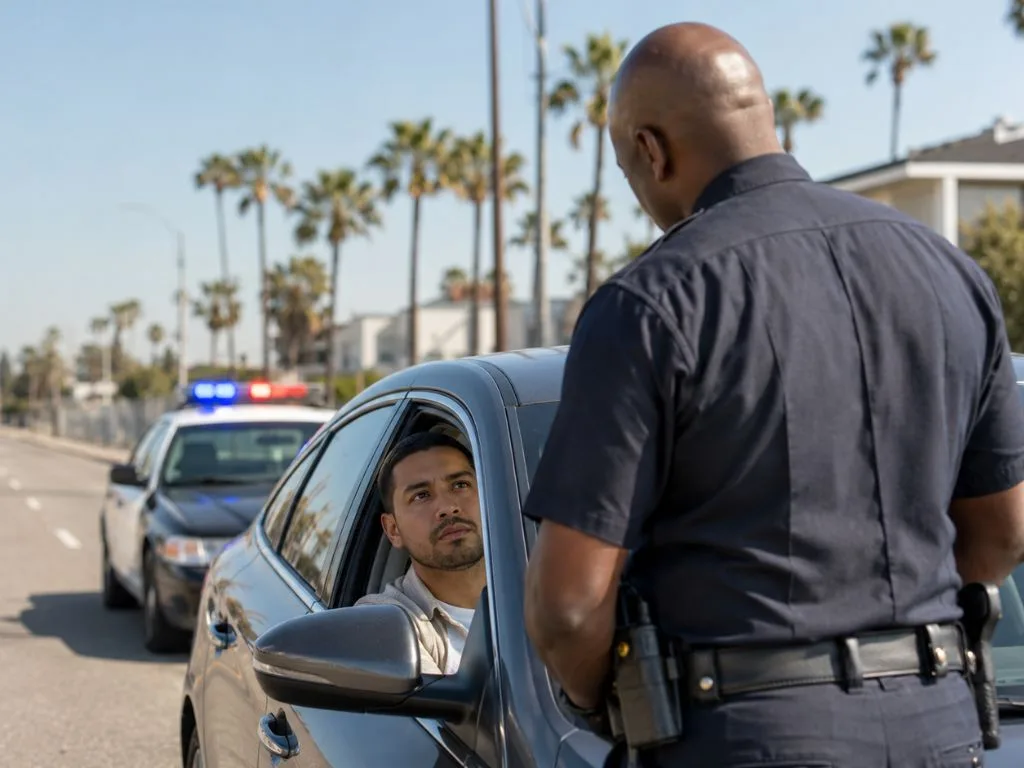
Racial profiling by police occurs when law enforcement uses a person’s race, ethnicity, national origin, or other protected characteristic as a basis for stops, searches, or enforcement decisions rather than specific evidence of criminal activity. In California, it is not only unconstitutional under the federal Constitution — it is explicitly prohibited by state statute, tracked through a statewide data system, and actionable through civil rights litigation.
The Law Office of Sam Salhab represents clients across California whose encounters with law enforcement have raised serious civil rights concerns. If you believe you were stopped or targeted because of your race or identity, this article explains what the law requires, what the data shows, and what legal remedies are available.
California’s Legal Definition of Racial Profiling
California’s definition of prohibited profiling goes beyond race. Under the Racial and Identity Profiling Act (RIPA), enacted through AB 953 in 2015 and codified in California Penal Code § 13519.4, racial and identity profiling means relying on actual or perceived race, color, ethnicity, national origin, age, religion, gender identity, sexual orientation, disability, or immigration status when initiating a stop, search, or other enforcement action rather than on specific, objective facts suggesting criminal activity. Federal guidance generally addresses only race and national origin — California’s statute is substantially broader.
Constitutional Rights Violated by Racial Profiling
A racially motivated police encounter can violate multiple constitutional protections simultaneously.
Fourth Amendment
The Fourth Amendment prohibits unreasonable searches and seizures. A stop driven by race rather than individualized, articulable suspicion of criminal activity fails the constitutional standard regardless of any post-hoc justification the officer provides.
Fourteenth Amendment
The Equal Protection Clause of the Fourteenth Amendment prohibits government officials from treating individuals differently based on race without sufficient justification. A stop, search, or arrest motivated by race is textbook discriminatory government conduct and forms the basis for an equal protection claim.
First Amendment
Where an officer retaliates against someone for engaging in constitutionally protected speech or recording police activity, a First Amendment retaliation claim may arise alongside the profiling claim. These often appear together in cases involving protests, journalism, or political activity.
What California’s Stop Data Shows
California’s RIPA program produces the most comprehensive police-stop dataset in the United States. The 2026 RIPA Board Report, analyzing 5,065,428 stops by 533 law enforcement agencies in 2024, found that individuals perceived as Black were stopped 127.87% more often than their share of California’s residential population would predict. Individuals perceived as Pacific Islander were stopped 57.53% more often than expected. These disparities are roughly equivalent to those found in the 2025 report, indicating the pattern has not narrowed.
The report also found a very low rate of sustained complaints for racial and identity profiling relative to the volume of stops, highlighting the gap between documented disparity and formal accountability through internal complaint processes.
What the Data Means in Litigation
RIPA stop data is agency-specific and publicly available through the California DOJ’s RIPA Board reports. In civil rights litigation, an agency’s own stop statistics showing persistent racial disparities across multiple officers and years are admissible evidence. They support both individual claims and broader Monell municipal liability challenges targeting the department’s policies or failure to address discriminatory enforcement patterns.
Not Every Unlawful Stop Is Racial Profiling
This distinction matters for evaluating the strength of a potential claim. A stop can violate the Fourth Amendment by lacking reasonable suspicion, without that stop necessarily constituting racial profiling. Fourth Amendment claims and racial profiling claims address different legal questions.
A successful racial profiling claim typically requires evidence that race, ethnicity, or another protected characteristic actually influenced the officer’s decision to act, rather than simply showing the stop lacked legal justification. The two often coincide in practice, but they require different evidence and proceed under different legal theories. An attorney experienced in civil rights litigation can assess which claims apply to a specific set of facts.
Examples of Conduct That May Constitute Racial Profiling
The following patterns are recognized by courts and civil rights agencies as potential racial profiling. Combined with statistical evidence, officer statements, and prior complaints, they form the factual basis courts look for in civil rights claims.
| Scenario | Legal Concern |
| Repeated stops in same area with no traffic violation or articulable suspicion | Lack of reasonable suspicion; possible racial motivation |
| Vehicle search initiated after questions about country of origin | Fourth Amendment violation; identity profiling under RIPA |
| Detention based on vague description amounting to race and approximate age | Insufficient individualized suspicion |
| Immigration questioning based solely on appearance or language | Identity profiling under RIPA; equal protection concern |
| Selective enforcement in minority-occupied areas while ignoring similar conduct elsewhere | Equal protection violation; discriminatory application of law |
These patterns alone may not always satisfy the full evidentiary burden of a racial profiling claim. Their strength increases substantially when paired with body camera footage, RIPA agency stop data, and sustained prior complaints against the same officer.
Can You Sue for Racial Profiling in California?
Yes. The primary federal vehicle is 42 U.S.C. § 1983, which allows individuals to sue state and local officials who deprive them of constitutional rights under color of law. Equal protection and Fourth Amendment violations both support § 1983 claims. Cities and counties can face liability under Monell v. Department of Social Services when racially discriminatory stops result from an official policy, a pervasive custom, or a failure to train and supervise officers.
California’s Bane Act (Civil Code § 52.1) provides a parallel state law claim covering interference with constitutional or statutory rights through threats, intimidation, or coercion. Unlike § 1983, Bane Act claims carry no qualified immunity defense, making it a critical additional tool in California racial profiling cases. Both claims are typically filed together.
Evidence That Supports a Racial Profiling Claim
Strong racial profiling claims rest on layered documentation. Body camera footage is the most direct evidence, particularly when it captures the officer’s stated reason for the stop, the questions asked, and any comments about the person’s background or appearance. Dashcam recordings and bystander video provide corroboration.
The officer’s written report is equally important. The stated reason for the stop, the questions asked, and the outcome of the encounter all appear there and can be compared against body camera footage for inconsistencies.
Using Transparency Laws and Statistical Records
Under SB 1421 and SB 16, public records requests can produce prior complaints against the same officer and sustained findings of discriminatory conduct. RIPA stop data for the specific agency shows whether the officer’s department has documented patterns of racially disparate enforcement.
The California AG’s police complaints process provides a formal channel for reporting misconduct and creating an administrative record that can support subsequent litigation.
Consequences for Officers and Departments
Individual officers found to have engaged in racial profiling can face civil liability, administrative discipline, and in serious cases, loss of their law enforcement certification through California POST’s decertification process. POST’s definition of serious misconduct explicitly includes demonstrating bias based on race, national origin, religion, gender identity, sexual orientation, or disability in violation of law or department policy.
Departments with documented patterns of discriminatory enforcement face DOJ Civil Rights Division pattern-or-practice investigations, consent decrees, mandatory training requirements, and ongoing federal oversight.
Talk to a Civil Rights Attorney
Racial profiling claims require careful analysis of the specific facts, the available evidence, and the applicable legal theories. The window to preserve body camera footage and file a Government Claims Act notice is short.
The Law Office of Sam Salhab offers free, confidential consultations with 24/7 availability. Document everything you remember about the encounter and contact the firm before any evidence disappears or deadlines expire.
Frequently Asked Questions
Is racial profiling illegal in California?
Yes. California Penal Code § 13519.4 and RIPA explicitly prohibit racial and identity profiling by all California peace officers. Racially motivated stops also violate the Fourth Amendment and the Equal Protection Clause. California’s prohibition is broader than federal law, covering race, ethnicity, national origin, religion, gender identity, sexual orientation, disability, and immigration status.
Can police stop someone based on race alone?
No. A lawful stop requires reasonable suspicion based on specific, articulable facts. Race alone does not satisfy that standard under federal or California law. Stops motivated primarily by race violate both the Fourth Amendment and RIPA regardless of any other justification the officer provides after the fact.
What evidence is most useful in proving racial profiling?
Body camera footage showing the officer’s conduct and stated reason for the stop, the written police report, dispatch recordings, and witness testimony form the core of most claims. RIPA stop data for the specific agency provides statistical context. Prior sustained complaints against the same officer for discriminatory conduct, obtainable under SB 1421 and SB 16, can establish a pattern that significantly strengthens the case.
Does racial profiling only apply to traffic stops?
No. The prohibition applies to any law enforcement context: pedestrian stops, searches, arrests, immigration-related questioning, use of force, and selective enforcement. Traffic stops are the most common setting because they generate the highest volume of RIPA data, but the legal prohibition and civil rights remedies apply equally to all enforcement actions by California peace officers.
How much is a racial profiling lawsuit worth in California?
Settlement values depend on the specific facts, evidence strength, severity of harm, and whether municipal liability applies. Cases involving physical injury, prolonged detention, or documented departmental patterns typically settle higher. Compensatory damages cover actual losses, including emotional distress. Punitive damages are available against individual officers who acted with malice, and attorney’s fees are recoverable under 42 U.S.C. § 1988 when a § 1983 plaintiff prevails.
What is the difference between racial profiling and a pretextual stop?
A pretextual stop uses a minor traffic violation as the stated reason while actually targeting a person based on race or identity. The stop may be technically lawful under the Fourth Amendment if a violation occurred, but it still constitutes racial profiling under RIPA if a protected characteristic influenced the officer’s decision. California’s prohibition covers pretextual stops motivated by identity characteristics, even when a technical basis exists.
How long do I have to file a racial profiling lawsuit in California?
The § 1983 statute of limitations in California is two years from the date of the incident. A Government Claims Act notice against a public entity must be filed within six months. Missing that deadline can permanently bar the lawsuit. Body camera footage can be deleted within weeks under standard retention schedules, so consulting a civil rights attorney promptly after the incident is essential.