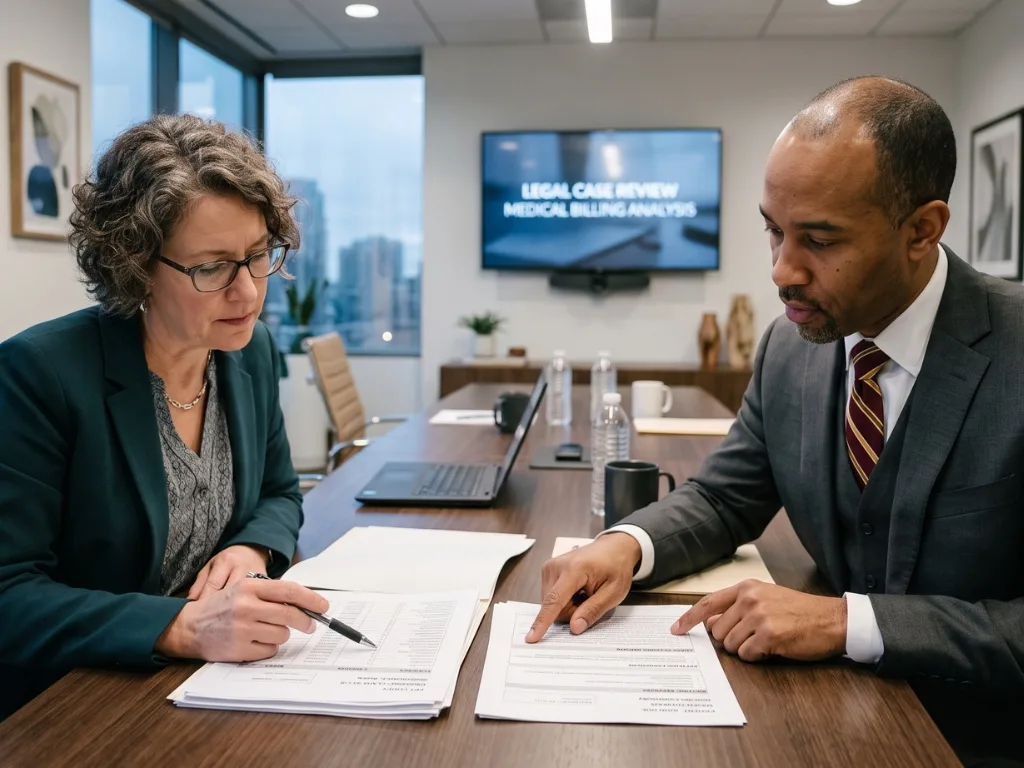
A billing audit letter from Medicare or a subpoena from HHS-OIG rarely announces the scale of what’s coming. What starts as a routine review of claims can escalate into a federal health care fraud indictment carrying years of prison exposure and permanent exclusion from Medicare and Medi-Cal. The Law Office of Sam Salhab defends physicians, clinic owners, and health care employees across the Fresno area who are facing exactly this kind of escalation, built on the belief that a provider under investigation deserves a defense grounded in the facts of their case, not a presumption of guilt.
Health care fraud cases move on the government’s timeline, often built over months of claims data analysis before a target ever knows an investigation exists. Anyone who has received an audit notice, a subpoena, or a visit from an OIG agent benefits from evaluating their options immediately, since the response to that first contact often shapes everything that follows.
What Counts as Health Care Fraud
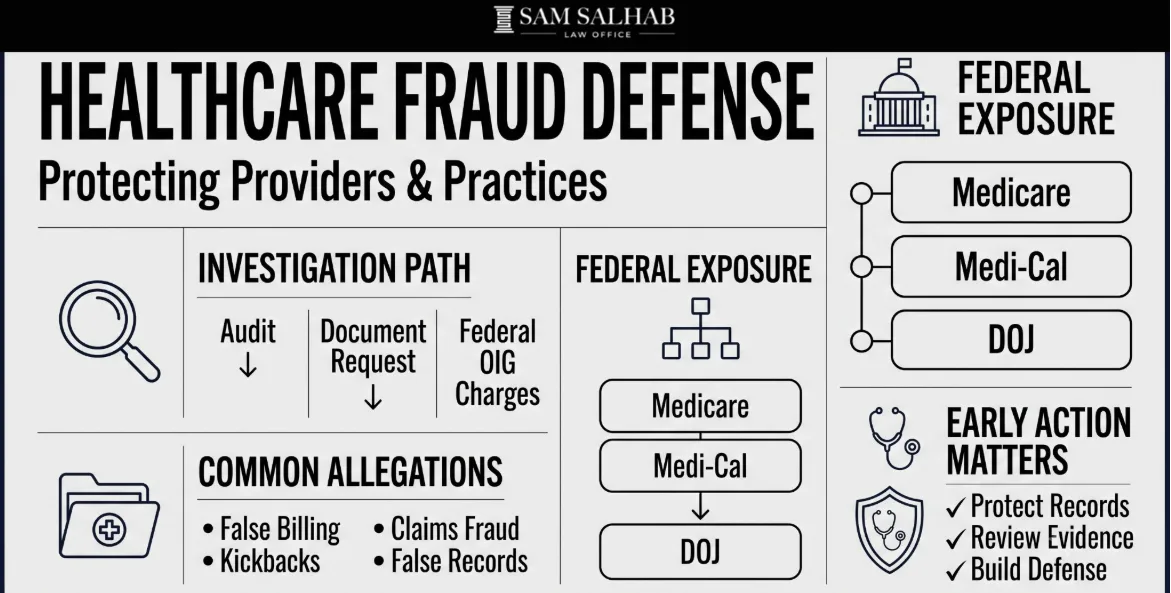
Health care fraud covers a range of conduct, from billing for services never rendered to paying kickbacks for patient referrals. California prosecutes fraud against the Medi-Cal program under Welfare and Institutions Code 14107, which the California Attorney General’s Division of Medi-Cal Fraud and Elder Abuse defines to include presenting a false claim for payment with intent to defraud, knowingly submitting false information to obtain greater compensation, and knowingly engaging in a scheme to defraud the Medi-Cal program. A related statute, Welfare and Institutions Code 14107.2, separately criminalizes soliciting or paying kickbacks for referrals.
At the federal level, most health care fraud cases are charged under 18 U.S.C. § 1347, which applies to schemes defrauding a health care benefit program, or under the civil False Claims Act, which allows the government to recover treble damages for false billing. Cases involving referral arrangements often also implicate the federal Anti-Kickback Statute and, for physician self-referrals, the Stark Law.
Federal Enforcement: The 2026 National Health Care Fraud Takedown
Health care fraud enforcement has intensified sharply in recent years. The Department of Justice’s most recent coordinated action, announced in June 2026, resulted in charges against 455 defendants, including 90 doctors and other licensed medical professionals, for alleged participation in health care fraud and opioid abuse schemes involving over $6.5 billion in false claims and significant patient harm. The action reached 56 federal districts across 45 states and territories, with all 50 state Medicaid Fraud Control Units participating, and represented the DOJ’s largest Medicaid-specific fraud enforcement action to date, with 295 defendants charged in connection with more than $518 million in false claims.
Civil enforcement has climbed alongside criminal prosecutions. The Department of Justice’s Civil Division reported that settlements and judgments under the False Claims Act exceeded $6.8 billion in the fiscal year ending September 30, 2025, the highest total in a single year in the statute’s history. That combination of aggressive criminal takedowns and record civil recoveries means a single billing dispute can now generate exposure on both fronts at once, which is part of why early legal involvement carries so much weight in these cases.
Federal Healthcare Fraud Investigation Timeline: What Happens Before Criminal Charges Are Filed
Most federal health care fraud cases do not begin with an arrest. They develop through a series of administrative reviews and investigative steps that can unfold over months or years, and understanding this timeline helps providers recognize when an audit has the potential to become a criminal investigation.
| Stage | What Happens | Provider’s Priority |
| Billing Audit | A Medicare contractor, Medicaid agency, or Medi-Cal program reviews claims to verify proper documentation, coding, and billing; many audits are routine and never become criminal cases | Preserve all billing records, medical charts, and electronic data, and seek legal advice before responding to significant findings |
| Document Request | Investigators or government contractors request patient records, billing files, compliance policies, or financial documents to evaluate potential overpayments or fraudulent billing | Ensure document productions are complete and accurate, but have counsel review requests before responding |
| OIG Subpoena or Civil Investigative Demand | The HHS Office of Inspector General or the DOJ’s Civil Division may issue subpoenas or Civil Investigative Demands seeking additional evidence | Coordinate all communications and document production through experienced legal counsel |
| Agent Interview | FBI or HHS-OIG agents may request a voluntary interview with providers or employees regarding billing practices, referrals, or patient care | Politely decline substantive interviews until your attorney is present and prepared to advise you |
| Indictment | Federal prosecutors in the Health Care Fraud Unit determine whether to seek a criminal indictment or pursue civil enforcement under statutes such as the False Claims Act | Begin a comprehensive defense strategy and prepare for court proceedings if charges are filed |
The Department of Justice and HHS Office of Inspector General coordinate healthcare fraud investigations across criminal investigators, auditors, and civil enforcement attorneys, and many cases begin with data analytics or document requests long before prosecutors decide whether criminal charges are appropriate. Responding carefully at each stage helps protect both a provider’s legal rights and professional career.
Health Care Fraud Cases in the Eastern District of California
Fresno providers are not insulated from this enforcement trend. The U.S. Attorney’s Office for the Eastern District of California has prosecuted a series of local health care fraud cases in recent years, including a Fresno County podiatrist and a pharmaceutical sales representative who pleaded guilty to a $3.2 million health care fraud conspiracy involving an unlicensed person performing skin grafts. In a separate case, the CEO of a Fresno-based home health care company was arrested at San Francisco International Airport and charged with fraudulently obtaining more than $7 million in payments from the Department of Veterans Affairs for services that were never rendered.
These cases illustrate a consistent pattern: health care fraud prosecutions in the Eastern District frequently involve licensed professionals and small business owners, not just large corporate entities. That pattern makes early legal guidance especially relevant for solo practitioners and small clinic operators who may not have in-house compliance resources to catch a billing dispute before it becomes a criminal referral.
Common Charges and Penalties
Health care fraud charges vary significantly in severity depending on the statute, the amount involved, and whether the case is prosecuted at the state or federal level.
- Medi-Cal fraud (WIC 14107) — a wobbler offense; felony exposure runs two to five years in state prison, with fines up to three times the fraudulent amount
- Medi-Cal kickbacks (WIC 14107.2) — felony exposure of 16 months to three years, with fines up to $10,000
- Insurance fraud (Penal Code 550) — covers fraudulent claims submitted to any insurer, not limited to government programs
- Federal health care fraud (18 U.S.C. § 1347) — up to 10 years in federal prison per count, or up to 20 years if the offense results in serious bodily injury
- Anti-Kickback Statute violations — felony exposure with fines and mandatory exclusion from federal health care programs
- False Claims Act liability — civil penalties including treble damages, pursued separately from or alongside criminal charges
A conviction under any of these statutes also risks separate administrative consequences, including license revocation and exclusion from Medicare and Medi-Cal billing, regardless of the criminal sentence imposed.
Building a Defense Against Health Care Fraud Allegations
Health care fraud cases are built on claims data, which means the strongest defenses are often built the same way. Distinguishing a billing error or a documentation gap from actual intent to defraud is frequently the difference between a compliance correction and a criminal conviction, and that distinction requires a granular review of coding practices, medical necessity documentation, and referral arrangements.
A defense grounded in the Fresno criminal defense practice at the Law Office of Sam Salhab starts by reconstructing what the billing records actually show, not what the government’s summary alleges. Many health care fraud cases turn on whether a provider’s documentation supports medical necessity, and building that record early, before formal charges are filed, often shapes whether a case proceeds to indictment at all.
Why Early Representation Matters for Providers
Providers facing an audit or subpoena often assume cooperation alone will resolve the matter, but voluntary interviews and unreviewed document productions can create the evidence a prosecutor needs to build a case. Responding to an OIG inquiry or a Medicare audit without counsel risks turning a fixable billing issue into a referral for criminal investigation.
Clients considering their options in this position often benefit from a consultation before producing any documents or answering investigator questions. The Law Office of Sam Salhab offers free consultations specifically because the earliest response to an inquiry frequently determines whether a case stays administrative or becomes criminal.
Moving Forward with a Fresno Health Care Fraud Defense Team
Health care fraud allegations carry professional consequences beyond the courtroom, threatening a medical license, a practice, and a career built over years. A defense grounded in the actual billing records and referral arrangements, not the volume of the government’s data analysis, is what separates a negotiated resolution from a conviction that ends a career.
For any provider facing an audit, subpoena, or health care fraud investigation in Fresno, reaching out through the firm’s contact page is a reasonable first step toward understanding what the case actually involves before the next document request arrives.
FAQs
What is considered health care fraud in California?
Health care fraud includes billing for services never rendered, submitting false information to obtain payment, and paying or receiving kickbacks for patient referrals. California prosecutes this conduct under Welfare and Institutions Code 14107 and 14107.2, while similar conduct against Medicare falls under federal statutes.
What is the difference between a Medi-Cal fraud charge and a federal health care fraud charge?
Medi-Cal fraud under Welfare and Institutions Code 14107 applies to California’s state Medicaid program and is prosecuted in state court, while federal health care fraud under 18 U.S.C. § 1347 applies to Medicare and other federally regulated health programs. Federal cases generally carry longer sentences and more extensive investigations.
How does a billing audit turn into a criminal investigation?
A routine billing audit can escalate when reviewers flag patterns suggesting intentional fraud rather than clerical error, prompting a document request and eventually a subpoena or Civil Investigative Demand from HHS-OIG or the DOJ. Each stage in that progression gives a provider a narrowing window to respond carefully before an agent interview or indictment follows.
Can a health care fraud charge be reduced or dismissed?
Yes, reductions and dismissals are possible when the evidence shows a billing error or documentation gap rather than intent to defraud. Many cases turn on whether the government can prove knowing and willful conduct as opposed to a coding mistake or a disputed medical necessity determination.
How large was the most recent national health care fraud enforcement action?
The Department of Justice’s 2026 National Health Care Fraud Takedown charged 455 defendants, including 90 doctors and licensed medical professionals, in connection with more than $6.5 billion in alleged false claims. It was described as the largest coordinated health care fraud enforcement action in the department’s history.
Does a health care fraud conviction affect a medical license?
Yes, a conviction typically triggers separate administrative consequences, including exclusion from Medicare and Medi-Cal billing and potential license revocation by the relevant state board. These consequences apply independently of any criminal sentence.
Should I speak with investigators before contacting an attorney?
No, providers should consult a health care fraud attorney before responding to any subpoena, audit request, or investigator interview. Statements made during a voluntary interview or documents produced without legal review are often used to build the case against the provider who cooperated.