A wire fraud allegation in Fresno rarely stays a state matter for long. Bank involvement, interstate transfers, or a mailed document can shift a case into federal court, where sentencing guidelines are less forgiving and investigations often span years before an indictment ever surfaces. The Law Office of Sam Salhab built its criminal defense practice on the principle that clients are people first, not case files, and that philosophy matters most in white collar matters, where the paper trail can feel more damning than it actually is.
White collar allegations move on two tracks at once: the government’s timeline and the client’s life. Anyone who has received a target letter, a grand jury subpoena, or a search warrant for financial records benefits from evaluating their options early, before charges are formally filed. It’s worth exploring a consultation while the investigation is still open rather than waiting for an indictment to force the issue.
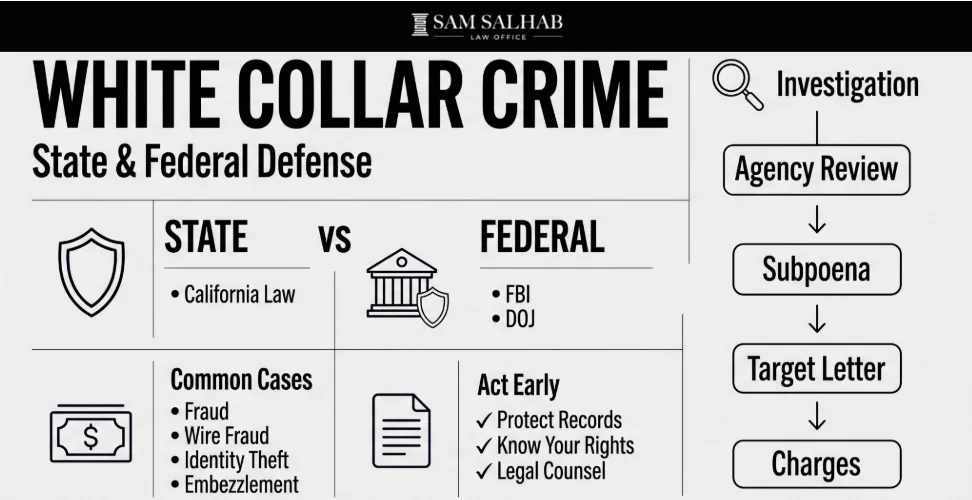
What Counts as White Collar Crime in Fresno
White collar offenses are financially motivated crimes committed without physical force, typically involving deception, breach of trust, or concealment. At the state level, California prosecutes these under statutes including Penal Code 503 (embezzlement), Penal Code 530.5 (identity theft), and Penal Code 470 (forgery). A related federal analysis, drawing on Department of Justice case records, groups these offenses together as corporate and consumer frauds, bankruptcy fraud, federal program fraud, financial institution fraud, health care fraud, tax fraud, identity theft, securities fraud, and antitrust violations.
The scale of the problem is larger than most people assume. Fraud examiners estimate that fraud costs U.S. businesses roughly 5% of annual gross revenue on average, and separate research places the annual cost of white collar crime to the American economy at $426 billion to $1.7 trillion. That figure dwarfs the losses from traditional property crime, which is part of why federal investigators increasingly treat financial cases as a priority target.
State vs. Federal Charges: Why Venue Changes Everything
Fresno sits inside the Eastern District of California, one of the largest federal judicial districts in the country. The district covers more than eight million residents across 87,000 square miles, spanning six urban areas including Sacramento, Fresno, Bakersfield, Stockton, Vallejo, and Fairfield. A dedicated White Collar Crime Unit operates out of the Sacramento office and works alongside the FBI, IRS, and Secret Service on complex financial cases.
The venue decision changes almost everything about a defense strategy. Federal cases carry sentencing guidelines tied to loss amounts and number of victims, and federal prosecutors generally have more resources and longer investigative timelines than their county counterparts. State charges under the Penal Code allow for more flexibility in plea negotiation and, in some cases, diversion programs that federal court does not offer.
Federal Investigation Timeline: What Happens Before Charges Are Filed
Many people assume a federal case begins with an arrest, but investigations often unfold over months or years before prosecutors decide whether to file charges. Recognizing each stage helps clarify when legal representation carries the most weight.
| Stage | What Happens | What You Should Do |
| Agency investigation | The FBI, IRS Criminal Investigation, or U.S. Secret Service gather financial records, interview witnesses, and analyze banking activity, often without notifying the target | Preserve documents, avoid deleting records, and don’t contact potential witnesses |
| Grand jury subpoenas | Prosecutors compel banks, employers, or accountants to produce documents or testify | Consult counsel before responding to any subpoena |
| Search warrant or target letter | Signals prosecutors believe they have evidence connecting a person to an offense | Decline voluntary interviews until an attorney is present |
| Charging decision | The U.S. Attorney’s Office decides whether to file a complaint or seek an indictment | Work with counsel to evaluate the evidence before proceedings begin |
| Arraignment | The defendant appears before a federal judge to hear the charges and enter a plea | Ensure representation is prepared to argue release conditions from the outset |
The FBI describes this process as designed to determine whether sufficient evidence exists before prosecutors seek formal charges. The Department of Justice’s Justice Manual treats grand jury proceedings, charging decisions, and arraignment as separate procedural stages, each carrying distinct legal considerations, and federal court guidance confirms that criminal jurisdiction only attaches once a federal law is implicated. Early legal involvement during the investigation phase, not after an indictment, is usually where a case is most shapeable.
Common Charges and Their Penalties
Fraud-related charges in Fresno span a range of statutes, each carrying different exposure depending on the amount involved and whether the case is charged as a misdemeanor, felony, or federal offense.
- Embezzlement (Penal Code 503) — theft of property entrusted to the defendant, chargeable as misdemeanor or felony depending on value
- Identity theft (Penal Code 530.5) — unauthorized use of personal identifying information, frequently charged alongside fraud counts
- Forgery (Penal Code 470) — falsifying signatures or documents for financial gain
- Wire fraud (18 U.S.C. § 1343) — using interstate wire communications to execute a fraud scheme
- Mail fraud (18 U.S.C. § 1341) — the mail-based counterpart to wire fraud, still common in mortgage and insurance schemes
- Money laundering (18 U.S.C. § 1956) — concealing the proceeds of criminal activity through financial transactions
- Tax evasion (26 U.S.C. § 7201) — willfully attempting to evade federal tax obligations
Federal fraud convictions can carry decades of prison exposure and restitution obligations that follow a defendant well past release. State-level charges under the equivalent Penal Code sections generally carry shorter exposure but still risk felony convictions, professional license loss, and probation terms with strict financial reporting requirements.
Building a Defense in a Financial Crime Case
White collar cases are document-heavy and often built slowly, which cuts both ways. Prosecutors accumulate months of bank records, emails, and witness interviews, but that same volume creates room to challenge intent, tracing, and attribution. A defense built around the Fresno criminal defense practice at the Law Office of Sam Salhab starts with a granular review of the government’s evidence before deciding whether the strongest path is negotiation, dismissal, or trial.
Intent is frequently the fulcrum of these cases. Fraud statutes require proof that the defendant knowingly and willfully engaged in deception, not that a business decision simply went badly or that recordkeeping was sloppy. Distinguishing negligence from criminal intent, and documenting that distinction early, often determines whether a case proceeds to indictment at all.
Immigration Consequences of a Fraud Conviction
A fraud or theft conviction can carry consequences beyond the courtroom for non-citizen clients, including removal proceedings tied to crimes involving moral turpitude or aggravated felony classifications under federal immigration law. Sam Salhab approaches these cases as a criminal defense attorney who accounts for immigration consequences in plea strategy, not as an immigration lawyer handling the immigration case itself. That distinction matters because the plea structure, not just the conviction, often determines the immigration outcome.
Clients facing this overlap benefit from raising immigration status early in the defense conversation, before a plea agreement is finalized. Restructuring a charge or negotiating a specific disposition can sometimes avoid a removable offense entirely, but only if immigration consequences are considered before the deal is signed rather than after.
Why This Matters for Fresno Clients Right Now
Financial crime cases rarely announce themselves with an arrest. They often begin with a subpoena to an employer, a bank freezing an account, or a letter from a federal agency requesting records. Anyone who has received one of these signals is already inside an investigation window where decisions about representation, communication, and document production can shape everything that follows.
Clients considering their options in this position often benefit from a consultation before any statement is made to investigators. The Law Office of Sam Salhab offers free consultations, including jail interviews and 24/7 emergency availability, specifically because early input tends to matter more in financial cases than in almost any other area of criminal defense.
Moving Forward with a Fresno Defense Team
White collar allegations carry a particular kind of pressure: the case can look overwhelming on paper long before anyone has tested the government’s evidence. A defense grounded in the client’s actual conduct, not the volume of documents, is what separates a negotiated resolution from a conviction that follows someone for decades. Teams and individuals in this position often benefit from securing counsel who understands both the Fresno County courts and the federal Eastern District process, since a case can shift between the two with little warning.
For anyone facing a fraud investigation, subpoena, or federal target letter, reaching out early through the firm’s contact page is a reasonable first step toward understanding what the case actually involves and what a realistic defense looks like.
What is considered a white collar crime in California?
White collar crime refers to non-violent, financially motivated offenses involving deception or breach of trust, such as embezzlement, forgery, identity theft, and fraud. California prosecutes these under specific Penal Code sections, while similar conduct involving interstate communications or banks can trigger federal charges instead.
What is the difference between state and federal fraud charges?
State fraud charges are prosecuted under the California Penal Code and handled in county courts, while federal fraud charges apply when the scheme involves interstate wires, mail, or federally insured banks. Federal cases in Fresno fall under the Eastern District of California and generally carry longer investigations and stricter sentencing guidelines.
Can a white collar charge be reduced or dismissed?
Yes, reductions and dismissals are possible depending on the strength of the intent evidence and how the financial records were obtained. Many cases turn on whether the prosecution can prove willful deception rather than a business error or accounting mistake.
How long do federal white collar investigations typically take?
Federal financial crime investigations often run for months or years before charges are filed, since agencies build a case through subpoenas, financial audits, and witness interviews before any arrest occurs. This extended timeline gives defendants a meaningful window to seek counsel before an indictment is issued.
Does a fraud conviction affect immigration status?
A theft or fraud conviction can trigger removal proceedings for non-citizens if it qualifies as a crime involving moral turpitude or an aggravated felony under federal immigration law. The specific plea structure, not just the underlying charge, usually determines whether that consequence applies.
What agencies investigate white collar crime in Fresno?
Financial crime cases in the Fresno area are typically investigated by the FBI, IRS Criminal Investigation, and the U.S. Attorney’s Office for the Eastern District of California, sometimes alongside local police financial crimes units. Federal involvement usually signals a case involving interstate transactions or federally regulated institutions.
Are consultations available before charges are formally filed?
Yes, the Law Office of Sam Salhab offers free consultations, including for individuals who have received a subpoena or target letter but have not yet been charged. Early legal input during the investigation phase often shapes how the case ultimately resolves.