A rideshare accident in Fresno does not follow the same rules as a standard two-car collision. Multiple insurance policies may apply simultaneously, the driver’s employment status affects how liability is assessed, and the digital evidence that determines which coverage tier governs your claim exists only in the app for a limited time after the crash. Understanding these distinctions before you speak to any insurer is where a rideshare injury claim begins.
The Law Office of Sam Salhab represents rideshare accident victims in Fresno and throughout the Central Valley. A free, confidential consultation is available whenever you need it.
How California Regulates Rideshare Companies
Uber and Lyft operate in California as Transportation Network Companies under the oversight of the California Public Utilities Commission (CPUC). This is a specific regulatory category created by AB 2293 in 2014 that imposes licensing requirements, mandatory driver background checks, vehicle inspection standards, and state-mandated insurance obligations on both companies.
Unlike ordinary drivers, rideshare companies cannot simply comply with standard personal auto insurance requirements. The CPUC framework governs what coverage must be in place and when.
Insurance Coverage by App Status
The most important and most frequently misunderstood concept in any rideshare injury claim is that insurance coverage changes depending on what the driver was doing at the exact moment of the crash.
| Driver App Status | Coverage That Generally Applies |
| App completely off | Driver’s personal auto insurance only |
| App on, waiting for a ride request | Limited third-party liability required by California law; personal coverage may not apply |
| Ride accepted, or passenger in the vehicle | Up to $1,000,000 commercial liability coverage, plus $1,000,000 UM/UIM coverage while a passenger is onboard |
Why the Period Determination Drives Everything
A driver merely logged in and waiting for a ride carries dramatically less available coverage than one who has accepted a ride or has a passenger in the vehicle. Proving which period applied typically requires app activity logs, GPS timestamps, and trip data — evidence that lives inside the platform’s systems, not in the police report. This is why rideshare cases require different evidence preservation strategies than standard crashes.
What Proposition 22 Means for Your Claim
Proposition 22 was approved by California voters in November 2020 and upheld as constitutional by the California Supreme Court in July 2023. Its most direct effect on rideshare injury claims is this: Uber and Lyft drivers are classified as independent contractors, not employees.
This means respondeat superior liability — the doctrine that makes employers directly responsible for employee negligence — generally does not apply to the company in the same way it would for a traditional employment relationship.
What It Does Not Eliminate
Independent contractor classification does not eliminate the state-mandated insurance obligations that apply to TNCs under California Public Utilities Code §§ 5430-5434. The $1,000,000 commercial policy is still required. Coverage for passengers and third parties still exists. Proposition 22 affects the driver’s own employment rights, not the injury rights of passengers and third parties harmed in a crash.
What It Provides for Injured Drivers
For rideshare drivers injured while driving, Proposition 22 provides occupational accident insurance covering up to $1,000,000 in medical expenses and disability payments equal to at least 66% of average weekly earnings for up to 104 weeks. These benefits replace workers’ compensation for most purposes, though they exclude certain protections that standard workers’ compensation includes.
Who Can Bring a Claim After a Rideshare Crash
Rideshare injury claims are not limited to passengers. Anyone injured by a rideshare driver’s negligence has potential recourse.
Passengers
A passenger in an Uber or Lyft during an accepted or active trip is protected by the highest coverage tier, the $1,000,000 commercial liability policy. This applies regardless of whether the rideshare driver caused the crash or whether another driver was at fault.
Third Parties: Other Drivers, Pedestrians, and Cyclists
A driver, pedestrian, or cyclist struck by a rideshare vehicle can pursue a claim against the applicable TNC coverage based on the driver’s app status at the time of impact. The claim proceeds against the insurer for the applicable period, not against Uber or Lyft directly in most circumstances.
When Another Driver Caused the Crash
If a rideshare vehicle was struck by a negligent third-party driver, the injured passenger can pursue the third party’s insurance directly. If that insurance is insufficient, the rideshare company’s $1,000,000 UM/UIM coverage applies during Periods 2 and 3 to make up the difference.
What to Do Immediately After a Fresno Rideshare Crash
The steps that distinguish a rideshare accident from an ordinary one are the digital ones.
- Call 911 and request medical assistance even if injuries feel minor
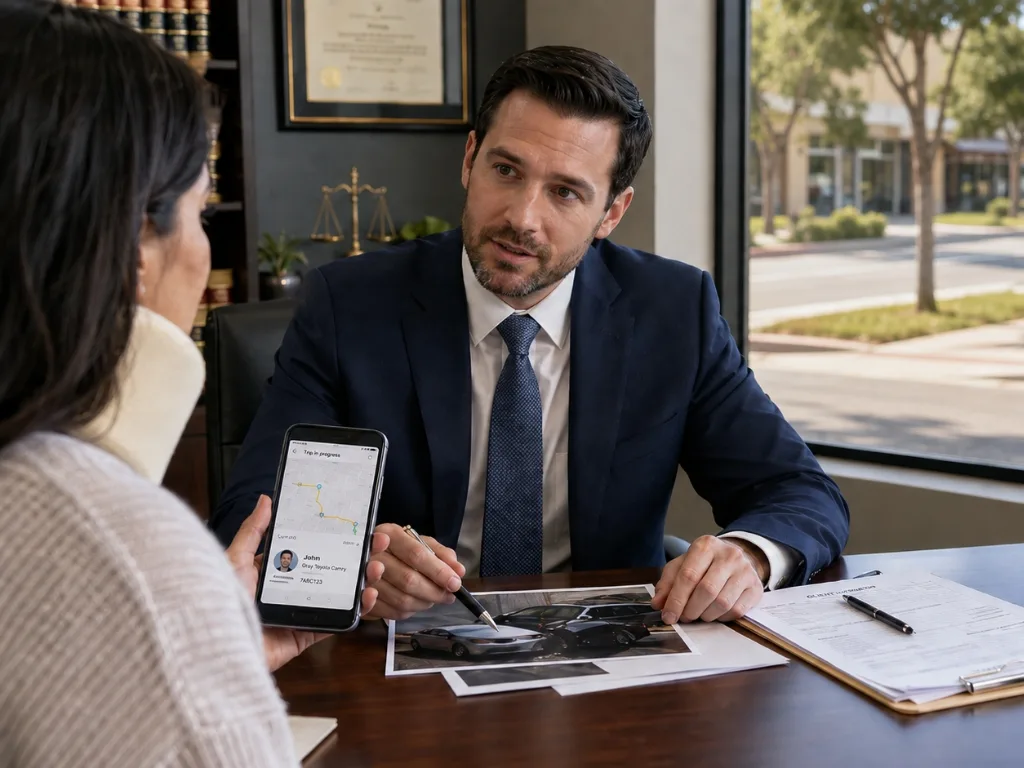
- Screenshot the active trip immediately, including the driver’s name, vehicle details, and timestamps, before the trip closes in the app
- Save the ride receipt and confirmation email from Uber or Lyft
- Photograph all vehicles, the scene, road conditions, and any visible injuries
- Obtain witness contact information before people leave the scene
- Report the crash through the rideshare app, which creates an internal company record
- Seek medical evaluation the same day, even if symptoms seem manageable
Trip data in the app can become harder to obtain once a trip closes and time passes. Screenshots taken at the scene are the most reliable proof of period status.
When Multiple Insurers Dispute Responsibility
Multi-insurer disputes are one of the most frustrating aspects of rideshare accident claims, and they are more common than in standard car accidents.
When the at-fault driver’s personal insurer argues the TNC coverage should apply first, and the TNC’s commercial insurer argues the personal policy should apply first, the injured party can be caught between two carriers each pointing at the other. California’s Fair Claims Settlement Practices Regulations require each insurer to handle its own obligations in good faith, and an attorney can compel each carrier to respond rather than allowing the dispute to delay your claim indefinitely.
Damages Available After a Rideshare Injury
A rideshare injury claim can include the full range of California personal injury damages.
Economic damages cover medical expenses, future treatment and rehabilitation, lost wages, and reduced earning capacity for permanent injuries. Non-economic damages cover physical pain, emotional distress, loss of enjoyment of life, and permanent disability. Given that the $1,000,000 commercial policy applies during active trips, the available coverage for serious injuries in a rideshare crash is often substantially higher than what a personal auto policy would provide.
The Peace of Mind That Comes From Getting This Right Early
Rideshare claims are more time-sensitive than most. Trip records can become harder to access, surveillance footage is overwritten within days, and the 10-day DMV clock runs simultaneously with any criminal or insurance proceeding if DUI was involved. The complexity of these cases is real, but it is entirely manageable with the right guidance from the beginning.
The Law Office of Sam Salhab has navigated these exact disputes for Fresno clients for over fifteen years. Free consultations are available 24/7, with no fee unless you recover. Bring your screenshots, your medical records, and the details of what happened. The rest is what the firm is there for.
Frequently Asked Questions
Which insurance policy applies during my Uber or Lyft ride?
If the driver had accepted a ride or had a passenger onboard at the time of the crash, Uber or Lyft’s $1,000,000 commercial liability coverage applies. If the driver was merely logged into the app and waiting for a ride request, a lower-tier third-party liability coverage applies. If the app was completely off, only the driver’s personal auto insurance applies.
Does Proposition 22 affect my injury claim as a passenger?
Proposition 22 classifies rideshare drivers as independent contractors rather than employees, which limits the respondeat superior liability theory against the company directly. It does not eliminate the state-mandated commercial insurance that applies to active TNC trips. Passengers and third parties injured during covered periods still have access to the $1,000,000 policy regardless of Proposition 22’s driver classification provisions.
What if another driver caused the crash while I was in an Uber?
You can pursue the at-fault third-party driver’s insurance directly. If their coverage is insufficient, the rideshare company’s $1,000,000 uninsured and underinsured motorist coverage applies during Periods 2 and 3 to cover the gap. You are not limited to pursuing only one source of recovery.
What if the rideshare driver was not carrying a passenger at the time?
If the driver had accepted a ride and was en route to the pickup, the $1,000,000 commercial coverage still applies under Period 2. If the driver was only logged into the app and waiting, the lower-tier Period 1 coverage applies. The exact timing and app status at the moment of impact determines which tier governs the claim.
What evidence is most important to preserve after a rideshare crash?
Screenshot the active trip, including driver name, vehicle details, and timestamps, before the trip closes in the app. Save the ride receipt and confirmation email. Photograph the scene, all vehicles, and your injuries. Obtain witness contact information. File a police report and report the crash through the app. These digital records are the foundation of any rideshare claim and are the most time-sensitive to secure.
How long do I have to file a rideshare accident lawsuit in California?
The standard personal injury statute of limitations is two years from the date of the crash under Code of Civil Procedure § 335.1. If a government entity is involved, a Government Claims Act notice must be filed within six months. Consulting an attorney early ensures the correct deadline is identified and that evidence is preserved before it disappears.
What happens when multiple insurance companies dispute responsibility?
Each insurer may attempt to direct the claim to the other carrier. California’s Fair Claims Settlement Practices Regulations require each insurer to handle its own obligations in good faith. An attorney can compel each carrier to respond to its independent obligations rather than allowing the inter-insurer dispute to delay your medical treatment compensation or property damage resolution indefinitely.