A phone call from Fresno County Juvenile Hall changes a family’s priorities instantly. The stakes look different than in adult court: a felony petition can shape a teenager’s record for decades, but the juvenile system also carries tools, like informal probation and diversion, that adult court does not offer. The Law Office of Sam Salhab approaches juvenile defense with the same principle that guides every case at the firm: a child accused of an offense is still a person, not a file number, and deserves representation built around that fact.
Juvenile cases move fast, often within days of an arrest, and the early hearings can set the direction of the entire case. Families weighing their options often benefit from a consultation as soon as a minor is detained or a petition is filed, since decisions made in the first week frequently matter more than anything that happens later.
Understanding California’s Juvenile Justice System
California handles most minors accused of a crime under Welfare and Institutions Code 602, which gives the juvenile court jurisdiction over anyone under 18 who violates a criminal law. The goal of this system is rehabilitation rather than punishment, though serious cases can still result in confinement through a county facility or a state-level program.
The scale of juvenile enforcement has shifted dramatically over the past two decades. California’s Department of Justice reports that youth arrests fell 84% since 2000, from 203,558 arrests to 32,325 in 2024, and that youth now make up just 4% of all arrests statewide, down from roughly 15% in 2000. Statewide, the Attorney General’s office found that juvenile arrests decreased 7.0% from 32,874 in 2024 to 30,568 in 2025, with 46.7% of those arrests for felony offenses and 52.1% for misdemeanors.
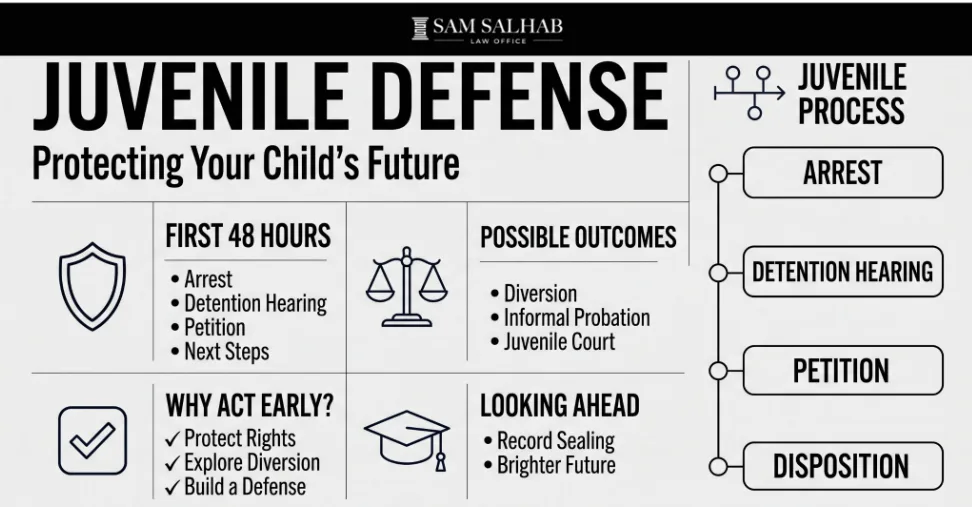
The First 48 Hours After a Juvenile Arrest: What Parents Should Expect
The first two days after a juvenile arrest often have the greatest impact on how a case unfolds. During this window, law enforcement, probation officers, and the court make decisions about detention, charging, and whether the case may qualify for an informal resolution, and acting quickly to understand the process can help protect a child’s rights before those decisions are finalized. Under California Rules of Court, Rule 5.752, a child must generally be released from custody within 48 hours unless a petition has already been filed, and a detention hearing for a felony or violent misdemeanor must be held no later than the next court day after that petition is filed.
| Time | What Happens | Parent’s Priority |
| Arrest | An officer may issue a citation, release the minor to a parent, or transport the child to the Fresno County Juvenile Justice Campus if detention is considered necessary | Remain calm, avoid discussing case facts over recorded phone calls, and begin looking for legal representation |
| Booking | Juvenile Hall staff conduct medical and safety screenings, fingerprinting, and an intake assessment while probation evaluates release or detention | Contact a juvenile defense attorney immediately and avoid encouraging your child to answer questions without legal advice |
| Within 24–48 Hours | The Fresno County Probation Department generally has 24 hours for misdemeanors and 48 hours for felonies to file a petition, and a detention hearing follows on the next day court is in session | Gather school records, report cards, and counseling records showing stability and family support |
| Following Days | Probation and the prosecutor decide whether to proceed with a formal petition or whether the case may qualify for diversion or informal supervision | Discuss diversion opportunities with your attorney before critical decisions are made |
| Weeks Later | If the case proceeds, the court schedules jurisdiction and, if necessary, disposition hearings | Begin assembling mitigation evidence, including character references and treatment records |
California’s self-help court guide confirms that a detained minor is entitled to at least two phone calls within one hour of arrest, one to a parent or guardian and one to a lawyer, and that a petition is typically filed within two days of the arrest. Families who understand these early milestones are often better positioned to make informed decisions before the case gains momentum.
The Fitness Hearing: When a Case Can Move to Adult Court
Not every juvenile case stays in juvenile court. Under Welfare and Institutions Code 707, a fitness hearing determines whether a minor accused of a serious offense should remain in the juvenile system or be transferred to adult criminal court. According to a Department of Justice-published analysis, this hearing applies when the alleged offense is serious enough to involve the risk of great bodily injury, and the minor must demonstrate amenability to treatment in order to avoid transfer.
The consequences of a transfer are significant, since adult court removes the confidentiality protections and rehabilitation focus of the juvenile system. Statewide data shows how rare this outcome actually is: the Attorney General’s 2025 report found only 95 juveniles were processed in adult court statewide, with 46.3% of those cases resulting in a conviction. A fitness hearing is winnable, and the outcome often depends on the strength of the psychological, educational, and family history evidence presented to the judge.
From Petition to Disposition: How a Juvenile Case Moves Forward
Once a petition is filed, a juvenile case follows a distinct sequence of hearings, each with its own stakes and its own opportunity to change the case’s direction.
- Jurisdictional hearing — the juvenile court equivalent of a trial, where the judge decides if the allegations are true
- Disposition hearing — the equivalent of sentencing, where the court orders probation, placement, or another outcome
- Fitness hearing (if applicable) — occurs before jurisdiction if the prosecution seeks transfer to adult court
- Review hearings — periodic check-ins while a minor remains on probation or in placement
Each stage gives defense counsel a chance to challenge the evidence, argue for release, or negotiate an informal resolution before a formal record is created. Acting early, often before the petition is even filed, gives a defense attorney more room to influence how the case is charged in the first place.
Diversion and Informal Probation: Avoiding a Formal Record
California’s juvenile system includes options that do not exist in adult criminal court. Under Welfare and Institutions Code 654, a probation officer can resolve a case informally before a petition is even filed, often through counseling, restitution, or community service. This path avoids a formal adjudication entirely when the offense and the minor’s history support it.
Even after a petition is filed, Welfare and Institutions Code 725 allows a judge to place a minor on informal supervision without a formal finding of wardship. Fresno County probation departments generally favor these outcomes when a minor has no significant prior history, which lines up with the statewide pattern showing 35.1% of cases referred to county probation departments closed at intake with no further action taken.
Sealing Juvenile Records for a Clean Future
A juvenile record can follow a young person into college applications, employment background checks, and military enlistment long after the case closes. Welfare and Institutions Code 781 allows most juvenile records to be sealed once the minor reaches a qualifying age or completes probation, effectively treating the case as though it never happened for most purposes.
Sealing is not automatic in every county, and the process requires a petition demonstrating rehabilitation. Families are often unaware this option exists until years after a case closes, which is why raising it early, sometimes even at the disposition hearing, can shorten the time before a record can be sealed.
Why Early Representation Changes the Outcome
The first 48 hours after an arrest often determine whether a minor goes home to a parent or spends the following weeks in custody. Decisions about admitting to allegations at a detention hearing, agreeing to informal probation, or requesting a psychological evaluation ahead of a fitness hearing all shape where the case ends up months later.
Families in this position often benefit from a consultation before any statement is made to probation or law enforcement. The Law Office of Sam Salhab offers free consultations, including jail interviews, specifically because early guidance in a juvenile case tends to matter more than in almost any other area of criminal defense.
Moving Forward with a Fresno Juvenile Defense Team
A juvenile case is rarely just about the immediate charge. It is about whether a teenager enters adulthood with a sealed record and a clean path forward, or with a conviction that limits college, employment, and housing options for years. A defense built around the minor’s specific circumstances, not a generic script, is what tends to separate a diversion outcome from a formal adjudication.
Parents and guardians facing a juvenile arrest or petition in Fresno can reach out through the firm’s contact page to discuss the case before the next hearing, since the earliest decisions in a juvenile matter are often the ones with the longest reach.
What happens at a juvenile detention hearing?
A detention hearing determines whether a minor is released to a parent or guardian or held in custody pending further proceedings, and under California Rules of Court, Rule 5.752, it must generally occur within 48 hours of custody or the next court day for felony cases. The court considers the alleged offense, the minor’s history, and whether release poses a safety risk.
Can a juvenile be tried as an adult in California?
Yes, but only through a fitness hearing under Welfare and Institutions Code 707, which applies to minors 14 or older accused of serious offenses. The prosecution must show the minor is not amenable to treatment within the juvenile system before a transfer can be granted.
What is informal probation for juveniles?
Informal probation allows a minor to avoid a formal adjudication by completing conditions such as counseling, restitution, or community service, typically under Welfare and Institutions Code 654 or 725. It is generally reserved for first-time offenses or minors without a significant prior history.
How can a juvenile record be sealed in California?
Most juvenile records can be sealed under Welfare and Institutions Code 781 once the minor reaches a qualifying age or completes probation, which removes the record from most background checks. The process requires filing a petition and is not automatic.
How soon must the prosecution file charges after a juvenile arrest?
Fresno County Probation generally has 24 hours to file a petition for a misdemeanor and 48 hours for a felony, excluding weekends and holidays, once a decision is made to detain a minor. If the child remains in custody, a detention hearing follows on the next day the court is in session.
How common is it for a juvenile case to be transferred to adult court?
Transfers are rare. Statewide data from the California Department of Justice found that only 95 juveniles were processed in adult court in 2025, a small fraction of the roughly 30,500 juvenile arrests that year.
When should a family contact a juvenile defense attorney?
Families benefit from contacting an attorney as soon as a minor is arrested or detained, ideally before any statement is made to police or probation. California law entitles a detained minor to a phone call to a lawyer within an hour of arrest, and using that call wisely can shape everything that follows.