Cyclists in California have the same legal right to the road as any other vehicle operator, but they face a disproportionate share of serious injuries and fatalities when crashes occur. According to the UC Berkeley SafeTREC 2025 Bicycle Safety Fact Sheet, 145 bicyclists were killed in California in 2023, representing 3.6% of all motor vehicle fatalities despite cyclists accounting for a fraction of total road users. Understanding California bicycle law, local crash patterns, and what a claim actually involves is the foundation of any effective response to a Fresno bicycle accident.
The Law Office of Sam Salhab represents bicycle accident clients in Fresno and throughout the Central Valley. A free, confidential consultation is available to evaluate your situation.
California Bicycle Laws Most People Don’t Know
Cyclists in California have both rights and responsibilities under the California Vehicle Code, and both matter in accident litigation.
The Three-Foot Passing Law
Vehicle Code § 21760, California’s Three Feet for Safety Act, requires motorists to maintain a minimum three-foot clearance when passing a bicyclist. A driver who cannot safely pass with three feet must slow to a reasonable speed and only pass when it is safe. A violation of this statute is direct evidence of negligence in a personal injury claim, and it applies whether the cyclist was in a designated bike lane or sharing a travel lane.
When Cyclists May Take the Lane
California law allows cyclists to move away from the right edge of the road and occupy the full travel lane when the lane is too narrow to be safely shared side-by-side with a motor vehicle, when overtaking another vehicle, when preparing to turn left, or when necessary to avoid hazardous conditions. A motorist who rear-ends a cyclist legally occupying the travel lane cannot argue the cyclist had no right to be there.
Dooring Liability
Vehicle Code § 22517 prohibits opening a vehicle door into traffic unless it can be done safely without interfering with traffic. A driver or passenger who opens a door into a cyclist’s path is liable for the resulting crash under this statute, regardless of whether a bike lane was present.
The Crash Picture in California and Fresno
SafeTREC’s analysis of 2023 SWITRS data found that broadside crashes were the most common fatal and serious injury bicycle crash type in California at 34.9%, followed by rear-end crashes at 10.3%. According to NHTSA’s 2023 bicyclist crash data, 81% of pedalcyclist fatalities occurred in urban areas, 53% occurred in the dark, and 39.9% of California’s fatal bicycle crashes happened between 6pm and midnight.
Fresno’s wide arterial roads, limited protected bike infrastructure in many corridors, agricultural access roads on the city’s periphery, and the mix of high-speed traffic common near Highway 99, Highway 41, and Highway 168 all create specific crash risk patterns. Downtown pickup and drop-off zones, school zones, and multi-use trail crossings are common locations for intersection and right-hook conflicts.
How Fault Is Determined in Bicycle Accident Cases
California’s pure comparative negligence rule applies to bicycle accidents. A cyclist found partially at fault can still recover damages, reduced proportionally by their fault percentage. This is where insurance companies most often challenge bicycle claims by arguing the rider was not using lights at night, failed to signal, or was riding in an unexpected location.
Common Liability Scenarios
| Crash Type | Common Fault Theory |
| Right hook | Driver turned right across cyclist’s path without yielding |
| Dooring | Driver opened door into cyclist without checking |
| Rear-end | Driver failed to see or yield to cyclist in lane |
| Left cross | Oncoming driver turned left in front of cyclist |
| Unsafe passing | Driver passed within three feet in violation of § 21760 |
| Road hazard | Government entity failed to maintain safe roadway |
Evidence Unique to Bicycle Accident Cases
Bicycle accidents generate specific categories of evidence that standard car accident investigations do not address.
- The condition and damage patterns of the helmet can corroborate where and how impact occurred.
- Bicycle frame damage, particularly on carbon components where damage may not be visible to the naked eye, often requires inspection by a certified mechanic before the bicycle is moved or cleaned.
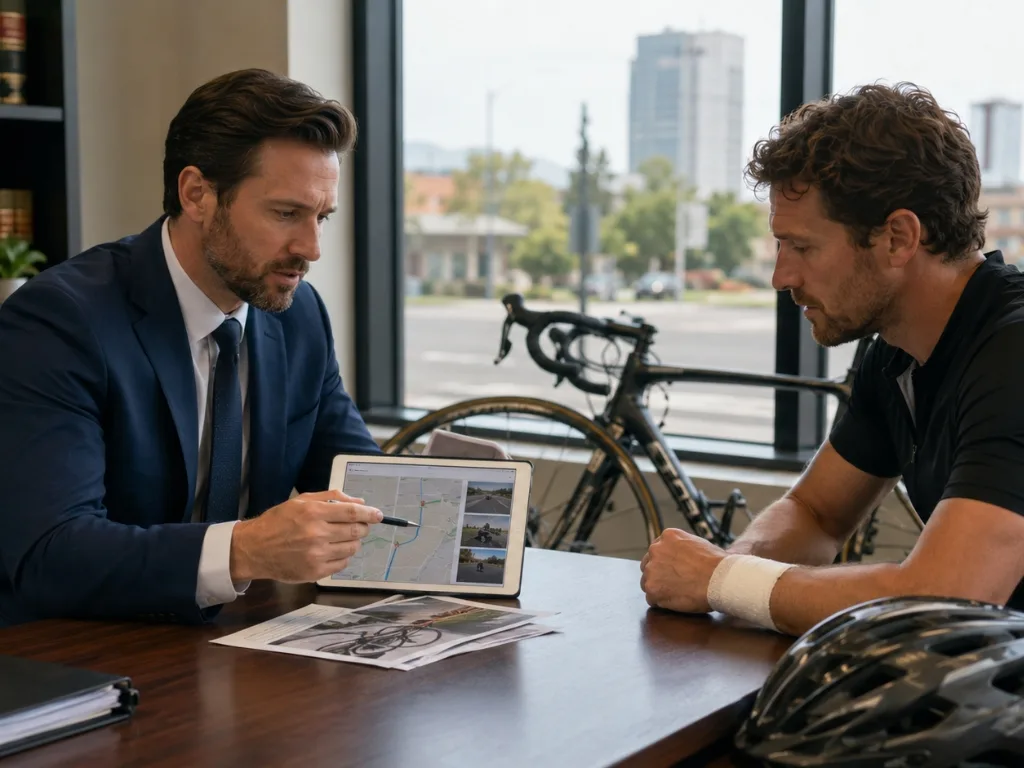
- GPS data from a cycling computer, Garmin device, or Strava app records speed, route, and location at the time of the crash with precision a witness account cannot match.
- GoPro or handlebar camera footage from the cyclist or nearby riders can be decisive in disputed liability cases.
Digital Cycling Data as Evidence
A Strava segment file or GPS track establishing the cyclist’s position, speed, and trajectory in the seconds before impact is the kind of evidence defense teams rarely anticipate but cannot easily contradict. Cyclists who use any tracking device should preserve and back up that data immediately after a crash before it is overwritten by a subsequent ride.
Injuries Common in Bicycle Accidents
The absence of surrounding vehicle structure means cyclists absorb crash forces directly, producing injury patterns similar to those seen in motorcycle accidents.
- Traumatic brain injury is a significant risk even with a helmet, particularly in high-speed or large-vehicle impacts.
- Road rash, often treated as minor, carries real infection risk and can require skin grafting in serious cases.
- Clavicle fractures, wrist fractures, and knee ligament injuries are among the most common orthopedic injuries.
- Spinal injuries and internal bleeding, which may not present full symptoms for hours, underscore why immediate medical evaluation after any bicycle crash matters for both health and documentation.
Damages Available in a Fresno Bicycle Accident Claim
Beyond medical bills, bicycle accident claims can include compensation for the bicycle itself, including carbon frame inspection and replacement costs, cycling gear, computers, and power meters. Lost race entry fees and training time losses may be recoverable in appropriate cases for competitive cyclists. Lost wages, future treatment, rehabilitation, pain and suffering, and diminished quality of life are all available under California law.
What If a Road Defect Caused the Crash
When a pothole, broken pavement, missing drainage grate, or failed road surface contributed to a bicycle crash, a government entity may be liable for failure to maintain a safe roadway. These claims carry a different and shorter deadline. A Government Claims Act notice must be filed with the responsible agency within six months of the incident before any lawsuit can proceed, separate from the standard two-year personal injury limitations period under Code of Civil Procedure § 335.1.
Helmet Use and Your Claim
California law requires cyclists under 18 to wear a helmet under Vehicle Code § 21212, but there is no statewide helmet requirement for adult riders. If you were not wearing a helmet and sustained a head injury, a defendant may argue the missing helmet increased your damages, but this argument applies only to head injury damages, not to the rest of your claim. The same comparative negligence analysis used across all California personal injury cases governs how any such reduction would be calculated.
Talk to a Fresno Bicycle Accident Attorney
The Law Office of Sam Salhab offers free, confidential consultations with 24/7 availability, with no fee unless you recover. Preserve your bicycle, gear, and all digital cycling data before anything is changed, and contact the firm before any filing deadlines run.
Frequently Asked Questions
Can I recover damages if I wasn’t wearing a helmet?
Yes, unless you are under 18, California law does not require adult cyclists to wear helmets. A missing helmet can reduce the damages attributable to head injuries, but it does not bar your claim or affect compensation for injuries unrelated to head or neck trauma.
Can I sue if I was partially at fault?
Yes. California’s pure comparative negligence rule allows recovery even when the cyclist bears partial responsibility. Your total damages are reduced by your assigned fault percentage rather than eliminated. Insurance companies routinely attempt to inflate cyclist fault percentages, making independent evidence documentation essential.
What if a pothole or road defect caused the crash?
A government entity may be liable for dangerous road conditions it knew or should have known about. These claims require a Government Claims Act notice filed with the responsible agency within six months of the incident, well before the two-year personal injury limitation applies. Missing the six-month window can permanently bar the claim.
Can I recover compensation for my damaged bike and gear?
Yes. The bicycle itself, cycling gear, GPS computers, and power meters are all recoverable as property damage. For high-value carbon frames, a professional inspection confirming structural damage is essential, since crash damage to carbon is often invisible to the naked eye but renders the frame unsafe to ride.
What if the driver fled the scene?
A hit-and-run crash may be covered by your own uninsured motorist (UM) coverage if you have it. Documenting the scene immediately, noting any vehicle description, and identifying any witnesses or cameras in the area are the most important steps. A police report, even filed after the driver left, creates the official record the UM claim will rely on.
What if a commercial vehicle or rideshare driver caused the crash?
Commercial vehicle crashes involve federal regulations and layered insurance policies distinct from standard passenger vehicle cases. Rideshare crashes require establishing the driver’s app status to determine which insurance tier applies. Both scenarios add legal complexity that benefits from experienced representation from the start.
What evidence helps most in a bicycle accident case?
GPS data from a cycling computer, Strava, or smartwatch establishing speed and position at the time of impact is particularly powerful and often overlooked. Combined with helmet and bicycle damage patterns, the police report, witness statements, and any available dashcam or surveillance footage, it creates a layered evidentiary record that is difficult to contradict.