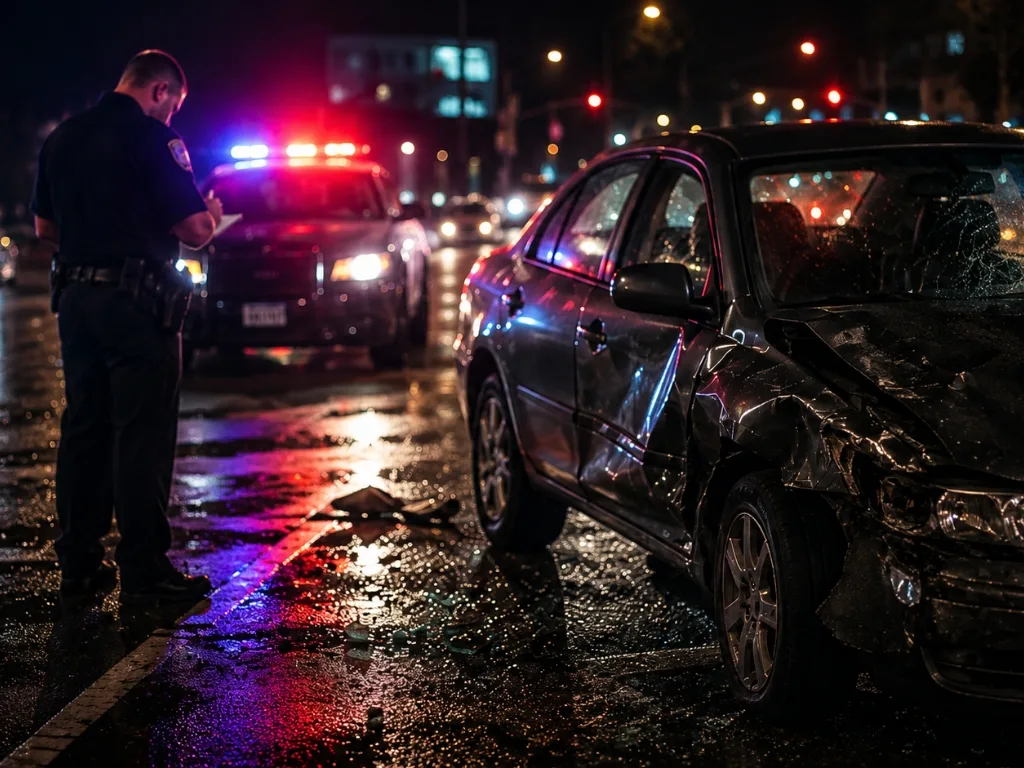
An assault charge can move from a heated argument to a felony filing faster than most people expect. California law draws sharp lines between simple assault, battery, and aggravated assault with a deadly weapon, and which side of that line a case falls on often determines whether someone faces a misdemeanor or years in state prison. The Law Office of Sam Salhab defends clients across the Fresno area against assault charges, built on the understanding that a single altercation, viewed in isolation, rarely tells the whole story a prosecutor presents in a police report.
Assault cases frequently turn on conflicting accounts of who started the confrontation and what happened in the seconds that mattered most. Anyone facing an assault charge benefits from securing representation early, before witness statements harden and before a plea offer is presented as the only option on the table.
What Counts as Assault Under California Law
California treats assault and battery as related but distinct offenses. Penal Code 240 defines assault as an unlawful attempt, coupled with a present ability, to commit a violent injury on another person, meaning no actual physical contact is required for a conviction. Penal Code 242 defines battery as the willful and unlawful use of force or violence against another, which does require actual contact, however slight.
Most simple assault and battery charges are misdemeanors, but the classification changes quickly once a weapon, a peace officer, or a serious injury enters the picture. Understanding which statute a prosecutor has charged, and why, is often the first step in evaluating how serious a case actually is.
Aggravated Assault: When Charges Escalate
Several circumstances elevate a simple assault into a far more serious felony charge. Penal Code 245(a)(1) criminalizes assault with a deadly weapon other than a firearm, while Penal Code 245(a)(4) covers assault by force likely to produce great bodily injury, even without a weapon. Penal Code 243(d) separately punishes battery that causes serious bodily injury to the victim, and Penal Code 245(b) applies enhanced penalties when the victim is a peace officer or firefighter.
Even conduct that never results in contact can carry felony exposure. Penal Code 417 criminalizes brandishing a weapon in a threatening manner, and prosecutors frequently charge it alongside assault counts when a weapon was displayed during a confrontation. Each of these statutes carries its own sentencing range, which means the specific words used in a charging document matter as much as the underlying incident.
What Happens After an Assault Arrest in Fresno? A Step-by-Step Timeline
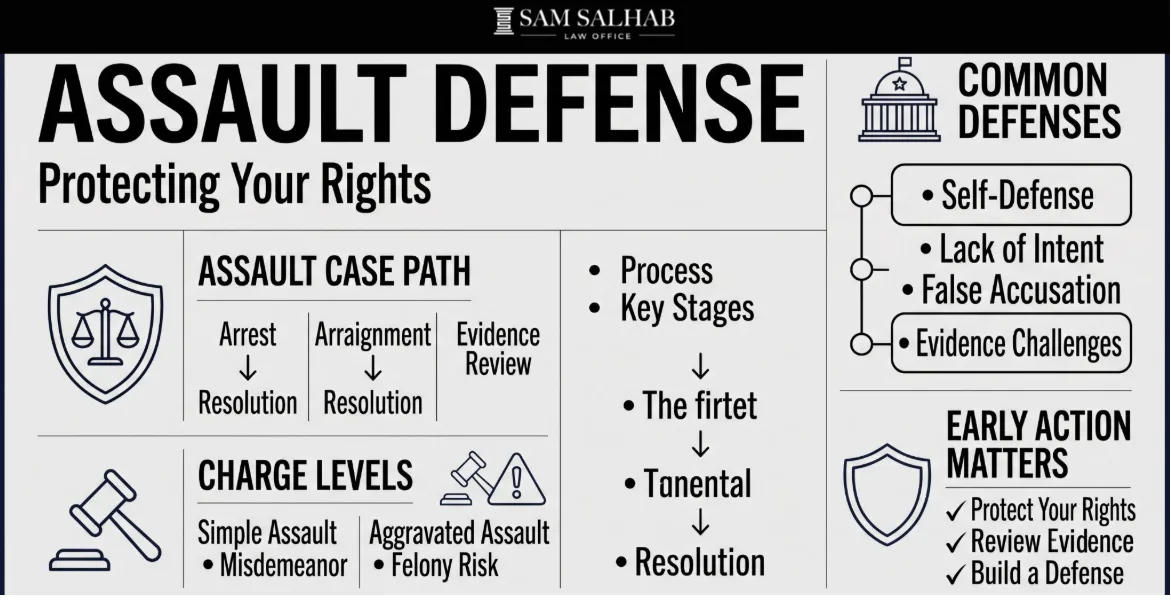
An assault arrest can feel overwhelming because many people do not understand what happens after the initial police contact. While every case depends on the specific facts, California criminal cases generally follow a structured process from arrest through resolution, and knowing what happens at each stage helps defendants avoid mistakes that can affect the outcome.
| Stage | What Happens | Defense Opportunity |
| Arrest & Booking | Law enforcement documents the allegations, collects evidence, and creates initial reports that prosecutors may later rely on when filing charges | Avoid discussing the facts of the incident with investigators without legal guidance; preserve evidence and document your own account of what occurred |
| Arraignment | The defendant appears in court, learns the formal charges, enters an initial plea, and may address bail or release conditions | Review the charging document carefully, challenge unnecessary restrictions, and begin evaluating the prosecution’s evidence |
| Discovery | Prosecutors provide available evidence, which may include police reports, witness statements, photographs, videos, and other investigative materials | Compare the evidence against the allegations, identify inconsistencies, and determine whether important evidence is missing or unreliable |
| Pretrial Motions | The defense may challenge evidence, including information obtained through unlawful searches or improper procedures | Seek suppression of improperly obtained evidence or other remedies that may weaken the prosecution’s case |
| Negotiation or Trial | Many assault cases resolve through negotiated agreements, while others proceed to a jury trial where the prosecution must prove guilt beyond a reasonable doubt | Present the strongest factual defense based on the evidence, witness credibility, and applicable legal defenses |
California’s Courts Self-Help Guide confirms that most criminal cases move through charging, arraignment, pretrial activities, and trial in that general order, though not every case includes every step. The Judicial Council’s Criminal Jury Instructions set the legal standards jurors apply if a case reaches trial, and assault cases filed locally proceed through the Fresno County Superior Court’s Criminal Division. Early decisions, such as what is said after arrest and whether charges are challenged before trial, can influence the direction of the entire case.
California Assault Trends: What Recent Data Shows
Assault charges are being filed against a backdrop of declining violent crime statewide. California’s Attorney General reported that the statewide violent crime rate decreased 10.2% in 2025, falling from 480.3 per 100,000 people in 2024 to 431.1 in 2025, remaining well below the historical peak of 1,103.9 recorded in 1992. Independent analysis of the same data found that reported aggravated assault rates in California reached their lowest level since 1974.
That decline in reported crime has coincided with an increase in enforcement activity. The Attorney General’s office noted that the total arrest rate increased 3.6% in 2025, from 2,673.8 per 100,000 in 2024 to 2,770.4 in 2025, even as underlying violent crime fell. That combination, fewer incidents but more arrests per capita, means individual assault cases are drawing significant prosecutorial attention even as the overall trend moves in the opposite direction.
Common Defenses to Assault Charges
Assault and battery charges are frequently defensible on grounds that go beyond disputing whether contact occurred. A defense strategy typically starts by examining several possibilities.
- Self-defense or defense of others — California law permits reasonable force to protect oneself or another person from imminent harm
- Mutual combat — when both parties willingly engaged in a physical confrontation, context can undercut a straightforward victim narrative
- Lack of intent — assault requires a willful act, so accidental contact generally does not meet the legal standard
- False accusation or mistaken identity — particularly relevant in chaotic altercations involving multiple people
- Insufficient evidence of a deadly weapon — often contested in cases charged under Penal Code 245 where the object’s dangerousness is disputed
Which defense fits a given case depends heavily on the specific facts, the witness accounts available, and any physical or video evidence collected at the scene.
Penalties and Sentencing Enhancements
Assault penalties vary widely depending on the statute charged and the defendant’s criminal history. Simple assault under Penal Code 240 is typically charged as a misdemeanor, carrying up to six months in county jail, while assault with a deadly weapon under Penal Code 245(a)(1) is a wobbler that can be charged as a felony carrying up to four years in state prison.
Sentencing enhancements can add significant additional time, particularly when a victim suffers great bodily injury or when the offense is committed against a protected category of victim such as a peace officer. A prior strike conviction under California’s Three Strikes law can also double the sentencing exposure on a subsequent felony assault charge, which makes the defendant’s criminal history as important to a defense strategy as the facts of the current case.
Building a Defense Strategy
An effective assault defense starts with a careful review of how the incident was documented, since police reports written in the aftermath of a chaotic confrontation often contain gaps or inconsistencies. Body camera footage, 911 call recordings, and witness statements taken at the scene frequently tell a different story than the narrative summary in a charging document.
A defense built around the Fresno criminal defense practice at the Law Office of Sam Salhab starts by identifying which specific elements of the charged statute the prosecution actually has to prove, then testing the evidence against that standard rather than against the general narrative of the incident.
Why Early Representation Matters in Assault Cases
The first days after an assault arrest often determine whether a case proceeds as a misdemeanor or a felony, since prosecutors have discretion in how to initially file many assault-related offenses. Statements made to police without counsel present, or a rushed decision to accept an early plea offer, can foreclose defenses that would otherwise be available.
Clients considering their options in this position often benefit from a consultation before entering any plea or making further statements to investigators. The Law Office of Sam Salhab offers free consultations, including jail interviews and 24/7 emergency availability, because the earliest decisions in an assault case frequently shape everything that follows.
Moving Forward with a Fresno Assault Defense Team
An assault charge carries consequences that extend well past a courtroom outcome, from employment background checks to firearm rights and immigration status for non-citizens. A defense grounded in the specific statutory elements and the actual evidence, not the general impression left by a police report, is what separates a dismissed case from a felony conviction that follows someone for years.
For anyone facing an assault or battery charge in Fresno, reaching out through the firm’s contact page is a reasonable first step toward understanding what the case actually involves before the next court date arrives.
FAQ
What is the difference between assault and battery in California?
Assault under Penal Code 240 requires only an attempted violent act with the present ability to carry it out, while battery under Penal Code 242 requires actual physical contact. A single incident can result in charges under both statutes depending on what actually occurred.
What makes an assault charge a felony instead of a misdemeanor?
Assault typically becomes a felony when a deadly weapon is involved, when the force used is likely to cause great bodily injury, or when the victim is a peace officer or firefighter. Simple assault without these aggravating factors is usually charged as a misdemeanor.
Can self-defense be used against an assault charge?
Yes, California law allows the use of reasonable force to defend oneself or another person from imminent harm, and successfully raising self-defense can result in an acquittal or dismissal. The amount of force used generally must be proportionate to the threat faced.
How much prison time can an assault with a deadly weapon charge carry?
Assault with a deadly weapon under Penal Code 245(a)(1) is a wobbler offense that can be charged as a felony carrying up to four years in state prison. If charged as a misdemeanor, the maximum exposure is generally up to one year in county jail.
What happens at an arraignment for an assault charge?
At arraignment, the defendant appears in court, is formally informed of the charges, enters an initial plea, and the court addresses bail or release conditions. This is also an early opportunity for defense counsel to review the charging document and begin evaluating the prosecution’s evidence.
Is brandishing a weapon the same as assault?
No, brandishing a weapon under Penal Code 417 involves displaying a weapon in a threatening manner and does not require an attempt to cause injury, while assault requires an attempted violent act. Prosecutors frequently charge both offenses together when a weapon was visible during a confrontation.
How can I fight a false assault accusation?
A false accusation defense typically relies on witness testimony, video evidence, inconsistencies in the accuser’s statements, or evidence of a motive to fabricate the claim. Building this defense effectively usually requires securing evidence quickly, since witness memories and available footage can both degrade over time.