
A federal indictment changes the calculus of a criminal case entirely. The government has already built its case for months, sometimes years, before an arrest ever happens, and federal sentencing guidelines leave far less room for negotiation than state court. The Law Office of Sam Salhab represents clients across the Fresno area facing federal charges in the Eastern District of California, built on the conviction that the size of the government’s resources should never determine the quality of a person’s defense.
Federal cases carry a different rhythm than state prosecutions, with mandatory minimum sentences, sentencing guideline calculations, and a prosecution team that has typically reviewed the evidence extensively before charging. Anyone who has received a target letter, a grand jury subpoena, or a visit from federal agents benefits from evaluating their options immediately, since the investigation is often further along than it appears.
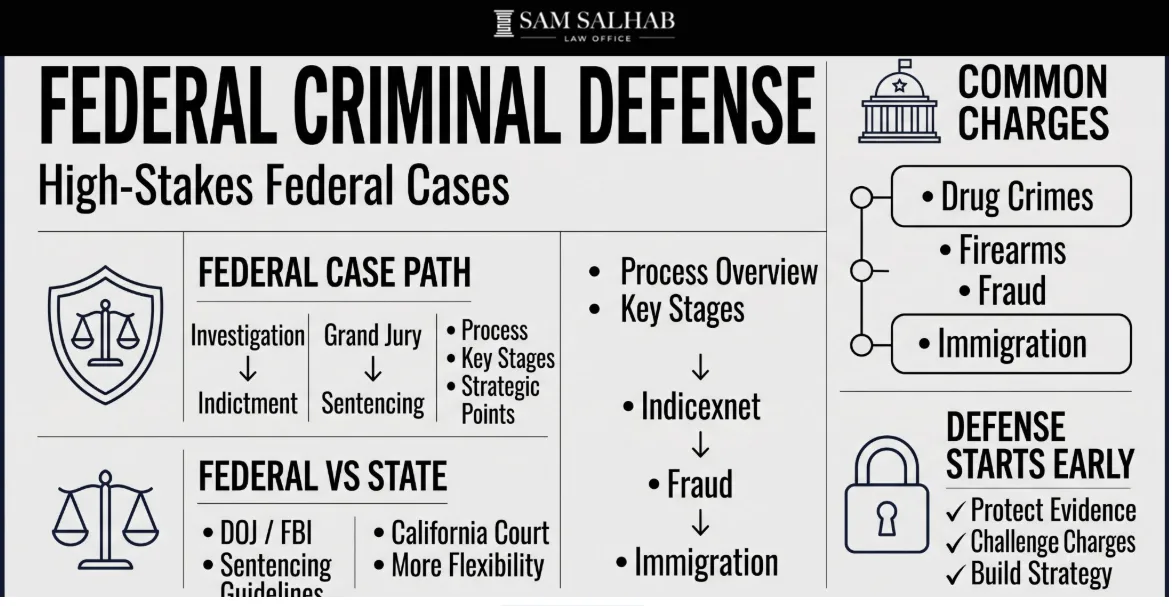
What Makes a Federal Case Different from State Charges
Federal prosecution applies when conduct violates federal law, whether through interstate commerce, federal property, controlled substances trafficking across state lines, or offenses against federal agencies. The Eastern District of California, which includes Fresno, is one of the largest federal judicial districts in the country, covering more than eight million residents and 87,000 square miles across six major urban areas.
Federal cases differ from state cases in several concrete ways: federal prosecutors generally have more investigative resources, sentencing follows detailed guidelines rather than broad judicial discretion, and many offenses carry mandatory minimum sentences that limit what a judge can consider regardless of the circumstances. A dedicated White Collar Crime Unit and Narcotics and Violent Crime Unit operate out of the Sacramento office, working closely with the FBI, DEA, ATF, and Homeland Security Investigations on cases throughout the district.
Federal Criminal Case Timeline: From Investigation to Sentencing
A federal criminal case does not begin when an indictment is announced. By that point, prosecutors have often already spent months or years gathering evidence, interviewing witnesses, and building a theory of the case, and understanding the full timeline helps defendants recognize where the important decisions actually get made.
| Stage | What Happens | Defense Priority |
| Investigation | Federal agencies such as the FBI, DEA, ATF, or IRS Criminal Investigation gather records, conduct interviews, and analyze evidence before charges are filed | Avoid making statements to investigators without legal advice and preserve all potentially relevant evidence |
| Grand Jury | Prosecutors present evidence to a grand jury, which determines whether probable cause exists to issue an indictment | Review subpoena requests carefully and evaluate whether early intervention may affect charging decisions |
| Initial Appearance | After arrest or indictment, the defendant appears before a federal magistrate judge, who explains the charges and addresses release conditions | Address detention issues immediately and argue for appropriate conditions of release |
| Discovery and Motions | The government provides evidence, and defense counsel reviews documents, recordings, and investigative reports; motions may challenge unlawful searches or improperly obtained evidence | Identify weaknesses in the government’s case and pursue suppression or dismissal arguments when supported by law |
| Plea or Trial | The defendant may negotiate a resolution through a plea agreement or proceed to trial before a jury | Evaluate sentencing exposure, evidentiary risks, and the long-term consequences of each option |
| Presentence Investigation | If convicted, federal probation prepares a Presentence Investigation Report analyzing the offense conduct, criminal history, and guideline calculations | Review the report carefully and object to inaccurate facts or sentencing calculations |
| Sentencing | A federal judge imposes the final sentence after considering statutory requirements, the Sentencing Guidelines, and arguments from both sides | Present mitigating evidence and seek reductions that support the most favorable lawful outcome |
The FBI describes this process as a series of stages beginning with investigation and continuing through prosecution and sentencing, while the U.S. Sentencing Commission explains how the final sentencing decision is shaped by guideline calculations, criminal history, and statutory factors. Understanding each stage, and where a case currently sits within it, allows a defendant to make informed decisions before the options narrow.
Common Federal Charges in the Eastern District of California
Federal criminal cases fall into a handful of recurring categories, each governed by its own statutory framework and sentencing exposure.
- Drug trafficking (21 U.S.C. § 841) — manufacturing, distributing, or possessing controlled substances with intent to distribute
- Firearms offenses (18 U.S.C. § 922(g)) — unlawful possession of a firearm by a prohibited person, often charged alongside drug or violent crime counts
- Immigration offenses (8 U.S.C. § 1326) — illegal reentry after removal, one of the most frequently charged federal offenses nationwide
- Wire and mail fraud (18 U.S.C. § 1343) — fraud schemes using interstate communications or the postal service
- Conspiracy (18 U.S.C. § 371) — an agreement between two or more people to commit a federal offense, frequently added alongside a substantive charge
According to the U.S. Sentencing Commission’s most recent annual report, immigration offenses were the most prevalent federal crime type nationally at 38%, followed by drug trafficking at 25%, firearms offenses at 12%, and fraud cases at nearly 8%. These four categories have made up the substantial majority of federal felony cases for close to three decades.
Federal Sentencing: What the Data Shows
Federal sentencing operates under detailed guidelines that calculate a recommended range based on the offense and the defendant’s criminal history, and the numbers behind that process reveal how little room most defendants have once convicted. The Sentencing Commission reported that more than 90% of individuals sentenced in fiscal year 2025 received a prison-only sentence, while only 6% received probation alone, and the average sentence imposed nationally was 47 months. Guilty pleas resolve the overwhelming majority of cases, with more than 99% of immigration cases alone resulting in a guilty plea rather than a trial.
Sentence length varies enormously by offense type, which is part of why the specific charge matters as much as the underlying conduct. The Commission’s data shows average sentences ranging from just a few months for lower-level offenses to well over 20 years for the most serious violent crimes, which means the charging decision itself, not just the facts, often determines the realistic range a defendant is facing.
Mandatory Minimums and Why They Matter
Many federal drug and firearms offenses carry mandatory minimum sentences set by statute rather than by the sentencing guidelines, which removes a judge’s discretion to sentence below that floor regardless of mitigating circumstances. The Sentencing Commission found that 13,926 of the 66,662 cases sentenced in fiscal year 2025, or 15% of all sentenced individuals, involved an offense carrying a statutory mandatory minimum penalty.
Because mandatory minimums attach to the specific charge rather than the conduct as a whole, the earliest stages of a case, before an indictment is finalized, are often the best opportunity to negotiate a charge that avoids triggering one. This is one of the clearest reasons federal cases reward early legal intervention over a strategy of waiting to see what the government actually files.
Building a Federal Defense Strategy
A federal defense strategy starts with understanding exactly what the government can prove, not what the indictment alleges. Evidence gathered through search warrants, wiretaps, or informant testimony is frequently challengeable on constitutional grounds, and a successful suppression motion can eliminate the core of a prosecution’s case before trial ever begins.
For clients facing immigration-adjacent federal charges, such as illegal reentry or document fraud, the Fresno criminal defense approach at the Law Office of Sam Salhab accounts for immigration consequences in plea strategy as part of a broader criminal defense, since the plea structure itself, not just the conviction, often determines what happens to a client’s immigration status afterward.
Why Early Representation Matters in Federal Cases
The gap between a target letter and an indictment is often the only window where a defense attorney can influence what charges actually get filed. Once an indictment is returned, the government’s position is set, and a defendant’s options generally narrow to negotiating a plea or preparing for trial.
Clients considering their options in this position often benefit from a consultation before making any statement to federal agents or responding to a subpoena. The Law Office of Sam Salhab offers free consultations, including jail interviews and 24/7 emergency availability, because the earliest response to federal contact frequently shapes the entire trajectory of the case.
Moving Forward with a Fresno Federal Defense Team
Federal charges carry a level of resources and permanence that state charges typically do not, from sentencing guidelines that leave little room for discretion to collateral consequences that follow a conviction for decades. A defense built around the specific evidence the government actually has, not the volume of the indictment, is what separates a negotiated resolution from a sentence dictated entirely by statute.
For anyone facing a federal investigation, subpoena, or indictment in the Eastern District of California, reaching out through the firm’s contact page is a reasonable first step toward understanding what the case actually involves before the next filing deadline arrives.
FAQs
What is the difference between a state and federal criminal case?
A federal case applies when conduct violates federal law, such as offenses involving interstate commerce, federal property, or agencies like the DEA or FBI, while state cases are prosecuted under the California Penal Code. Federal cases generally carry more rigid sentencing guidelines and fewer opportunities for judicial discretion than state court.
How long do federal investigations typically take before charges are filed?
Federal investigations often unfold over months or years as agencies gather records, interview witnesses, and build a case before seeking an indictment. This extended timeline gives a target a meaningful window to retain counsel before formal charges are filed.
What is a Presentence Investigation Report?
A Presentence Investigation Report is prepared by federal probation after a conviction and analyzes the offense conduct, the defendant’s criminal history, and the applicable sentencing guideline calculations. The judge relies heavily on this report at sentencing, which is why reviewing it carefully and objecting to inaccuracies matters.
What are mandatory minimum sentences?
Mandatory minimum sentences are statutory floors that a judge must impose once a defendant is convicted of certain offenses, most commonly involving drug trafficking or firearms. Roughly 15% of individuals sentenced in federal court in fiscal year 2025 were subject to a mandatory minimum at sentencing.
Can a federal charge be reduced before trial?
Yes, federal charges can sometimes be reduced or dismissed through plea negotiation, particularly before an indictment is finalized or when evidence supports a motion to suppress. Once an indictment is returned, negotiating room generally narrows, which is why early legal involvement matters.
Do most federal cases go to trial?
No, the substantial majority of federal cases resolve through a guilty plea rather than a trial. National data shows guilty pleas resolve the overwhelming majority of cases across nearly every offense category, with trial rates highest in the most serious cases such as murder and kidnapping.
Does a federal conviction affect immigration status?
Yes, certain federal convictions, particularly those involving controlled substances, firearms, or fraud, can trigger removal proceedings for non-citizens regardless of the criminal sentence imposed. Raising immigration status early in the defense strategy, before a plea is finalized, can sometimes affect which specific charge a client ultimately resolves.