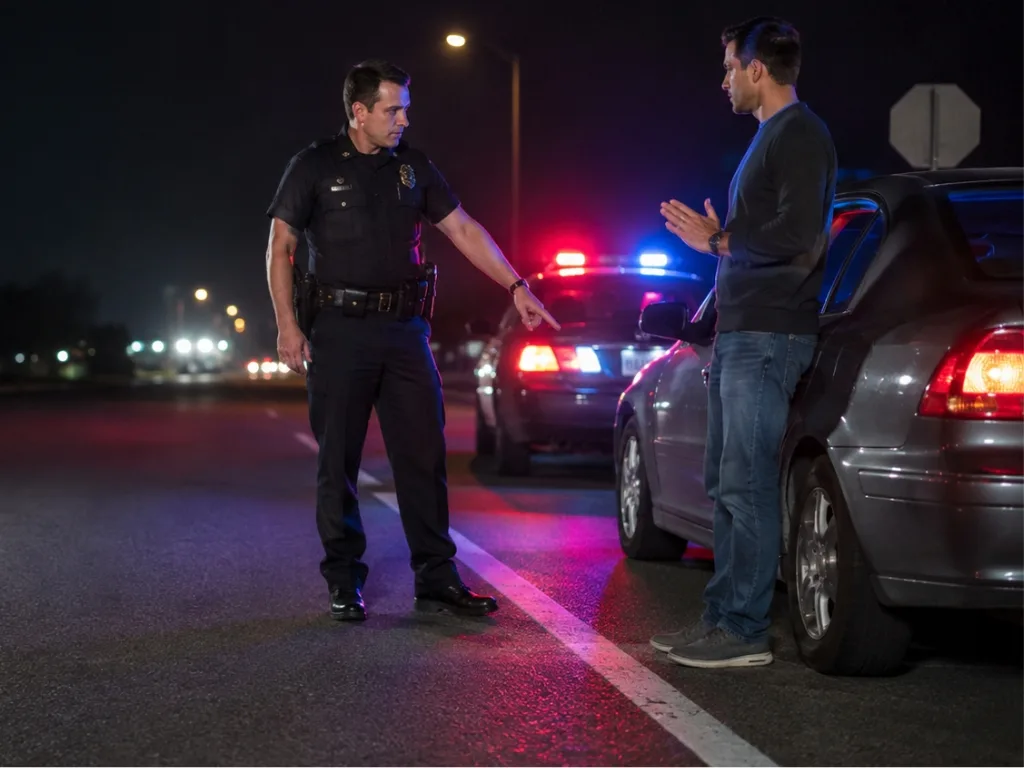
If a California officer asks you to step out of your car and perform field sobriety tests, one of the first things you may wonder is whether you actually have to. The short answer is no, for most adult drivers. But the longer answer requires understanding the difference between a pre-arrest roadside test and a post-arrest chemical test, because those two things carry very different legal consequences.
If you are facing DUI charges in Fresno, the Law Office of Sam Salhab offers free, confidential consultations.
The Core Distinction: Before Arrest vs. After Arrest
Everything in California DUI law turns on whether you have been formally arrested. The rules before and after that moment are fundamentally different.
Before Arrest: Tests Are Generally Voluntary
Standardized field sobriety tests, including the Horizontal Gaze Nystagmus (HGN), Walk-and-Turn, and One-Leg Stand, are administered before any arrest decision is made. Their purpose is to help an officer build probable cause for an arrest. For most adult drivers aged 21 and over who are not on DUI probation, these tests are voluntary. Declining them does not trigger automatic license suspension or criminal penalties.
The same general rule applies to the Preliminary Alcohol Screening (PAS) breath test, the small handheld breathalyzer an officer may produce at the roadside. For most adult drivers, refusing the PAS test before arrest carries no automatic license consequence and the refusal generally cannot be used as evidence of guilt at trial.
After Arrest: Chemical Tests Are Required
Once you are lawfully arrested for DUI, California’s implied consent law takes effect. Under Vehicle Code § 23612, any person who drives a motor vehicle in California is deemed to have consented to a chemical test of their blood or breath if lawfully arrested for a DUI offense. Refusing this post-arrest chemical test triggers serious, automatic consequences entirely separate from any criminal case.
Field Sobriety Tests vs. Chemical Tests: A Direct Comparison
| Field Sobriety Tests | Post-Arrest Chemical Test | |
| When administered | Before arrest, at the roadside | After a lawful DUI arrest |
| Voluntary for most adults? | Yes | No |
| Governed by implied consent? | No | Yes, under Vehicle Code § 23612 |
| Purpose | Build probable cause for arrest | Measure BAC or drug presence |
| Refusing automatically suspends license? | No | Yes |
| Refusal admissible at trial? | Generally not | Yes |
Consequences of Refusing a Post-Arrest Chemical Test
Refusing the post-arrest breath or blood test is not a neutral act. Under Vehicle Code § 13353, the DMV will automatically suspend or revoke your license based solely on the refusal, regardless of whether you are ever convicted of DUI:
- First refusal: One-year hard suspension, no restricted license option in most circumstances
- Second refusal within 10 years: Two-year revocation
- Third or subsequent refusal within 10 years: Three-year revocation
The refusal can also be introduced as evidence of consciousness of guilt in the criminal case, and if you are convicted of DUI, the refusal triggers additional mandatory jail time under the refusal enhancement in California law.
Who Has Different Rules
Not every driver has the same pre-arrest rights. Two categories face stricter obligations.
Drivers Under 21
Under Vehicle Code § 13353.1, drivers under 21 are required to submit to a PAS breath test when lawfully requested, even before arrest. Refusing the PAS as an underage driver carries license suspension consequences that do not apply to adults over 21.
Drivers on DUI Probation
Any driver currently serving probation for a prior DUI conviction is also required to submit to a PAS test upon request before arrest. This is a condition of DUI probation, and refusing it violates both the probation terms and the statute.
What Officers Can Still Use Without Field Sobriety Tests
Declining field sobriety tests removes one category of evidence from the officer’s investigation. It does not end the investigation. Officers can still establish probable cause for an arrest based on the totality of their observations, which may include:
- The officer’s direct observation of driving behavior prior to the stop
- The odor of alcohol from the driver or vehicle
- Slurred or confused speech
- Bloodshot or watery eyes
- The driver’s own statements about drinking
- Open containers visible in the vehicle
- Dashcam or body camera footage of the entire encounter
- Witness statements from other drivers or bystanders
A driver who declines the tests but shows multiple other observable signs of impairment may still be arrested based on those observations alone.
Common Myths About Refusing Field Sobriety Tests
| Myth | Reality |
| Refusing guarantees you won’t be arrested | Officers can arrest based on other observations |
| Passing every test guarantees no arrest | Officers weigh all evidence, not just test results |
| Only impaired people fail field sobriety tests | Medical conditions, fatigue, and environment affect performance |
| Chemical tests and field sobriety tests are the same | They are entirely different; only chemical tests are mandatory post-arrest |
| Police must tell you the tests are voluntary | No California statute requires this advisement for adults |
How the Stop Unfolds: A Timeline
Understanding the sequence helps clarify where each right applies.
- Traffic stop: Officer observes a vehicle and initiates a stop
- Initial contact: Officer notes driving behavior, appearance, and speech
- Request for field sobriety tests: Generally voluntary for most adult drivers at this stage
- PAS breath test request: Generally voluntary for adults not on probation or under 21
- Arrest decision: Based on the totality of observations, with or without test results
- Post-arrest chemical test: Required under implied consent law
- 10-day DMV clock begins: Runs from the date of arrest regardless of criminal proceedings
- DMV Administrative Per Se hearing and criminal court: Two parallel proceedings
Factors That Affect Field Sobriety Test Performance
If you did take the tests and performed poorly, that performance is not necessarily proof of intoxication. The NHTSA 2023 SFST Participant Manual acknowledges that several factors can affect performance entirely unrelated to alcohol:
- Uneven, sloped, or slippery pavement
- Poor lighting or glare from passing headlights
- Footwear with heels over two inches
- Age over 65 or weight significantly above ideal
- Inner ear disorders, vertigo, or balance conditions
- Knee, back, or hip injuries
- Neurological conditions or certain medications
- Anxiety from the stop itself
Officers who fail to account for or document these factors may be administering tests that cannot yield reliable results. Body camera footage of the test administration is often the most effective tool for challenging results that do not accurately reflect the driver’s actual condition.
If You Have Already Been Arrested
If you are facing DUI charges in Fresno, the decisions that matter most going forward are: requesting the DMV APS hearing within 10 days of the arrest, preserving any dashcam or body camera footage, and obtaining legal counsel before making any statements in either the DMV or criminal proceeding.
Sam Salhab has conducted over 25 jury trials and brings direct trial experience to every DUI defense. The road ahead has more options than it may feel like right now, and understanding them clearly is where the process begins. The Law Office of Sam Salhab offers free, confidential consultations with 24/7 availability.
Frequently Asked Questions
Are roadside field sobriety tests mandatory in California?
For most adult drivers aged 21 and over who are not on DUI probation, standardized field sobriety tests are voluntary before arrest. You may decline them without triggering automatic license suspension or criminal penalties. Drivers under 21 and those on DUI probation face different rules for the PAS breath test specifically.
What is the difference between a PAS breath test and a post-arrest breath test?
The PAS is a handheld roadside device used before arrest to help establish probable cause. It is generally voluntary for adults not on probation. The post-arrest breath test is administered after a formal DUI arrest at the station or in a controlled setting, is required under California’s implied consent law, and carries automatic license suspension consequences if refused.
Can I still be arrested if I refuse the field sobriety tests?
Yes. Officers can establish probable cause through their own observations of driving behavior, physical appearance, speech, odor, and other evidence, without any field sobriety test results. Declining the tests reduces the evidence available to the officer but does not prevent an arrest.
Does refusing field sobriety tests automatically suspend my license?
No. Automatic license suspension applies to refusing the post-arrest chemical test under implied consent law, not to declining pre-arrest field sobriety tests or the PAS breath test for most adult drivers.
What happens if I have a medical condition affecting my balance?
Medical conditions that affect balance, coordination, or eye movement can produce field sobriety test results that appear to indicate impairment when they do not. This is a recognized basis for challenging SFST evidence in court. An officer who fails to ask about medical conditions before administering tests, or who fails to document conditions that were disclosed, may be administering tests that lack evidentiary reliability.
Can bodycam footage challenge field sobriety results?
Yes. Body camera recordings of the test administration frequently reveal deviations from NHTSA’s standardized procedures, environmental conditions not mentioned in the written report, and performance that does not match the officer’s written description of the clues observed. This footage is one of the most valuable pieces of evidence in any SFST challenge.
Does implied consent apply before or after arrest?
After. California’s implied consent law under Vehicle Code § 23612 applies only after a lawful DUI arrest. Before that point, most adult drivers retain the right to decline roadside field sobriety tests and the PAS breath test without triggering implied consent consequences.